
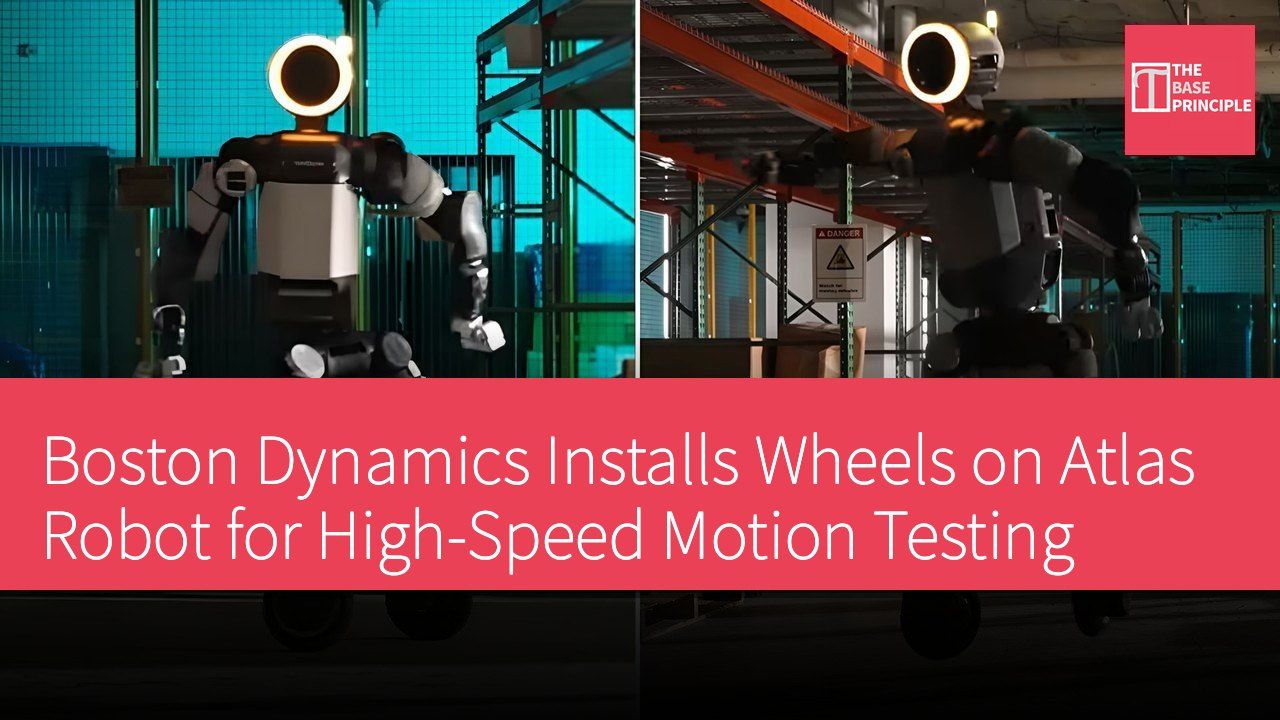
- Boston Dynamics is experimenting with replacing Atlas robot's legs with wheels.
- The modification process is straightforward, utilizing wheels from a standard electric scooter and custom adapters.
- The wheels force the motors to provide high torque during testing, facilitating applications of reinforcement learning.
- These findings will influence the development of Atlas's standard configuration, enhancing the robot's capabilities.
Boston Dynamics has made an unusual upgrade to its Atlas humanoid robot: replacing its legs with a pair of wheels. This experimental setup allows engineers to test the robot's performance during sustained high-speed movement and under heavy loads. The setup also provides a demanding environment for testing the robot's motors and machine learning-based control systems. Notably, this wheeled version of Atlas is not a planned commercial product but a research platform developed by Boston Dynamics to investigate how simulated training controllers can accurately operate real hardware.
The project also explores what happens when engineers push the robot's actuators to their physical limits.
Ease of the Modification Process
The engineering behind this modification is surprisingly simple. Boston Dynamics installed wheels from a standard electric scooter onto Atlas using custom adapters. These adapters connect directly to the robot's existing ankle actuators and do not require any other major hardware changes. The engineers also avoided rebuilding the robot's software model from scratch; they simply replaced the simulated legs with wheels that can continuously rotate. This simplicity reflects the modular hardware design of Atlas, which Boston Dynamics considered for manufacturability and ease of maintenance when designing the humanoid robot.
The same design principles made this experimental conversion relatively straightforward.
Testing Advantages of Wheels
During testing, the wheels also provided another advantage. They forced the motors to deliver significant torque while maintaining high rotational speeds. Each acceleration, turn, and stop placed continuous demands on the actuators. This experiment also gave engineers an opportunity to explore reinforcement learning (RL). This technique trains the robot through repeated simulations, allowing its control system to discover effective movements. However, transferring these learned behaviors to real hardware is a significant engineering challenge. Simulated motors may perform differently from their real-world counterparts, leading to movements that work in simulation but fail on the actual robot.
Boston Dynamics addressed this issue by improving its simulated motor models. Engineers conducted physical experiments to measure the behavior of the actuators and then adjusted the simulation parameters to reflect the actual performance of the hardware. The team also modified the existing reinforcement learning framework, with changes to training commands, reward functions, and posture control helping Atlas develop smooth rolling motions. The results underscored the importance of accurate motor simulation. Controllers trained with real hardware behavior are more likely to perform reliably outside of simulation.
Some of Atlas's movements were inspired by human motion capture videos. Engineers selected a variety of examples of foot sliding to explore how the wheels could replicate similar movements. A lateral sprint is an interesting example. Atlas learned to control its wheels and roll sideways instead of dragging its feet across the ground. The robot also performed a 360-degree jump using a trajectory tracking controller. This system followed recorded human motion data and completed the maneuver on the first attempt. Its approach differed from the foot-based Atlas configuration; before jumping, the robot rolled its lower body into position to prepare for takeoff.
This behavior demonstrates how reinforcement learning can discover new ways to utilize available traction.
Boston Dynamics stated that these findings will influence the development of Atlas's standard configuration. Engineers hope to combine accurate actuator models with whole-body learning to improve reliability and expand the capabilities of the humanoid robot. This wheeled experiment ultimately provides something beyond entertainment demonstrations. It offers engineers a rigorous testing environment to understand how motors and learning controllers work together under extreme conditions.
Application of Reinforcement Learning in Robot Motion
Boston Dynamics' modification of the Atlas robot with wheels not only showcases the flexibility of its modular design but also provides an opportunity for high-intensity testing. Through the use of wheels, the robot's performance under extreme conditions can be analyzed in depth, which is crucial for the development of reinforcement learning techniques. The combination of accurate motor simulation and reinforcement learning aids in enhancing the robot's motion capabilities, potentially transforming the application scenarios for humanoid robots, from entertainment to real-world task execution.