
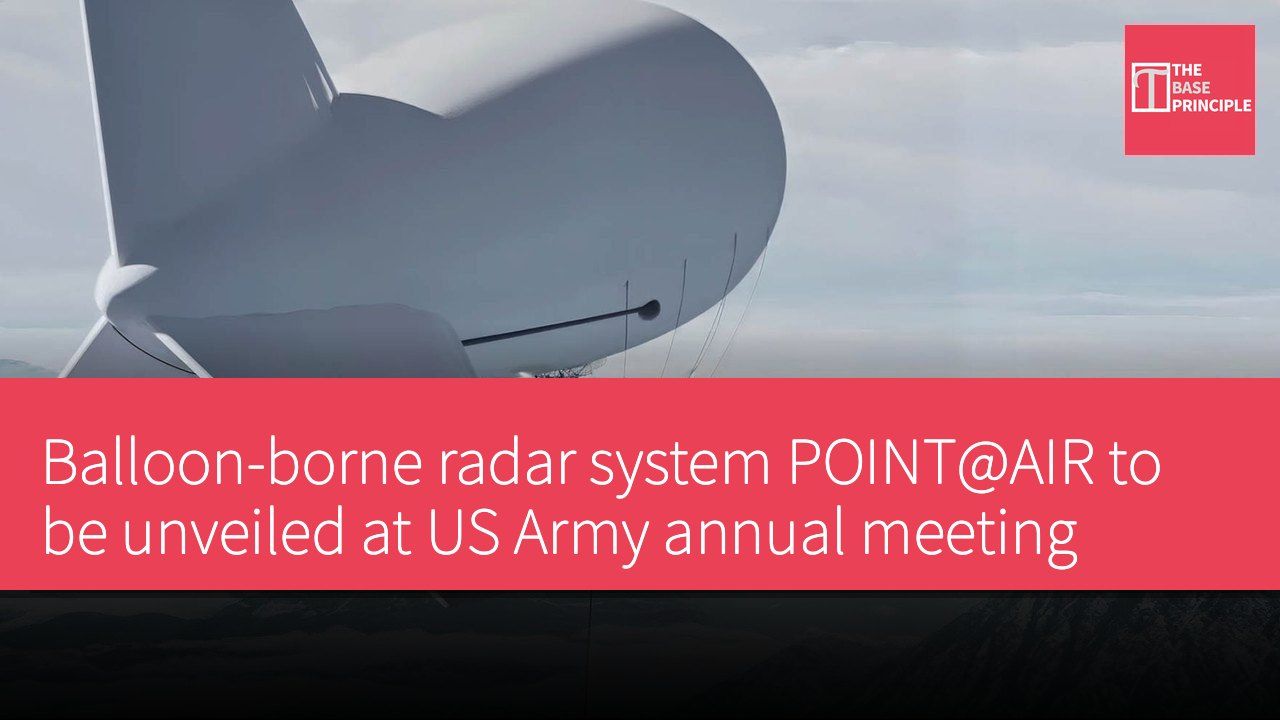
- POINT@AIR is a new balloon-borne radar system developed by Israel Aerospace Industries.
- The system can detect and track multiple airborne, maritime and ground targets without requiring permanent infrastructure.
- POINT@AIR provides 360-degree coverage and can be integrated with command and control systems.
- IAI has not yet disclosed the system’s operating altitude or other key performance details.
An Israeli aerospace and defense company will unveil a new balloon-borne radar system at the Association of the US Army’s annual meeting (AUSA 2026). The system, called POINT@AIR, is being developed by Israel Aerospace Industries (IAI) and uses a tethered helium balloon to suspend an active electronically scanned array radar above the ground. The company said this mobile system can detect and track multiple airborne, maritime and ground targets while transmitting data to command and control systems.
Based on IAI’s ELM-2083 radar series, POINT@AIR is designed to provide enhanced surveillance for ground forces against low-flying drones, aircraft and other potential threats without relying on permanent infrastructure. The balloon radar system combines an active electronically scanned array (AESA) radar with a tethered helium balloon to monitor airborne, maritime and ground targets. According to IAI, by suspending the sensor above ground level, the system aims to overcome visibility limitations caused by hills, buildings and the Earth’s curvature, which can hinder ground radar coverage.
System capabilities and design
This elevated platform helps military units detect low-flying aircraft and drones earlier, and its mobile design allows it to be repositioned as surveillance needs change without requiring permanent installation. According to IAI’s website, “The system can integrate with command and control and fire control systems to enable rapid threat detection, tracking and engagement, supporting neutralization before threats enter defended areas or approach critical assets.” IAI has not disclosed the balloon’s operating altitude, radar detection range, flight endurance or deployment time, details that will be critical for determining the system’s operational capability.
Based on IAI’s ELM-2083 radar series, POINT@AIR uses electronic beam steering in azimuth and elevation, combined with mechanical rotation to provide 360-degree coverage. This configuration enables the radar to scan in different directions and track multiple targets. The system can prioritize detected targets and transmit radar data to command and control networks, allowing operators to incorporate information from the elevated sensor into a broader operational picture, supporting multi-domain surveillance.
Past balloon surveillance experience
The system is similarly designed for land and maritime operations, offering up to 30 days of persistent airborne surveillance and early warning beyond the line-of-sight limits of ground systems. IAI describes POINT@AIR as a more compact and mobile balloon-mounted radar surveillance solution compared to larger systems in the ELM-2083 family. Its actual performance will depend on radar specifications, weather conditions, communication links and deployment requirements. The US military has previously used balloon-based surveillance to monitor facilities in Iraq and Afghanistan, and has used tethered balloons carrying cameras.
The US Army also developed the Joint Land Attack Cruise Missile Defense Elevated Netted Sensor System (JLENS). This larger balloon program was cancelled in 2015 after one balloon broke free from its tether in Maryland. IAI has not announced POINT@AIR’s customers or pricing, and its unveiling at AUSA 2026 is expected to provide further details on the system’s capabilities.
Strategic significance of balloon radar systems
The introduction of the POINT@AIR system reflects the growing demand for flexible surveillance capabilities in modern warfare, particularly in countering low-altitude threats such as drones. By using a balloon platform, the system can overcome terrain limitations and provide broader monitoring coverage, which is crucial for rapid response and threat identification. Additionally, IAI’s design emphasizes mobility, allowing military forces to adjust surveillance positions based on operational needs, which is especially important in dynamic battlefield environments. Past US Army balloon surveillance experience also provides a reference for the effectiveness of such systems, highlighting the potential of balloon technology in military applications.