
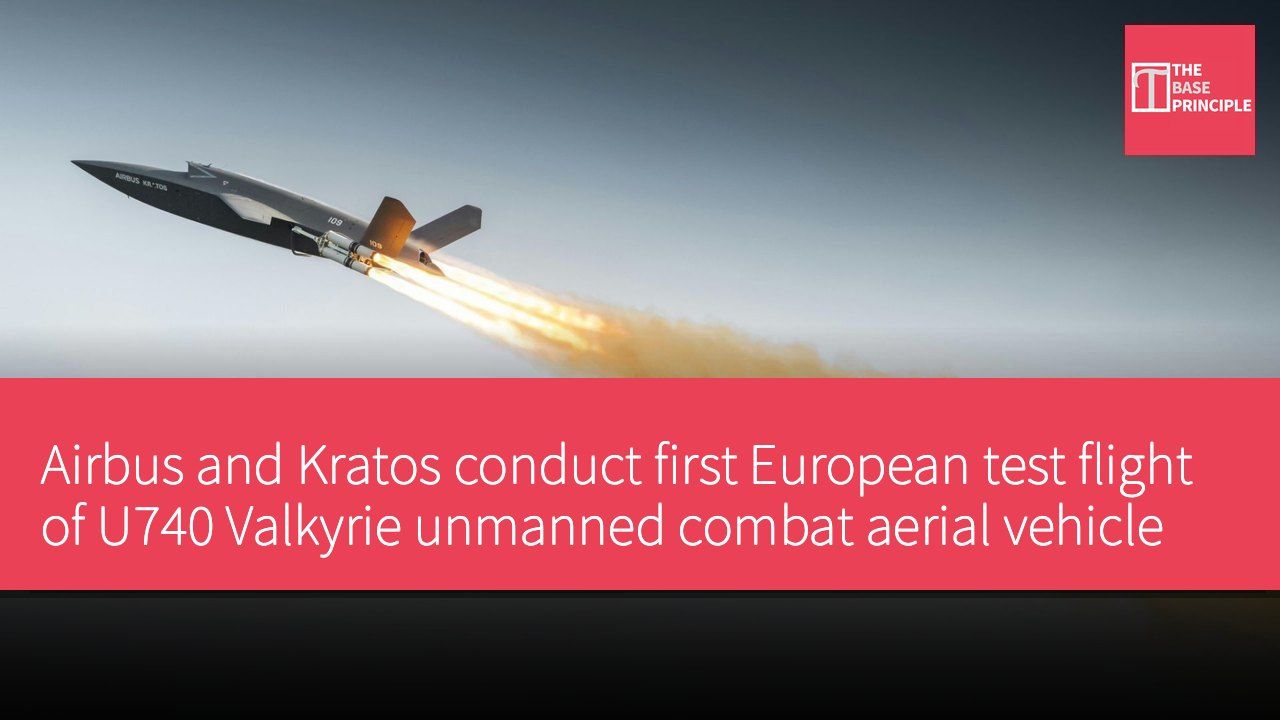
- Airbus and Kratos conduct first European test flight of U740 Valkyrie unmanned combat aircraft.
- Valkyrie drone features rocket-assisted takeoff and near-supersonic flight capability.
- The drone can operate independently or collaborate with manned fighter jets.
- MARS system will provide Valkyrie with autonomous mission control and coordination capabilities.
Airbus and Kratos Defense & Security Solutions conducted the first European flight test of the U740 Valkyrie unmanned combat aircraft. This milestone advances the partners' efforts to deliver a combat-ready Collaborative Combat Aircraft (CCA) to Germany and other European military customers by 2029.
The aircraft completed a series of test flights at an undisclosed facility in Northern Europe, including rocket-assisted takeoff without a conventional runway, flight at a near-supersonic speed of Mach 0.8, and in-flight adjustment of mission parameters. The partners plan further advanced trials involving Airbus' MARS mission system. This software will enable the Valkyrie to execute missions autonomously while preserving European control over its critical systems.
Valkyrie drone performance
The Valkyrie drone's European debut demonstrated strong performance. It measures 9.1 meters (29.9 feet) in length with a wingspan of 8.2 meters (26.9 feet). The aircraft features an internal weapons bay and additional payload stations, with a maximum takeoff weight of approximately three metric tons. Its range exceeds 3,100 miles, and it can operate at altitudes up to 45,000 feet. These specifications make the Valkyrie suited for missions that would place conventional aircraft and their crews at significant risk. It can operate independently or collaborate with manned fighter jets, including the Eurofighter.
Airbus expects the drone to extend the operational reach and firepower of existing combat aircraft, and its design offers a way to increase the number of available combat platforms without relying entirely on expensive manned fighters. The aircraft supports conventional runway operations, but its rail-launch capability provides an alternative deployment option. Rocket-assisted technology enables it to take off without depending on traditional runways.
Role of the MARS system
Airbus' Multi-platform Autonomous Reconfigurable Secure (MARS) system will provide the Valkyrie with its European mission architecture. The system enables European operators to control mission applications, software, data, and hardware. MARS uses AI-assisted software to manage autonomous missions and coordinate the actions of multiple aircraft. Human operators will retain oversight of the system, particularly for decisions involving established rules of engagement. This arrangement allows European forces to adopt autonomous combat aircraft without ceding control of their mission systems to external vendors. Future flight tests will evaluate how MARS integrates with the Valkyrie's existing capabilities.
Kratos Defense & Security Solutions CEO Mike Schoellhorn said modern air forces need affordable ways to enhance combat capability in an increasingly competitive environment. He stated: "By combining Kratos' mature airframe as the 'program of record' with Airbus' sovereign European mission system, we can deliver a powerful, sovereign, affordable, and combat-capable CCA system before the end of the decade." Kratos CEO Eric DeMarco praised the first flight, noting the aircraft's maturity and the integration work between the two teams.
He said the partnership could expand opportunities in Germany and other international markets. The 2029 target gives the companies several years to mature the aircraft and its autonomous mission software. Subsequent tests will determine how effectively the Valkyrie combines economical production, flexible deployment, and collaborative combat with manned fighters.
Item Specification Length 9.1 米(29.9 英尺) Wingspan 8.2 米(26.9 英尺) Maximum takeoff weight 約 3 公噸 Range 超過 3,100 英里 Operational altitude 高達 45,000 英尺
Future development potential of unmanned combat aircraft
The development of unmanned combat aircraft such as the U740 Valkyrie reflects modern military demand for cost-effectiveness and operational flexibility. As technology advances, these drones can not only execute high-risk missions but also collaborate with traditional manned fighters to enhance combat efficiency. The introduction of the MARS system further strengthens Europe's mastery of autonomous combat technology, reducing reliance on external vendors — a particularly important consideration in the current geopolitical environment.