
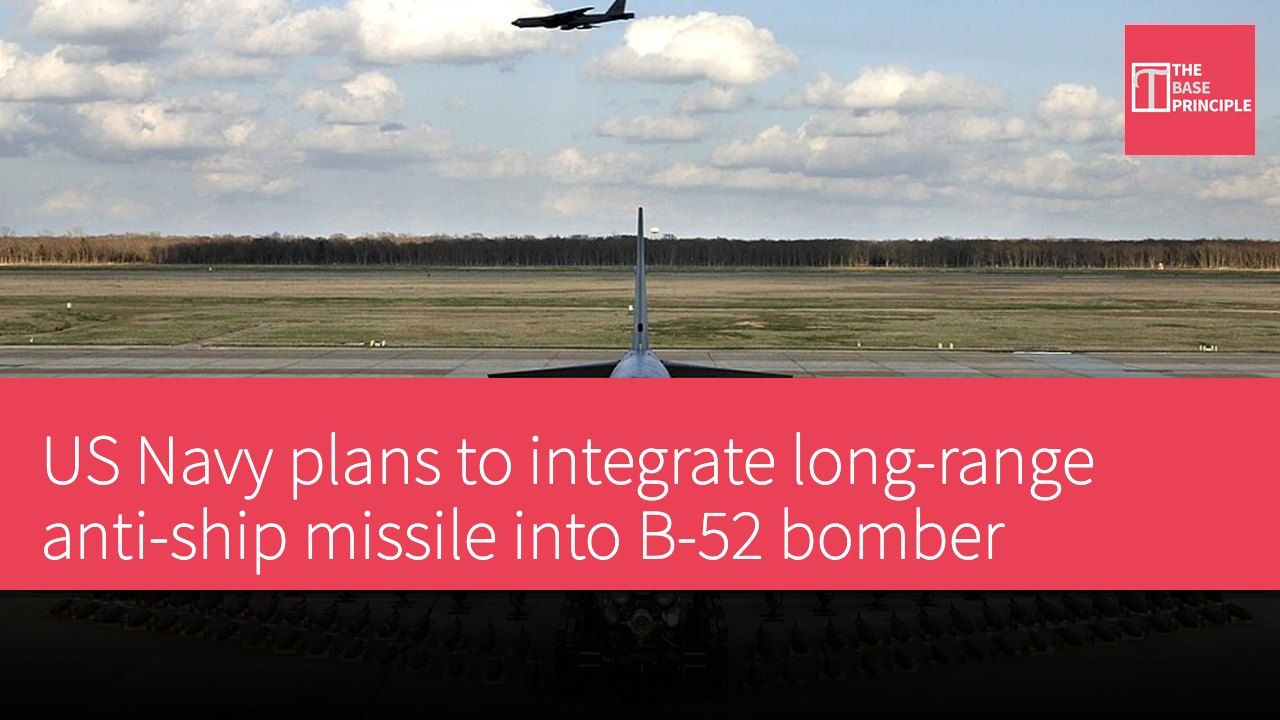
- The US Navy plans to integrate LRASM into the B-52 bomber, providing new tactical options.
- LRASM is a stealth air-launched cruise missile designed to destroy warships.
- The plan to integrate LRASM into the B-52 still requires extensive testing and development work.
- B-52 integration will provide the Navy with a potential firepower advantage, but its stealth issues must still be considered.
The US Navy plans to integrate the Long Range Anti-Ship Missile (LRASM) into the payload of its B-52 "Stratofortress." According to reports, the Navy will sign a contract with Lockheed Martin to realize this plan. The initiative aims to effectively turn the B-52 into a long-range flying anti-ship missile silo, providing the Navy with some interesting tactical options, particularly in a conflict with adversaries such as China. The move pairs cutting-edge technology with a vintage bomber that has been in service for more than 70 years.
First developed in the 1950s, the B-52 possesses massive weapons payload capacity and intercontinental range. The AGM-158C LRASM is a stealth air-launched cruise missile designed to track and destroy warships, including moving vessels in contested environments. These missiles possess autonomous navigation capabilities, meaning they can independently locate and destroy targets within a specific "kill zone" without requiring precise coordinates. As a result, the missiles can be launched into a general area to find potential targets.
LRASM Design and Capabilities
Currently, the B-52 already carries the AGM-158 Joint Air-to-Surface Standoff Missile (JASSM), which is effectively the land-attack version of the LRASM. In theory, this should make integration of the latter simpler than starting from scratch. However, extensive work on targeting software and operational testing remains. It is important to note that this is a planned integration contract, not an announcement that the B-52 already has operational LRASM capability. If successful, each B-52 should be able to carry an LRASM payload similar to that of the JASSM, currently about 20 per aircraft.
Therefore, a small number of LRASM-equipped B-52s would provide the Navy with a large amount of potential firepower.
Challenges and Risks of B-52 Integration
Retired Air Force Colonel Mark Gunzinger told Air & Space Forces Magazine: "A handful of B-52s will be able to put more weapons on maritime targets, and at ranges far beyond those of Navy carrier aircraft on a daily basis." So why is this needed? Currently, the Navy must rely on submarines, surface warships, and strike aircraft such as the F/A-18 Super Hornet to launch these missiles. Each platform has its advantages, but also limitations. For example, carrier aircraft have relatively short range, while ships have limited missile capacity.
Moving warships such as carriers close to contested areas to launch these weapons also carries inherent risks.
Even integration into the B-52 is not foolproof. Each LRASM has a range of approximately 200 miles (320 kilometers), meaning that even if the B-52 takes off from bases thousands of miles away, it must still get relatively close to launch the missiles. Moreover, the B-52 is not the stealthiest aircraft. For a capable adversary such as China, this means the B-52 would need support assets to distract enemy attention or protect it directly. Lockheed Martin spokesperson Scott Swofford said: "As a precise, stealthy, and survivable cruise missile, LRASM provides multi-service, multi-platform, and multi-mission strike capability for surface warfare."
He added: "By leveraging Lockheed Martin's expertise in successful cruise missile production, LRASM brings low-risk, long-term flexible capabilities to the warfighter's strike surface warfare environment that other weapons cannot provide."
Strategic Significance of B-52 LRASM Integration
Integrating LRASM into the B-52 bomber demonstrates the US Navy's strategic adjustment in the face of potential adversaries. This plan not only leverages the B-52's long-range capabilities but also enhances its firepower in maritime operations. However, technical challenges and stealth issues during integration may affect its operational effectiveness. As the global military environment evolves, the success of this program will provide the Navy with more flexible strike options and enhance its competitiveness in maritime warfare.