
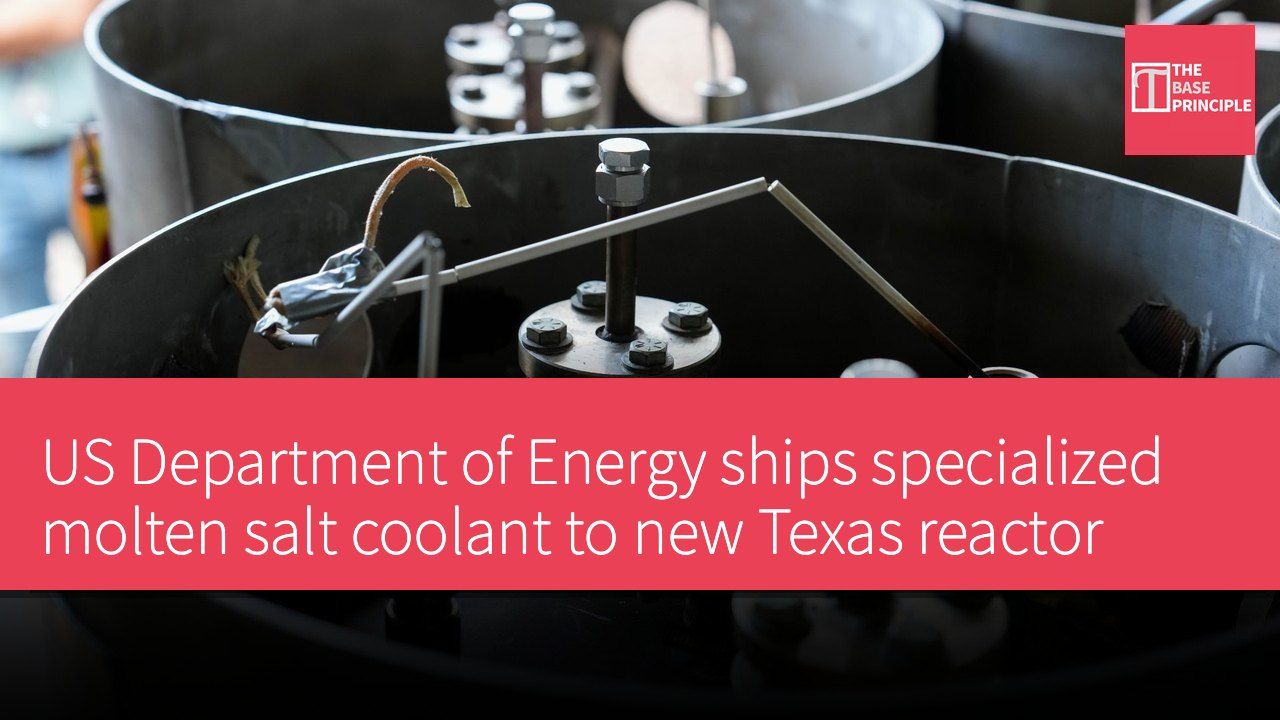
- Natura Resources secures molten salt coolant from the US Department of Energy, addressing supply chain challenges.
- The FLiBE salt originates from Oak Ridge National Laboratory and links to early molten salt technology.
- The company plans to use the MSR-1 reactor for testing, collecting data to design future systems.
- The arrival of the salt marks the second major milestone for the Abilene project, following a nuclear safety design agreement.
A specialized molten salt coolant has arrived at a new experimental nuclear reactor in Texas. Advanced nuclear energy company Natura Resources received the material from the US Department of Energy on September 18. The material will serve as the coolant for Natura's MSR-1 demonstration reactor. Workers are currently building the test facility at Abilene Christian University. By securing the compound, the company has resolved a major supply chain challenge and obtained a critical material needed to operate the facility. According to the company, Natura's small modular nuclear reactor is designed to deliver clean, reliable baseload electricity using liquid fuel and low-pressure operating conditions.
The newly delivered substance, known as FLiBE salt, originated at Oak Ridge National Laboratory and passed through Idaho National Laboratory before reaching Texas.
History and technology of FLiBE salt
This particular salt directly links today's commercial efforts to the birth of molten salt technology six decades ago. The Molten Salt Reactor Experiment (MSRE) operated from 1965 to 1969, logging more than 13,000 hours of operation and demonstrating passive safety, high-temperature performance and fuel flexibility. The company notes that it was this very FLiBE salt formulation that cooled the 1960s experiment. Natura is now using that early success as the technical baseline for its modern small modular reactor.
"Receiving this salt from the Department of Energy symbolizes a handoff between generations of American innovation," said Jordy Robison, chief executive officer of Natura Resources. "The MSRE demonstrated what molten salt technology can achieve. We are picking up that legacy and turning it into a commercial reality capable of delivering reliable energy, clean water and medical isotopes to the world."
Designing future commercial systems
Natura obtained the rights to use the coolant through a competitive bid process run by the US Department of Energy. The bidding process launched in August 2025 and was administered by Idaho National Laboratory. The material has precise chemical properties that are critical for nuclear operations. The FLiBE salt contains 99.99% enriched lithium-7, which helps minimize tritium production within the salt. Natura plans to use the MSR-1 reactor as a test bed, with engineers collecting operational data from test runs to design and license future commercial systems.
The company plans to deploy these small, liquid-fueled modular units to power industrial sites, remote communities and critical infrastructure. In addition to reliable energy, the technology is intended to produce medical isotopes and support clean water production.
The arrival of the salt represents the second major milestone for the Abilene project in recent months. In July, the Department of Energy approved the nuclear safety design agreement for the research facility. This formal agreement outlines the safety rules and design standards for the reactor, defining the technical framework needed to evaluate the principal safety features, structural materials and operational limits of the liquid-fueled core. Establishing these baseline boundaries is an important regulatory step, giving federal authorities the legal basis to approve construction and authorize system testing.
Impact of molten salt coolant on nuclear energy development
The FLiBE salt acquired by Natura Resources is not only a technical advance but also a symbol of America's heritage in nuclear energy innovation. The use of this coolant ties closely to past molten salt reactor experiments, demonstrating the technology's potential and reliability. With the development of small modular nuclear reactors, Natura expects to deliver clean, stable energy for a range of applications and to drive further technological innovation in medical and water resource management. These advances not only help meet current energy needs but may also have a far-reaching impact on future energy policy and markets.