
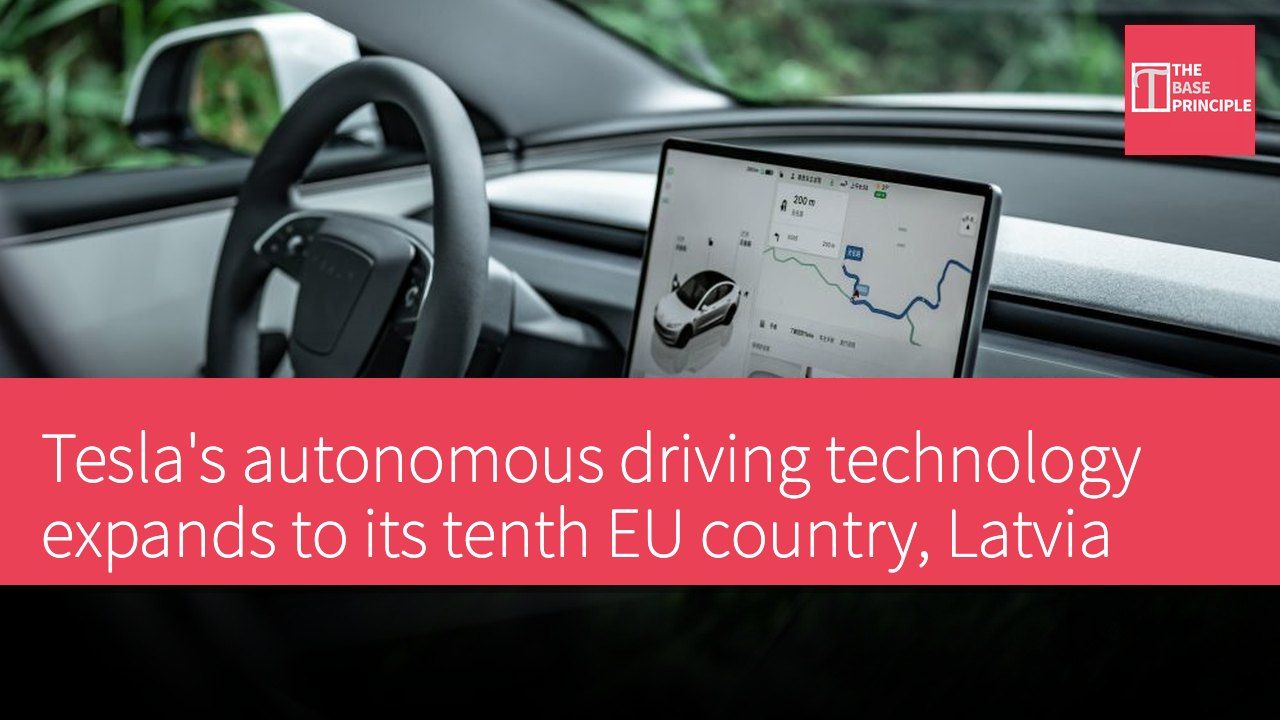
- Latvia becomes the tenth EU country to receive approval for Tesla's Full Self-Driving.
- The system remains at SAE Level 2, requiring drivers to continuously monitor the road.
- The approval is based on a temporary European type approval issued by Dutch authorities.
- Full EU authorization still requires a qualified majority, with major countries like Germany under review.
Tesla has expanded its Tesla Advanced Driver Assistance (TAD) system to its tenth European country, with Latvia joining the growing list of EU member states authorized for the company's advanced driver assistance technology. Tesla Europe announced this morning that the system has now been approved in Latvia, with software updates set to begin shortly. This approval and rollout are based on a temporary European type approval issued by the Dutch RDW authorities on April 10.
Background of Latvia's Approval
Latvia has just received approval for Tesla's Full Self-Driving (supervised), making it the tenth EU country to be approved:
1. Netherlands — April 10, 2026 (original RDW approval) 2. Lithuania — May 20, 2026 3. Estonia — May 29, 2026 4. Denmark — June 9, 2026 5. Belgium — June 10, 20266. Slovenia — September 7, 2026 7. Czech Republic — September 21, 2026 8. Croatia — September 29, 2026 9. Slovakia — October 16, 2026
The Latvian Road Traffic Safety Directorate (CSDD) evaluated the Dutch documentation and coordinated with other national authorities to review updates from Tesla, which included enhancements to speed deviation limits, automatic resets of manual speed adjustments after each trip, and stronger driver monitoring. In Europe, this feature is referred to as Tesla Advanced Driver Assistance following recent regulatory changes, as the term "Full Self-Driving" is considered misleading.
Challenges for Full EU Authorization
The system remains an SAE Level 2 driver assistance tool, rather than an unsupervised autonomous driving system. It can control speed, steering, braking, lane changes, and intersections, following navigation paths. Drivers are not required to keep their hands on the wheel at all times but must continuously monitor the road and be ready to intervene immediately. The EU's approval sequence began with the Netherlands in April, followed by Lithuania, Estonia, Denmark, Belgium, Slovenia, Czech Republic, Croatia, and Slovakia. Most countries rely on mutual recognition of the temporary approval from the Netherlands rather than independent national testing.
These approvals do not yet constitute full EU authorization. A decision for full EU authorization requires a qualified majority in a technical committee: at least 15 member states representing 65% of the EU population out of a total of 27 countries. Major markets such as Germany, France, and Italy are still under review, with a vote expected in December this year. However, for Tesla owners in Latvia with compatible vehicles and software, this upcoming rollout expands the use of the supervised system while emphasizing the importance of human oversight.
Significance of Tesla's Expansion to Latvia
Tesla's approval in Latvia marks a further expansion of its autonomous driving technology in Europe, demonstrating the acceptance of this technology across different markets. However, despite multiple countries receiving approval, true full EU authorization still faces challenges, particularly during the review processes in large markets like Germany and France. This reflects that the promotion of autonomous driving technology requires not only technological maturity but also a consensus among governments regarding safety and regulation.