
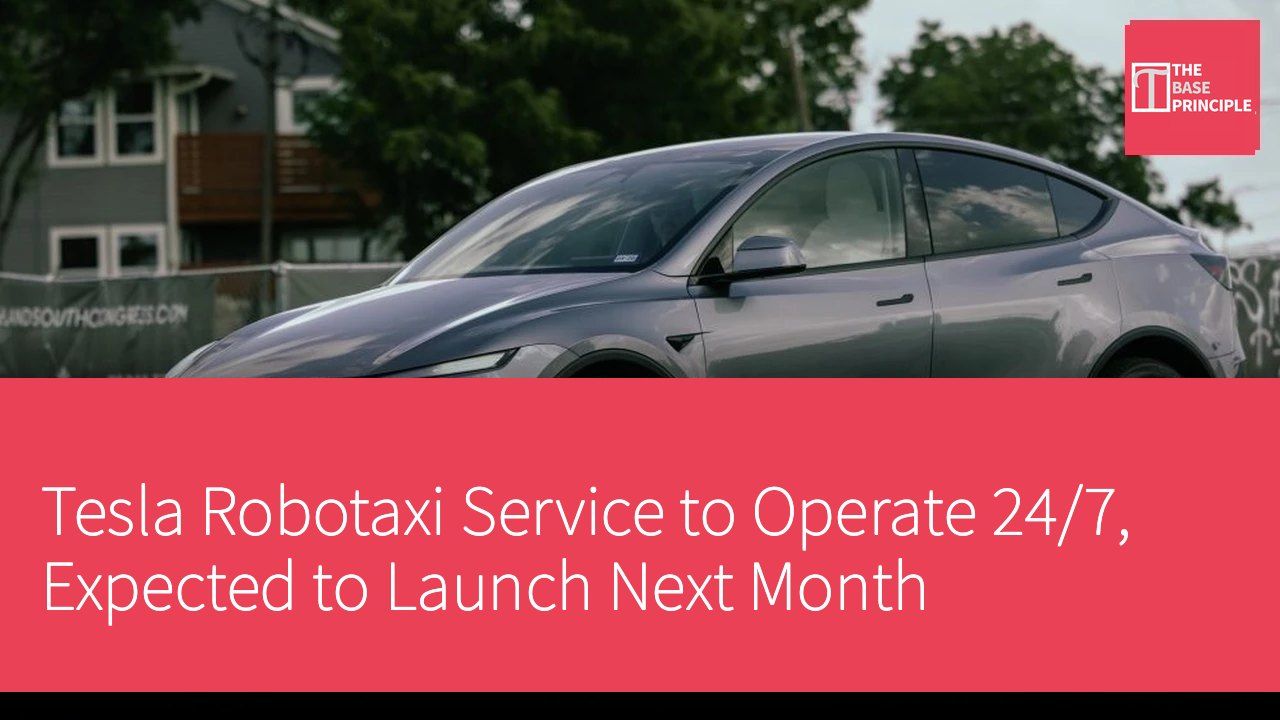
Tesla AI head Ashok Elluswamy announced this week that a 24/7 Robotaxi service is on the horizon. Responding to a passenger on X who wished for Cybercab service during nighttime hours, he wrote that the feature would launch "around next month" once "the next piece of tech in the v15 stack is ready." The comment came a day after Tesla launched its public Cybercab service in Austin on September 4th. This is the clearest near-term timeline yet for round-the-clock unsupervised operation. Tesla's paid Robotaxi network currently operates seven days a week in Austin, Dallas, Houston, Miami, Orlando, and Tampa from 6 a.m. to 10 p.m.
> Around next month. The next piece of tech in the v15 stack will make it possible. — Ashok Elluswamy (@aelluswamy) September 4, 2026
The current 16-hour operational window is shorter than the 6 a.m. to 2 a.m. schedule the company used for much of last year. Elluswamy did not specify which feature, nor whether the change would first apply to purpose-built Cybercabs, the existing Model Y fleet, or both. He also did not provide a rollout list by city. However, the connection to Full Self-Driving v15 remains significant.
Tesla describes v15 as an architecture with seven concurrent improvement tracks, with roughly ten times the number of parameters as earlier versions. Early versions of the software are already running on the Robotaxi fleet and contain about 40% of the planned improvements. As of July 2026, the unsupervised fleet has driven over 380,000 miles across six cities in two states and maintained an impeccable safety record, with no major accidents caused by the vehicles themselves. Tesla has repeatedly argued that a camera-based end-to-end neural network, rather than additional sensors, is the core solution. Nighttime service will test this claim in low-light conditions while also improving vehicle utilization, a key variable in Robotaxi unit economics. The company has begun using public Superchargers at night and is building dedicated Robotaxi charging stations.
Passengers have asked why the software must change if vehicles can already drive in the dark. The practical answer seems to be reliability and scale: Tesla has been holding back large-scale expansion until it merges more of the v15 stack, claiming the need for higher confidence before deploying thousands of unsupervised vehicles on the road around the clock. If Elluswamy’s timeline holds, 24/7 service could begin in some markets as early as October 2026. This would mark a shift from a daytime-limited pilot service to one that can operate whenever there is demand, including the currently inaccessible late-night hours.
Tesla Introduces New Active Safety Feature, Further Enhancing Autonomous Driving Safety
Tesla has begun rolling out Full Self-Driving Supervised v14.3.9, a new active safety layer that can take control of the vehicle even when the driver is manually operating the car. Tesla AI states that the software can initiate FSD on behalf of the driver when it detects an impending collision and automatic emergency braking (AEB) may not be sufficient to avoid an accident. It may also intervene if the system detects severe distraction or an unexpected FSD disengagement. FSD Supervised v14.3.9 is rolling out soon.
This release includes a new active safety feature set: FSD Supervised can now initiate on your behalf if it detects an impending collision and AEB may not be sufficient to avoid an accident. If we…— Tesla AI (@Tesla_AI) September 4, 2026
This feature is essentially automatic collision avoidance. However, unlike traditional AEB, which primarily applies brakes in a straight line, this feature can use a combination of steering, braking, and acceleration if the car calculates that stopping alone will not prevent a collision and a safer path exists. The system may change lanes or move toward the shoulder if conditions permit, then continue driving after handling the immediate threat, rather than simply stopping. This intervention is designed to serve as a last-resort safety net, not as a replacement for attentive driving.
A Significant Step in Enhancing Driving Safety
Tesla's description of FSD still positions it as supervised assistance. A secondary report of internal release notes states that the feature can initiate while the car is under manual driving if cabin camera monitoring shows the driver is not attentive enough, such as reaching for the back seat, or if FSD seems to have unexpectedly disengaged. After emergency operation, the car is expected to alert the driver and request a return to manual control.
The safety case is straightforward. Many collisions occur in the last second because the driver is distracted, misoperates controls, or faces obstacles that brakes cannot fully resolve. A system that can recognize AEB insufficiency and execute a coordinated avoidance path can reduce these remaining high-severity events.
Re-engaging after an unexpected disengagement also addresses a practical failure mode: a tiny steering wheel nudge at the worst moment causes FSD to disengage. The advantage is a background safety net that uses the same visual stack already running in v14, rather than relying solely on emergency braking when the driver is no longer in control. The feature still depends on FSD being active and reportedly requires an active FSD purchase or subscription. It does not make the vehicle unsupervised. The driver remains responsible, and Tesla has not released data on how frequently the system is expected to intervene or how it handles false positives. If the rollout is conservative and the false positive rate stays low, this update is a meaningful step: FSD is no longer just a feature the driver turns on. In the rare moment when disaster is already unfolding, it can intervene.
Conclusion
As Tesla continues to push the boundaries of autonomous driving technology, the launch of 24/7 Robotaxi service marks a significant milestone. This not only demonstrates Tesla's leadership in technological innovation but also opens up new possibilities for future urban transportation. As the FSD system continues to evolve, Tesla's autonomous driving technology will play a broader role in more application scenarios, providing users with safer and more efficient travel experiences. Tesla's spirit of innovation not only drives the development of the industry but also lays a solid foundation for the future of global transportation.