
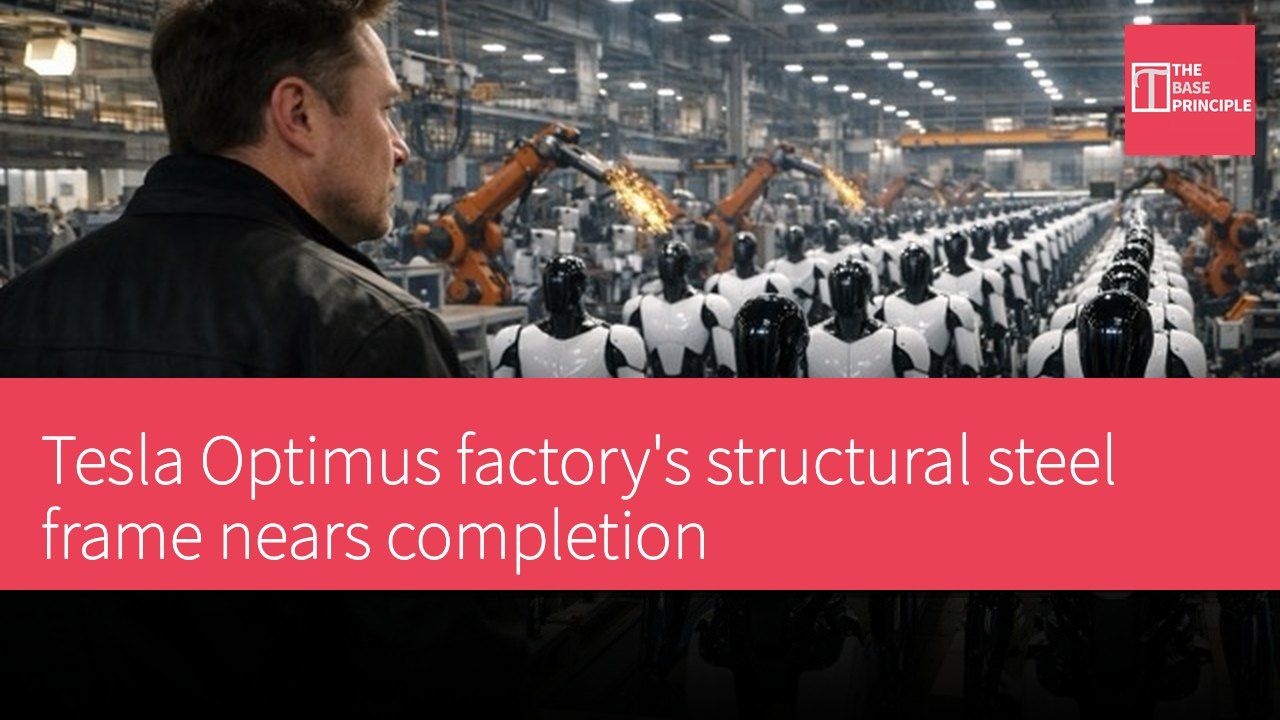
- Optimus factory's steel construction is approaching completion, with only about five bays remaining to the north perimeter beam.
- Construction pace has accelerated, with steel framing and concrete work proceeding in parallel to save time.
- The expansion covers more than 5.2 million square feet, targeting annual output of 10 million Optimus units.
- The Terafab chip fabrication facility is being built in parallel with the Texas site to streamline the supply chain.
Tesla's dedicated Optimus factory at the Texas Gigafactory is approaching the finish line on its steel frame construction, according to drone footage released on Thursday afternoon by long-time observer Joe Tegtmeyer. In the video, Tegtmeyer noted that the structural steel assembly is only about five bays from the building's north perimeter beam, meaning the main skeleton is in its final phase, roughly six months after Tesla broke ground on the north campus site in late March.
According to the latest update, construction at the Giga Texas Optimus factory is continuing to accelerate. Steel framing is about five bays from the north perimeter beam, three-story concrete work has already begun, rebar is still being laid, and foundation and grade-beam work is also underway. This parallel approach — steel rising at one end while concrete cures at the other — mirrors the scheduling Tesla used on the original Giga Texas building and is clearly being repeated here to save time before the factory is scheduled to begin production in 2027.
Construction progress and methods
Teslarati has been tracking the building's progress since Tesla confirmed the formal groundbreaking in May, when the first steel columns went up on what was then bare reclaimed land. The facility is part of the more than 5.2 million-square-foot north campus expansion at Giga Texas, which Tesla says will stretch nearly the length of the existing auto plant, over 4,000 feet, though at a relatively narrow width. Musk has set the long-term production target at 10 million Optimus units per year, a figure that would dwarf the 1 million-unit pilot production line Tesla has stood up independently at its Fremont, California factory.
Supply chain optimization strategy
The Texas facility is rising in parallel with another major build on the same campus. Terafab, the joint Tesla and SpaceX chip fabrication plant, will eventually supply silicon to the Optimus units operating on site. Co-locating robot assembly and chip production on the same grounds is a deliberate supply chain decision, cutting the transportation and delivery time that would otherwise sit between the two. Tesla has not provided an updated timeline beyond its previously stated goal of kicking off high-volume Optimus production at the site in the summer of 2027.
The smaller pilot production line in Fremont began large-scale manufacturing of the current Gen 3 robots in January, and that factory is expected to turn out tens of thousands of units this year, primarily to generate the real-world data Tesla needs to refine the robot's software before scaling up at Giga Texas.
After six months of visible construction progress — almost entirely tracked through Tegtmeyer's periodic drone flights — it offers the clearest external view yet of how seriously Tesla is taking its 2027 deadline.
How Tesla is accelerating the Optimus production plan
Construction progress at Tesla's Optimus factory in Texas underscores the company's commitment to its future production plans. The parallel approach of steel framing and concrete work not only improves building efficiency but also reflects Tesla's strategy on time management. With the Terafab chip fabrication facility rising alongside it, Tesla is further streamlining its supply chain and cutting transportation time, a move that will be critical to large-scale manufacturing going forward. These efforts not only support the production targets Musk has set, but also reflect the company's long-term planning around both technology and production processes.