
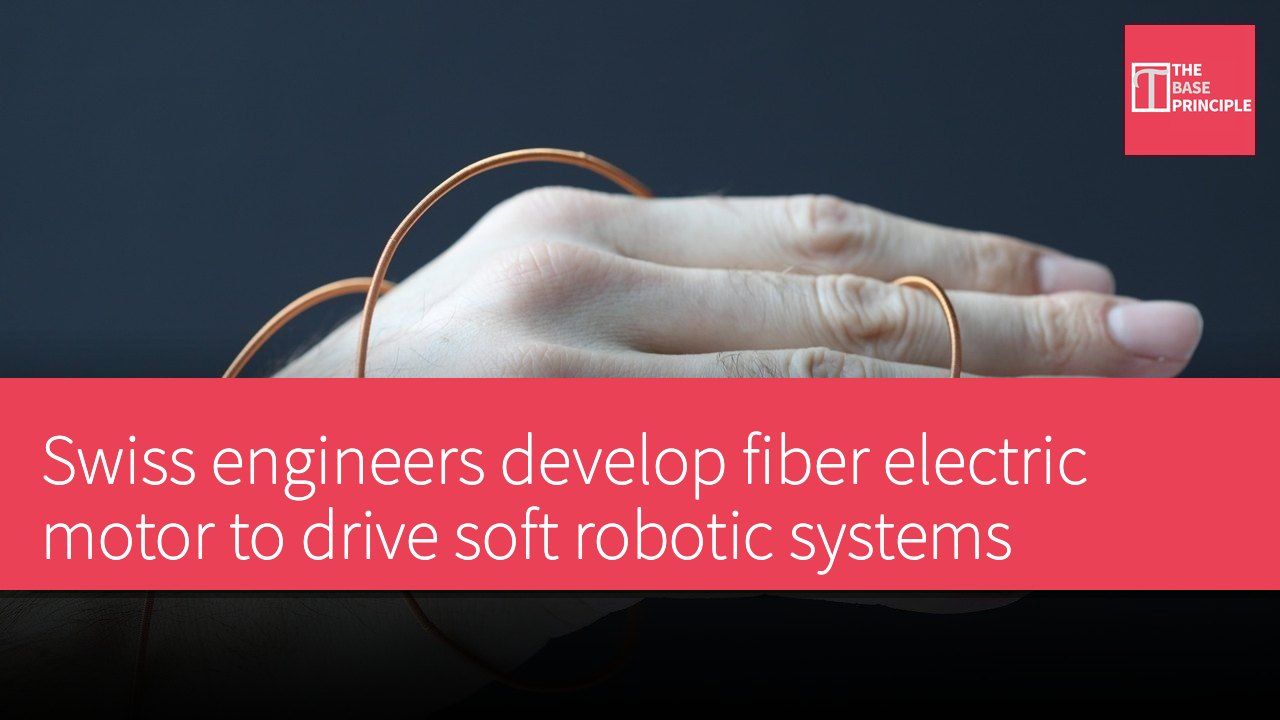
- FiberMotor is the first fiber-format sliding motor capable of driving soft robots.
- The device requires no gears or transmission mechanisms and features backdrivability.
- Researchers plan to apply FiberMotor to wearable assistive devices.
- Startup Elecsyor will focus on commercializing this technology.
Engineers at the Swiss Federal Institute of Technology Lausanne (EPFL) have successfully developed a flexible motor called FiberMotor that resembles a thin thread, capable of generating enough force to drive soft robotic systems while operating silently and with bidirectional motion. The device measures between 1 and 3 millimeters (0.04 to 0.12 inches) in diameter and can convert electrical energy directly into motion. The research, "Fiber-Format Soft Linear Electrostatic Motor," has been published in the journal Advanced Materials.
The FiberMotor consists of two concentric hollow fibers. Each fiber is tightly wound with insulated copper wire electrodes only slightly thicker than a human hair. When voltage is applied, electrostatic forces repeatedly pull the fibers into alignment, causing the inner fiber to slide within the outer fiber, similar to a telescope. Herbert Shea, head of EPFL's Soft Transducers Laboratory, said: "Our FiberMotor is the first fiber-format sliding motor capable of generating sufficient force to drive soft robotic applications while remaining silent, flexible, and bidirectional."
FiberMotor's Innovative Design
Everyday activities such as lifting, pushing, and pulling rely on linear motion rather than rotational motion. Researchers say replicating linear motion has been a long-standing challenge in wearable robotics because motors capable of driving linear motion typically require rigid gears, transmissions, and other bulky components. While so-called artificial muscles exist, their range of motion is limited by the material's ability to stretch, contract, or bend. By contrast, the FiberMotor's range of motion is limited only by the length of its fibers. Because it requires no gears or transmissions, the device is backdrivable, meaning external forces can safely drive it in reverse.
If the wearer moves unexpectedly or against the drive direction, the fibers slide past each other rather than locking, allowing the device to cooperate more naturally with human movement than conventional motors.
In laboratory demonstrations, a single FiberMotor supported a static load of approximately 75 grams (2.6 ounces). Four motors combined generated enough force to lift a 46-gram (1.6-ounce) chocolate bar and bend a tendon-driven robotic finger. The team also integrated the motor into a prototype garment designed for the knee. Because the motor is lightweight and thin, researchers envision distributing it within smart textiles rather than concentrating force in a single rigid unit.
Future Applications and Commercialization Plans
This research builds on the lab's 2023 debut of the world's first fiber-format pump, which can be sewn into smart textiles to circulate fluid for thermal regulation and haptic feedback. Next, researchers will focus on improving the FiberMotor's performance and durability, using thinner electrodes made primarily of insulators and optimized materials. They also plan to integrate feedback data on the wearer's position and movement so the motor can quickly adapt to the wearer's intent. Ultimately, the team hopes to apply this combination of force and flexibility to wearable assistive devices such as soft exoskeletons for mobility, wearable haptic systems for virtual reality, and lightweight prosthetics.
First author Sylvain Schaller has founded the startup Elecsyor to commercialize the technology. The research was funded by the Swiss National Science Foundation and the Novo Nordisk Foundation.
FiberMotor's Impact on Wearable Technology
The development of FiberMotor marks a major advance in wearable robotics, with its silent and backdrivable capabilities enabling more natural collaboration with the human body and overcoming the limitations of conventional motors. This technology not only enhances convenience in daily activities but also has potential applications in mobility assistive devices and virtual reality systems. With the founding of startup Elecsyor, commercialization will accelerate, potentially changing how people perceive and use wearable technology in the future.