
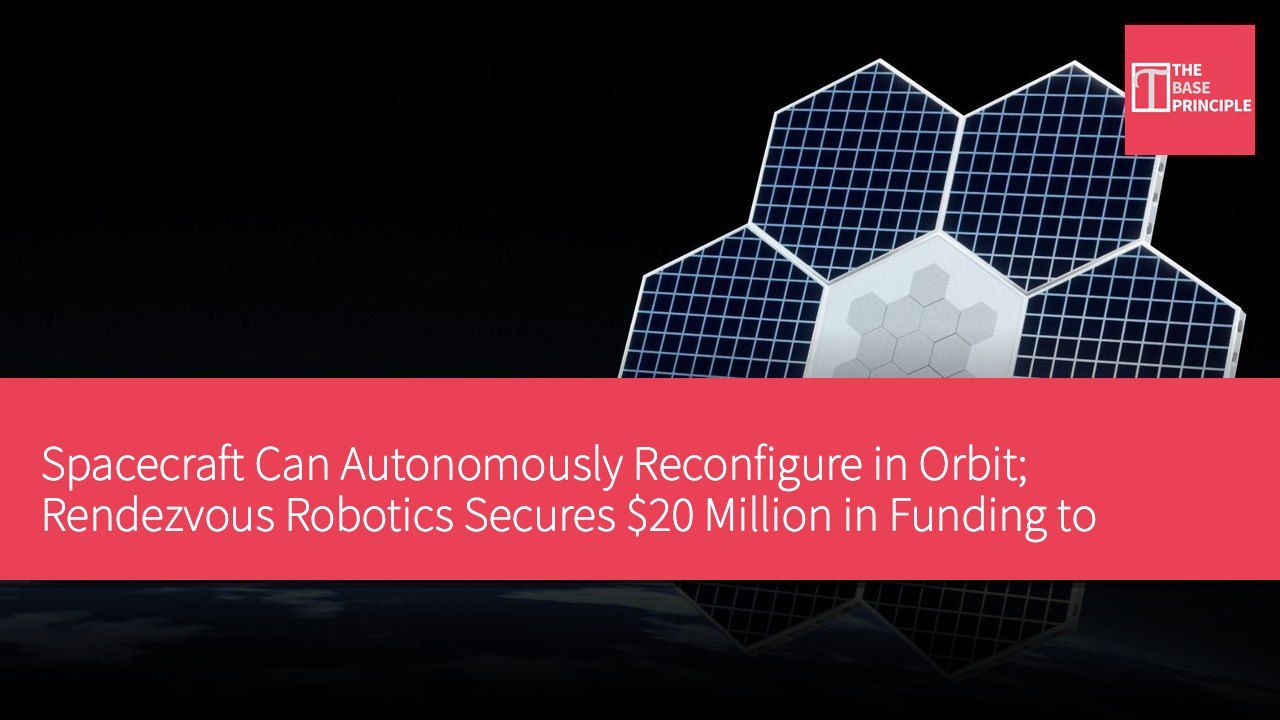
- Rendezvous Robotics has secured $20 million in funding to develop autonomous reconfiguration technology.
- Spacecraft can change shape in orbit to enhance functionality without new devices.
- The technology is based on the TESSERAE modular self-assembly concept from MIT.
- The 2028 mission will test the spacecraft's autonomous docking and reconfiguration capabilities.
In the future, spacecraft may be able to change shape after reaching orbit, allowing operators to enhance functionality without launching entirely new devices. Rendezvous Robotics has secured $20 million in funding to develop this technology, with plans for its first orbital demonstration in 2028. The startup intends to launch seven independent spacecraft components that will connect in space, then separate and assemble into different configurations to test whether autonomous spacecraft can build and reshape larger structures without external robotic assistance.
MaC Venture Capital and Toyota Ventures participated in the oversubscribed seed funding round. Rendezvous will use this funding to advance its spacecraft design and prepare for flight demonstrations.
Challenges of Autonomous Reconfiguration Technology
Traditional spacecraft sizes are limited by rocket fairing dimensions, requiring engineers to fit each component within this range, which restricts the size of equipment such as antennas and power systems. Rendezvous aims to shift some construction work to orbit, launching its spacecraft as independent components that can be controlled separately and then connected. The final structure could exceed the size of any single module.
Reconfiguration presents further engineering challenges. The seven components must coordinate their movements and establish connections before they can separate and form new arrangements. The planned mission will test whether they can autonomously complete these operations in low Earth orbit. CEO Joe Landon believes this approach could eventually support spacecraft with megawatt-level power generation capabilities. He also sees potential for larger communication and sensing apertures, which could support missions facing significant limitations under traditional spacecraft designs.
The technology is derived from TESSERAE, a modular self-assembly concept developed by MIT's Ariel Ekblaw. Ekblaw later advanced this research through the Aurelia Institute she founded and co-founded Rendezvous Robotics. Early versions of TESSERAE were flown on Blue Origin's New Shepard rocket and during two missions to the International Space Station (ISS).
These experiments helped researchers explore the concept's performance in microgravity environments.
New Methods for Future Spacecraft Construction
Ekblaw stated that this research aims to rethink how spacecraft are constructed. "Initially conceived as a self-assembly experiment, it is now gradually becoming a new method for building spacecraft in orbit." Rendezvous is developing larger components that can operate independently, with ground demonstrations currently testing their mobility and alignment capabilities before proceeding to connection. The next phase must determine whether these mechanisms can operate reliably under spaceflight conditions.
Two tests are upcoming. A parabolic flight activity planned for November 2026 will assess electromagnetic propulsion and component mobility in microgravity. The company has booked a ride-share launch for its orbital demonstration, tentatively scheduled for April 2028. Another milestone will occur in December 2026 at the International Space Station, where researchers plan to assemble 32 fifth-generation TESSERAE components into a three-dimensional structure in a controlled microgravity environment. This experiment will conclude the early TESSERAE research program as Rendezvous advances its free-flying spacecraft architecture.
These two demonstrations target different challenges; the ISS test examines assembly in a controlled environment, while the 2028 mission focuses on autonomous reconfiguration in open space. The new funding round also includes significant participation from the University of Michigan Foundation. Astera, co-founded by Jed McCaleb, has joined this funding round as a new investor. Existing supporters Aurelia Foundry, ATX Venture Partners, and Mana Ventures also participated in this financing.
Rendezvous must now translate laboratory research into systems that can operate outside controlled experiments, with its 2028 mission testing whether independent spacecraft can reliably connect and reconfigure in orbit, a capability that could change how engineers design future space infrastructure.
Impact of Autonomous Reconfiguration Technology on Space Exploration
Rendezvous Robotics' autonomous reconfiguration technology has the potential to fundamentally change the design and construction of spacecraft. Traditional spacecraft are constrained by the dimensions of rocket fairings, limiting their potential. By enabling modular construction in orbit, spacecraft can be flexibly adjusted according to mission requirements, significantly enhancing the efficiency and flexibility of space missions. As the technology matures, future space infrastructure may become more complex and powerful, which is crucial for exploring farther into space and undertaking more challenging missions.