
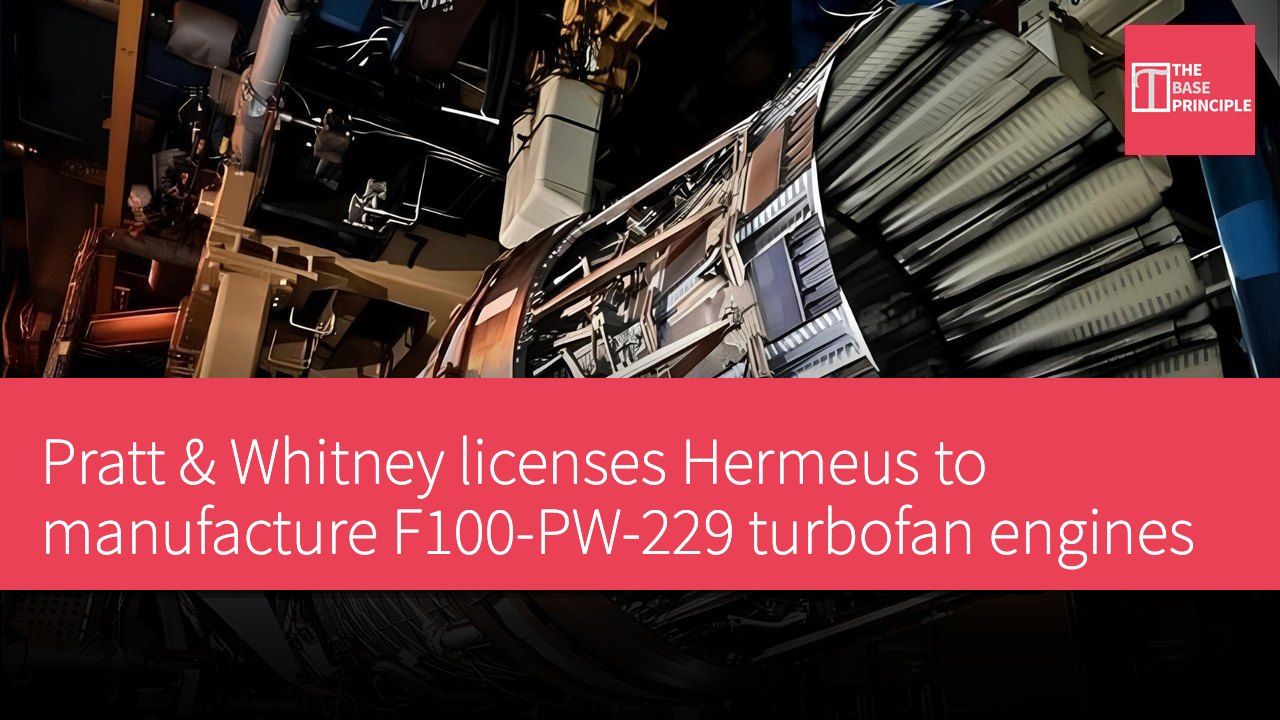
- Hermeus has been licensed to manufacture the F100-PW-229 turbofan engine, expanding the U.S. defense industrial base.
- The F100 family has accumulated more than 30 million flight hours, powering multiple fighter aircraft.
- The agreement addresses Hermeus's reliance on outside engine production and improves supply chain resilience.
- The new deal allows Hermeus to build a proven fighter engine while it continues work on high-speed aircraft.
Pratt & Whitney has licensed aviation startup Hermeus to manufacture the F100-PW-229 turbofan engine, creating a new production source for the most widely used U.S. fighter engine. Under the agreement, Hermeus will build the F100 to Pratt & Whitney's production standards while applying its own rapid-manufacturing methods. The two companies said the move will expand domestic engine capacity and strengthen the U.S. defense industrial base. Breaking Defense reported the agreement; the engine powers various versions of the F-15 and F-16.
Pratt & Whitney said the F100 family has logged more than 30 million flight hours and powers aircraft operated by 23 air forces. Hermeus becomes the second production source for the F100.
History and applications of the F100 engine
The F100-PW-229 entered service in 1992 and continues to operate in the U.S. fighter fleet. Pratt & Whitney said the engine is compatible with the F-15EX and remains in production to support existing and future aircraft. For Hermeus, the deal also resolves a specific issue. Its Quarterhorse unmanned aircraft uses the F100, and engine manufacturing can now sit closer to its airframe production rather than depending entirely on outside suppliers. Hermeus president Zach Shore told Breaking Defense that the company will initially use existing production facilities and views the arrangement as an extension of Pratt & Whitney's
production operations. He added that production levels and investment will ultimately depend on customer demand. The company does not intend to serve as a new fighter-engine manufacturer but will instead build an established engine under license, applying its own production processes within the agreement.
Rising demand for fighter engines
Demand for fighter engines is rising. According to Breaking Defense, an Air Force information request in August projected that peak F100 demand in fiscal year 2034 could exceed 180 engines per year, including requirements from F-15EX and F-16 aircraft operated by U.S. and international customers. The Air Force said it wants to see greater manufacturing innovation and supply chain resilience. A second production source could therefore give Pratt & Whitney additional capacity while reducing dependence on a single production line.
The F100 also has potential relevance for newer unmanned aircraft. Pratt & Whitney's F100-PW-229 product description states that the engine is suitable for current F-15 and F-16 aircraft as well as new fighters and unmanned platforms.
For Hermeus, the Quarterhorse offers an immediate application. The company is developing an unmanned aircraft for high-speed flight under a $219 million Defense Innovation Unit contract, with the ultimate goal of reaching speeds approaching Mach 3. Hermeus is also developing its own turbine-based combined-cycle propulsion technology, called Chimera, for future high-speed aircraft. That system combines elements of turbine and ramjet propulsion and is distinct from the licensed F100 production work.
The new agreement therefore gives a relatively young aerospace company an unusual position: it can manufacture a proven fighter engine while continuing to develop its own high-speed aircraft and propulsion technologies.
For Pratt & Whitney, adding another U.S. manufacturer could offer a way to scale F100 production as demand grows without standing up an entirely new engine production line. The two sides have not disclosed the production tempo or a specific start date for Hermeus-built F100 engines, but the agreement marks a notable expansion of the F100 industrial base and gives Hermeus a new role in supporting one of the longest-serving fighter engine lines in the United States.
New opportunities and challenges for Hermeus
Hermeus's license to produce the F100 engine presents a significant opportunity for its future development. It not only enables the company to manufacture engines without relying entirely on outside suppliers, but also allows it to improve production efficiency by leveraging proven technology while developing new unmanned aircraft. With fighter engine demand on the rise, the agreement could also give Pratt & Whitney additional capacity and reduce reliance on a single production line, thereby strengthening overall supply chain resilience.