
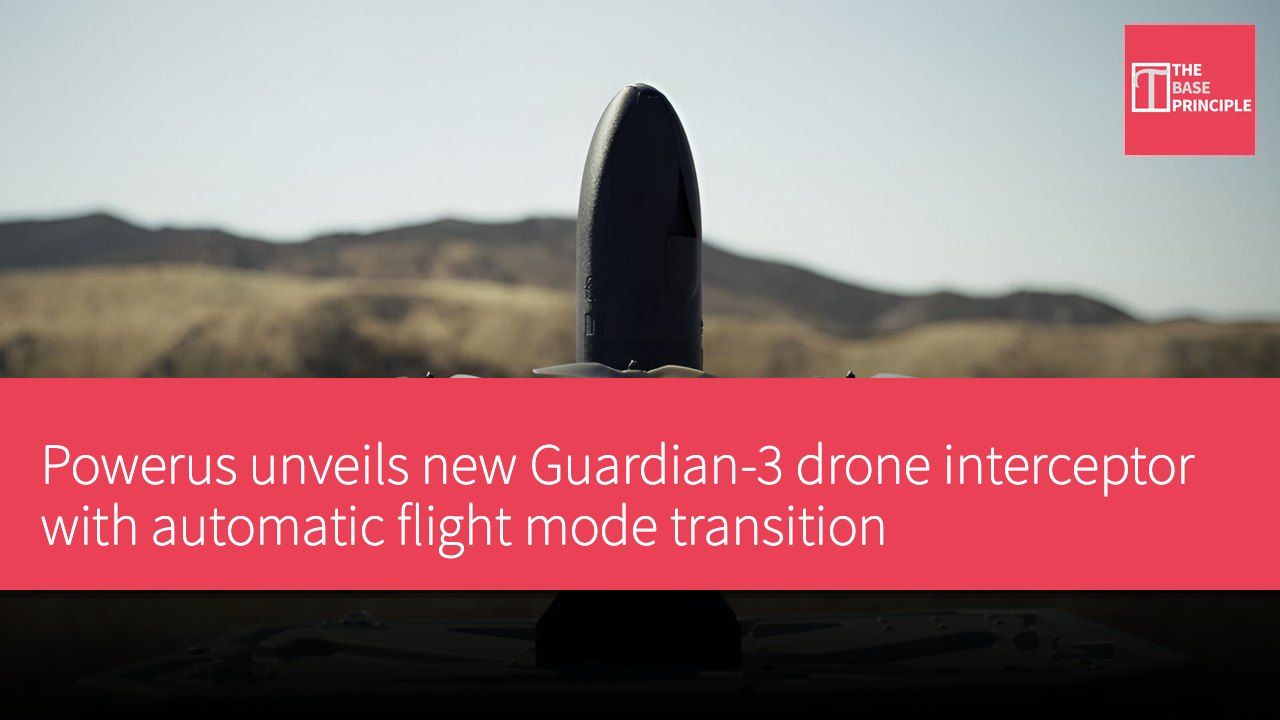
- Guardian-3 can automatically transition flight modes without pilot input.
- The drone's autonomy is significantly improved over its predecessor.
- GPS receiver mounted on gimbal to maintain navigation accuracy.
- Automated flight does not equal automated target engagement; combat capability remains to be assessed.
Powerus Corporation has announced a drone interceptor, the Guardian-3, capable of transitioning from vertical hover to forward flight without pilot input. The U.S. defense technology company unveiled the aircraft at the 2026 Association of the United States Army Annual Meeting and Exposition in Washington, D.C., marking the third generation of Powerus's Guardian interceptor series. The aircraft's key feature is its flight system, designed to manage the transition from takeoff to cruise, operating automatically once the operator authorizes launch.
Powerus displayed the interceptor at booth 8341 during the exhibition from Oct. 12 to 14, but the company has not disclosed its specifications, production timeline, or availability.
Enhanced autonomy and flight modes
The Guardian-3 takes off vertically, then hovers like a quadcopter before automatically pitching forward into a forward cruise flight mode requiring no pilot input. This transition gives the interceptor two distinct flight modes: vertical takeoff supports launch in confined spaces, while forward flight enables the aircraft to track its intended intercept path. Powerus has not explained the propulsion architecture behind this transition, nor has it disclosed the aircraft's speed, range, endurance, or maximum operating altitude. Compared with the Guardian-2, autonomy is a standout feature of the Guardian-3.
The former introduced semi-autonomous operation, while the Guardian-3 aims to automate more of the flight sequence. Once launch is authorized, the aircraft can manage its cruise transition without continuous manual control.
Navigation and thermal management challenges
The Guardian-3 mounts its GPS receiver on the camera gimbal. Powerus says this arrangement keeps the antenna pointed upward when the aircraft transitions to forward flight. The design addresses a specific navigation challenge: as the aircraft pitches forward, the orientation of onboard equipment changes, potentially affecting the orientation of a fixed antenna. Mounting the receiver on the gimbal helps maintain its intended orientation during this maneuver. Powerus has not released navigation accuracy data, nor has it explained how the system handles GPS jamming.
Thermal management presents another engineering challenge. The Guardian-3 uses ducted cooling for its electronic speed controllers (ESCs), which regulate power delivery to the motors. Powerus says this arrangement maintains airflow during hover and sustained full-throttle operation, as cooling demands differ across flight modes. The company has not provided temperature measurements, power consumption data, or details on the cooling ducts; further specifications would help determine the system's performance under demanding operational conditions.
Powerus describes the Guardian-3 as the next step in reducing operator workload. CEO Andrew Fox unveiled the system at AUSA, a venue for defense companies to showcase technology to Army personnel and industry partners. Co-founder and President Brett Velicovich said each Guardian generation shifts more tasks away from the operator, and the Guardian-3 extends that logic through automated flight transition.
However, automated flight is not equivalent to automated target engagement. Powerus has not detailed the Guardian-3's target acquisition, tracking, or intercept logic, making its combat capability difficult to assess. Speed, range, navigation performance, and test results will help determine the interceptor's ability to effectively counter aerial threats.
Operational impact of automated flight
The Guardian-3's automated flight modes demonstrate advances in drone technology that can effectively reduce operator workload. The design not only enhances the aircraft's flexibility but also enables missions in complex environments. However, while the introduction of automation can improve efficiency, Powerus must still address target acquisition and tracking to ensure the system's effectiveness in combat. Future test results will be the key factor in evaluating its combat capability.