
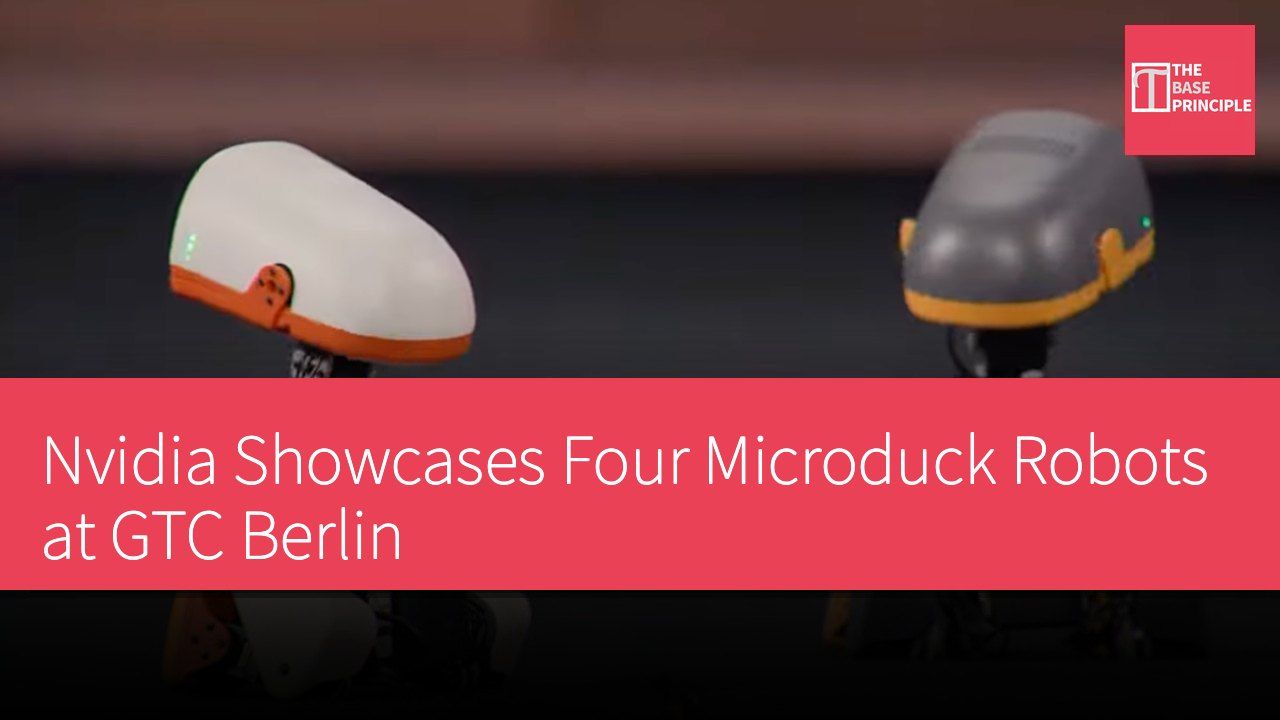
- Four Microduck robots performed on the GTC Berlin stage, showcasing their mobility.
- The robots were trained using Nvidia's cloud system and refined their movements in the Omniverse.
- Each Microduck is equipped with 15 motors and various sensors to execute commands.
- During the demonstration, the robots exhibited uneven responses, highlighting their mobility and occasional errors.
Four approximately 10-inch tall robots took to the stage at Nvidia's GTC Berlin on Wednesday night, subsequently sitting down, rolling over, and attempting to do flips. The demonstration featured the Microduck, a small bipedal robot developed by Pollen Robotics. Nvidia CEO Jensen Huang guided the robots through multiple commands, showcasing how each robot, weighing less than two pounds, moved and reacted during the live demonstration. Their performance included successful rolls, missed commands, and recoveries after falls.
The demonstration also highlighted the computational power behind these movements.
Robot Training and Command Responses
According to Jensen Huang, these robots were trained in the cloud using Nvidia's large systems, with their movements refined in the Omniverse digital twin running on RTX Spark machines. The four Microducks initially walked out independently. Huang greeted them, instructed them to sit, and then commanded them to stand up. The command to take a nap resulted in a less orderly response, with three robots immediately falling to the ground, while the fourth took a few more steps before tipping over. Huang laughed and encouraged the robots to stand back up and asked them to do flips.
Several successfully completed the flip, while others remained still or needed further encouragement. One robot walked further, stumbled, and then stood back up. Huang then called it back: "Pay attention, stay focused, come here." Eventually, the Microduck approached and sat down, eliciting more laughter from the audience.
Microduck Technical Specifications
This series of movements showcased the actions the robots could perform and the accompanying uneven responses. Each Microduck is equipped with 15 motors distributed across its legs, neck, and head. Its onboard equipment also includes a front-facing camera, depth sensors, and two small inertial measurement units. The movable beak allows this robot to pick up relatively lightweight objects from the ground, in addition to walking and posing. The robot can walk, sit, and squat, and can recover after falling. With added wheels, it can also glide. The stage demonstration focused on these physical capabilities, particularly walking, sitting, rolling, and standing back up.
While some commands elicited immediate responses, others required repeated encouragement.
Huang also used this appearance to discuss Europe's history in precision engineering product manufacturing, noting that Microduck is an example. The initial price for Microduck was US$399 (approximately HK$3,115), but the purchase window has since closed, and the robots are sold out. The first shipments are expected to arrive in North America and Europe before Christmas. Available colors include cream, graphite, lavender, and sky blue. The four robots appeared together during the demonstration, allowing the audience to see multiple units responding to the same commands.
Their differing responses became a recurring feature of the demonstration. Some sat down or rolled over when prompted, while others paused, wandered, or fell. These moments showcased the mobility of the small robots while also reflecting the occasional errors that accompany live performances.
Item Specification Number of Motors 15 Camera Front-facing camera Sensors Depth sensors
Technology and Challenges of the Microduck Robot Demonstration
The demonstration of the Microduck robots highlighted advancements in current robotics technology, particularly in mobility and responsiveness. Through cloud training and digital twin technology, these robots can perform a variety of actions; however, their uneven responses also reveal the limitations of current technology. These challenges not only affect the robots' performance but also reflect how robots face uncertainty and environmental changes in real-world applications. The design and demonstration of Microduck provide valuable insights for the future development of robotics technology.