
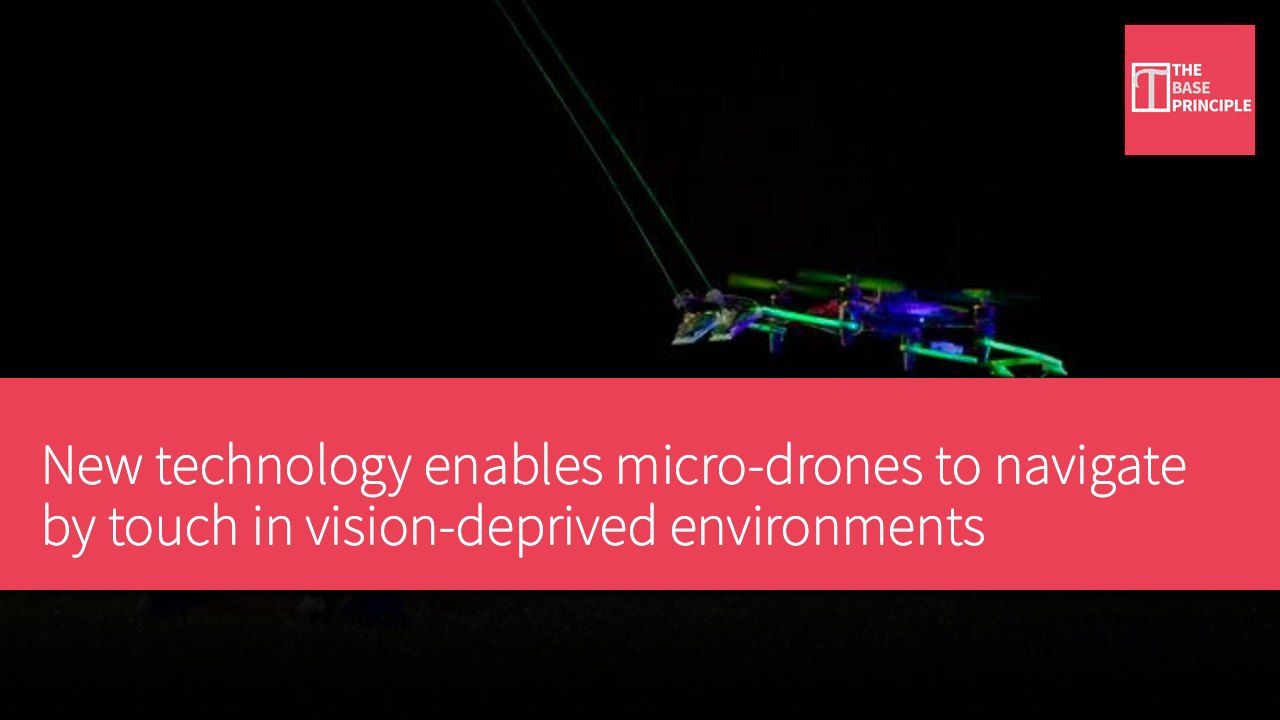
- New technology enables micro-drones to navigate in vision-deprived environments.
- The micro-drones use artificial whiskers to provide tactile navigation feedback.
- The technology can be applied in multiple fields such as rescue operations and industrial inspection.
- The whisker-equipped drones can map their surroundings and locate exits in the dark.
A new technology tackles one of robotics' biggest challenges: how to let tiny, ultralight drones navigate when they can barely see. Inspired by rodents darting through dark underground burrows, researchers have developed a whisker-based tactile framework that lets the drones sense their bearings in complex spaces. Two bio-inspired artificial whiskers mounted on the front of the micro-drone deliver real-time feedback, allowing the drone to register its position as it brushes against the surroundings. This compact setup brings tactile navigation directly to lightweight flying robots, replacing earlier systems that relied on robotic arms or bumpers.
Salua Hamaza, associate professor of Aerial Physical Interaction and Robotic Intelligence at TU Delft, explained: "Our aim is to give drones rich tactile awareness — not for aerial manipulation, but for a brand-new concept of tactile exploration and traversal through a tactile sense."
The inspiration behind whisker-based navigation
The rise of the whisker drone draws on rats and mice, which rely on their whiskers (or vibrissae) as a high-precision tactile navigation system that stands in for vision in the dark. Each whisker sits on a follicle packed with nerve endings capable of detecting minute deflections, vibrations and force changes when it brushes a surface. Rodents can gauge the width of tight gaps, sense nearby walls and chart their surroundings by sweeping their whiskers back and forth at high speed. This lets them race through cramped, pitch-black areas without crashing into anything. Taking a cue from nature, the development targets a fundamental challenge in aerial robotics.
Flying robots weighing under 100 grams cannot carry heavy LiDAR systems or power-hungry processors. These micro-drones typically crash in low-visibility crisis zones, where dust, smoke or pitch blackness blinds their cameras. Tactile sensing changes the equation.
A lightweight tactile sensing system
The researchers created an active, real-time sensing system by mounting a pair of flexible artificial whiskers at the front of the drone. In particular, they developed a fast, lightweight tactile perception system that lets the drone navigate without depending on vision. At the base of each whisker sit three miniature pressure sensors. As the whiskers flex against surfaces, the sensors measure tiny changes in force, quickly calculating the depth and location of the contact. The hardest part is not just sensing walls, but filtering out the drone's own noise. The propellers generate a storm of noise, air distortion and drift.
To address this, the TU Delft team designed a lightweight processing pipeline that runs in just 34KB of memory. The algorithm continuously strips out the turbulence generated by the drone itself, leaving clean depth data down to the millimeter. "We want to show that tactile sensing does not have to come at the cost of size or computational power," said Chaoxiang Ye of TU Delft.
Future application potential
In flight tests, the micro-drone navigated pitch-black environments, mapped unknown room layouts, traced surface contours and found exits without any visual cues. Replacing bulky cameras with flexible whiskers makes autonomous search-and-rescue robots smaller, lighter and smarter. In the future, these whisker-equipped micro-drones could offer advantages in several demanding fields. For instance, they could enter collapsed, smoke-filled buildings during earthquake or fire rescues, where visual and thermal cameras become unusable.
Industrial operators could deploy them to inspect structural defects in narrow pipes, ventilation shafts, sewers and underground mines. The technology is also well suited to space exploration, enabling navigation in dark lunar craters and Martian lava tubes that sunlight cannot reach. The research was published in the journal Nature Communications.
Breakthroughs and prospects for micro-drone technology
The breakthrough lies in applying tactile navigation to micro-drones, solving the problem of navigation in low-visibility environments. Traditionally, drones rely on vision systems to navigate, but in certain conditions like smoke or darkness, these systems fail to function properly. By imitating the tactile sensing of rodents, these micro-drones can operate efficiently in complex environments, demonstrating broad application potential in fields such as rescue operations, inspection and space exploration.