
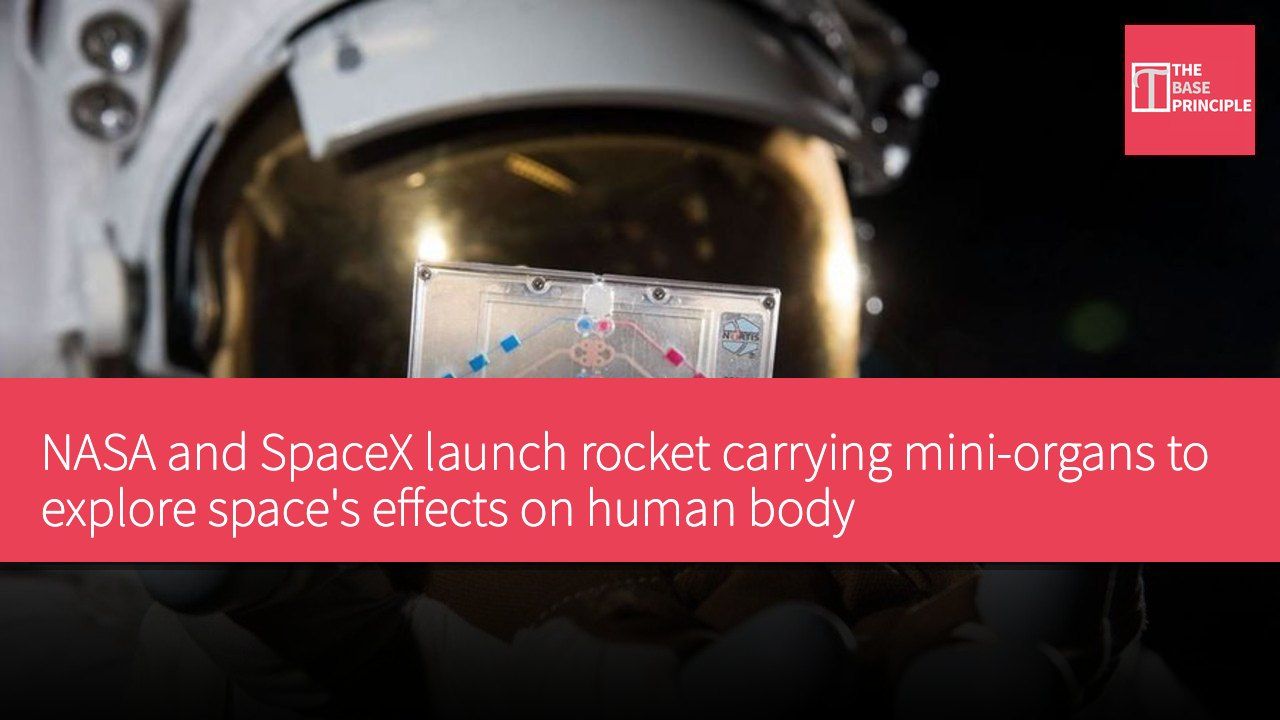
- NASA and SpaceX launch rocket carrying mini-organs to explore space's effects on human body.
- Miniature organs float in microgravity, serving as biological test subjects.
- Research helps predict astronaut health challenges and accelerates aging research.
- This mission also delivers multiple advanced experiments and hardware, benefiting humanity on Earth.
Spaceflight's effects on the human body are both peculiar and rapid. Six months in orbit can age an astronaut by 10 to 20 years on Earth. Now, miniature human tissue models are riding rockets into orbit to help explain the phenomenon, and their journey could change medicine in deep space and on Earth. On Tuesday, NASA and SpaceX launched the 35th Commercial Resupply Services (CRS-35) mission. A Falcon 9 rocket roared off from Cape Canaveral, carrying more than 6,300 pounds of critical cargo and cutting-edge science to the International Space Station (ISS).
Inside the Dragon spacecraft, one of the most intriguing pieces of cargo is miniature, lab-grown “mini-organs.”
Purpose of the mini-organ experiments
In a program jointly run by Mount Sinai Hospital, NASA, and aerospace company Space Tango, researchers sent up to 16 mini human heart models and lab-grown brain organoids into orbit. Floating in microgravity and exposed to space radiation, these miniature tissue models will serve as accelerated biological test subjects. Studying the behavior of miniature organs in microgravity offers multiple benefits. It helps predict the health challenges astronauts face on long-duration missions, while also providing a unique model to accelerate research into human aging and age-related diseases.
To support these living tissues, Space Tango integrated them into a CubeLab — a miniature, automated laboratory that simulates the human body's natural environment. Inside, researchers will deliver electrical signals to monitor how the three-dimensional heart models contract and respond in a near-zero-gravity environment. Microgravity rapidly accelerates biological aging, enabling experts to gather critical health data from these miniature organs in a fraction of the usual time. Ultimately, this accelerated research could help uncover potential treatments for neurodegenerative diseases such as Alzheimer's and Parkinson's, and speed drug development for heart failure and vascular stiffening.
Other key experiments on the resupply mission
Beyond the mini-organs, this resupply mission also delivered multiple advanced experiments and hardware to the International Space Station. The cargo includes an experiment to manufacture artificial retinas in zero gravity to restore human vision, research on fungal crop diseases to improve food safety, and a study monitoring antibiotic-resistant bacteria to combat superbugs. The shipment also includes a rapid diagnostic microplate reader for real-time analysis of astronaut health metrics, as well as the final pair of iROSA solar arrays to upgrade the station's power grid.
NASA noted in a press release: “Research and technology investigations conducted on the space station not only benefit people on Earth, but also lay the foundation for other agencies' deep-space missions.” The Dragon spacecraft is scheduled to autonomously dock with the ISS's Harmony module this Thursday. Astronauts will spend weeks conducting these experiments, after which Dragon will return to Earth with time-sensitive research samples, splashing down off the California coast in mid-November. These microscopic mini-organs could be key to protecting astronaut health, and as space agencies prepare for long-duration missions to the Moon and Mars, insights gained from this orbital research will help people on Earth live longer, healthier lives.
Impact of mini-organ research on space missions
Conducting mini-organ research in the space environment can rapidly reveal astronaut health issues, which is critical for future deep-space missions. As space exploration advances, understanding microgravity's effects on the human body will help formulate effective health management strategies, especially for long-duration missions. Moreover, these studies not only stand to improve astronaut health but could also positively impact medical research on Earth, driving progress in treatments for aging and related diseases.