
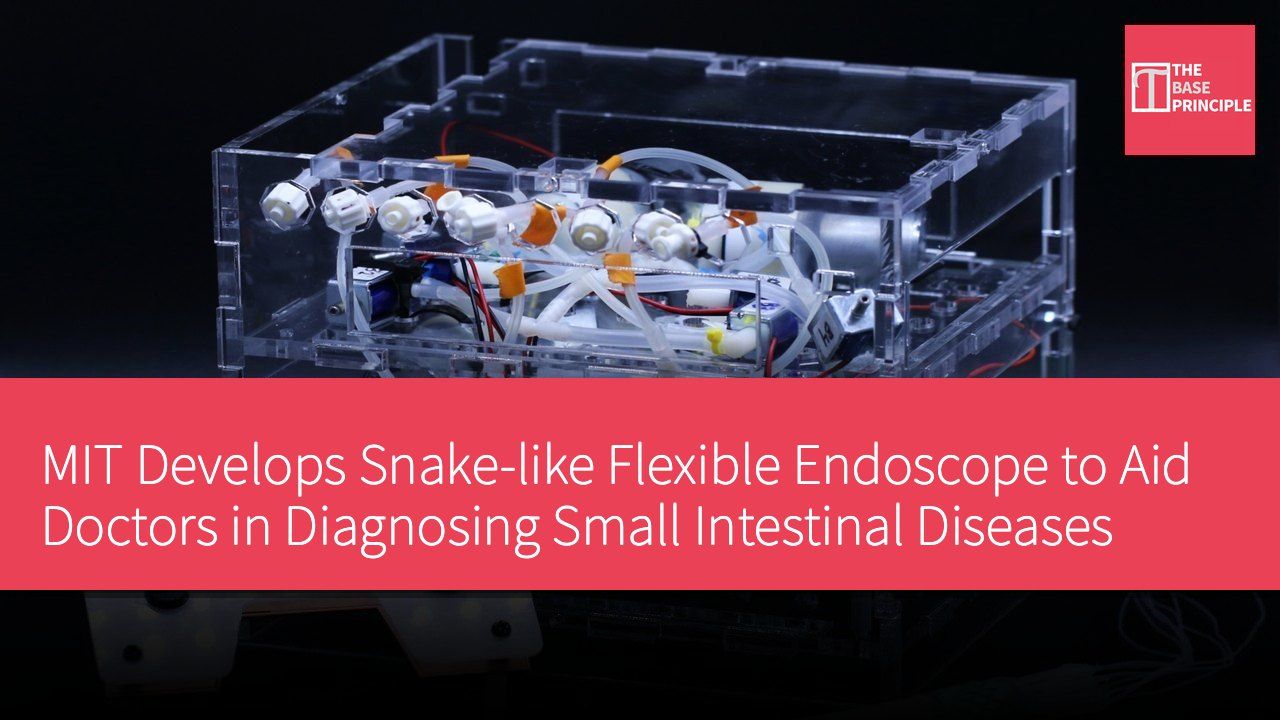
- MIT has developed a flexible robotic endoscope to assist in diagnosing small intestinal diseases.
- The new endoscope mimics snake movement and can move quickly through the intestine.
- The robot is equipped with imaging and drug delivery tools, capable of performing biopsies or removing polyps.
- Researchers are improving the navigation system and exploring other potential applications.
Engineers at MIT have developed a flexible robotic endoscope designed to crawl through the small intestine, assisting doctors in diagnosing and treating related diseases. This tubular robot mimics the movement of a snake and carries imaging, drug delivery, and tissue removal tools.
The small intestine measures over 20 feet (approximately 6 meters) in length and about 1 inch (approximately 2.5 centimeters) in diameter, making it more challenging to examine than the stomach or colon. Doctors typically need to assess issues such as bleeding, lesions, and blockages in this area. Currently, the only method for diagnosing these issues is through a double-balloon endoscopy, where medical personnel alternate inflating and deflating two balloons to push the endoscope forward. This process is slow and cumbersome.
Design and Functionality of the New Endoscope
The MIT team aims to develop an endoscope that is easier to control and can move more quickly through the intestine. Traverso stated that the goal is to assess segments of the intestine measuring 20 to 25 feet (approximately 6 to 7.6 meters) in a more automated manner.
Snake movement is controlled by contracting the muscles on one side of the body to steer in a direction, followed by contracting the other side. To mimic this, researchers designed multifunctional actuators to control the robot's movement. Each actuator has four chambers that can inflate in different combinations, allowing the tube to extend or bend in any direction. Adjusting the air entering the chambers enables the operator to "steer the robot's movement," Traverso said.
The robot's head and tail have additional fixed balloons that alternate inflating and deflating to help the robot move slowly forward. These parts are covered with kirigami-inspired patterned sleeves, a variant of origami that incorporates cuts. When the balloons inflate and stretch them, the coating lies flat, causing three-dimensional kirigami spikes to pop out. Like a snake's scales, these spikes provide the robot with better traction against the slippery intestinal walls.
Traverso's lab has previously used the same approach to develop grippier shoe soles and stents that can be temporarily embedded in the esophagus to release medication. Graduate student Ahmad Mujtaba Jebran, as the lead author, noted that these sleeves allow the robot to gain traction at specific locations without overstretching delicate tissues.
Clinical Applications and Future Prospects
This robot connects to an external controller via a cable, allowing the operator to maneuver it through narrow passages and sharp turns. Designed to enter the body through the mouth or rectum, its tools include a camera for imaging, a drug delivery sprayer, and clamps capable of performing tissue biopsies or removing polyps. Traverso stated that if small polyps are found, the robot can enable doctors to "perform biopsies or removals." In animal studies, the robot traveled approximately 6.5 feet (about 2 meters) within the small intestine. The team also demonstrated the use of the drug sprayer, tissue clamps, and camera.
Researchers are now improving the navigation system and testing the method's effectiveness in other small intestinal applications. Traverso is a professor of mechanical engineering at MIT, a gastroenterologist at Brigham and Women's Hospital, and an associate member of the Broad Institute of MIT and Harvard. The paper's lead authors include Binbin Ying, a former MIT postdoctoral researcher now at the University of Texas Southwestern Medical Center, Jebran, and former MIT research scientist Sahab Babaee.
The research was published in Science Robotics, with Giovanni Traverso from MIT serving as the senior author.
Impact of the Flexible Endoscope on Medical Diagnosis
The development of this flexible robotic endoscope marks a significant advancement in endoscopic technology, particularly for small intestine examinations. The traditional double-balloon endoscopy process is cumbersome and time-consuming, while the new endoscope's automated design can enhance examination efficiency and reduce patient discomfort. This technology not only improves the diagnostic process but also enables immediate biopsies or treatments upon detecting issues, which is crucial for increasing the early detection rates of small intestinal diseases. As research progresses, it may expand to examinations of more internal organs, further enhancing the quality of healthcare.