
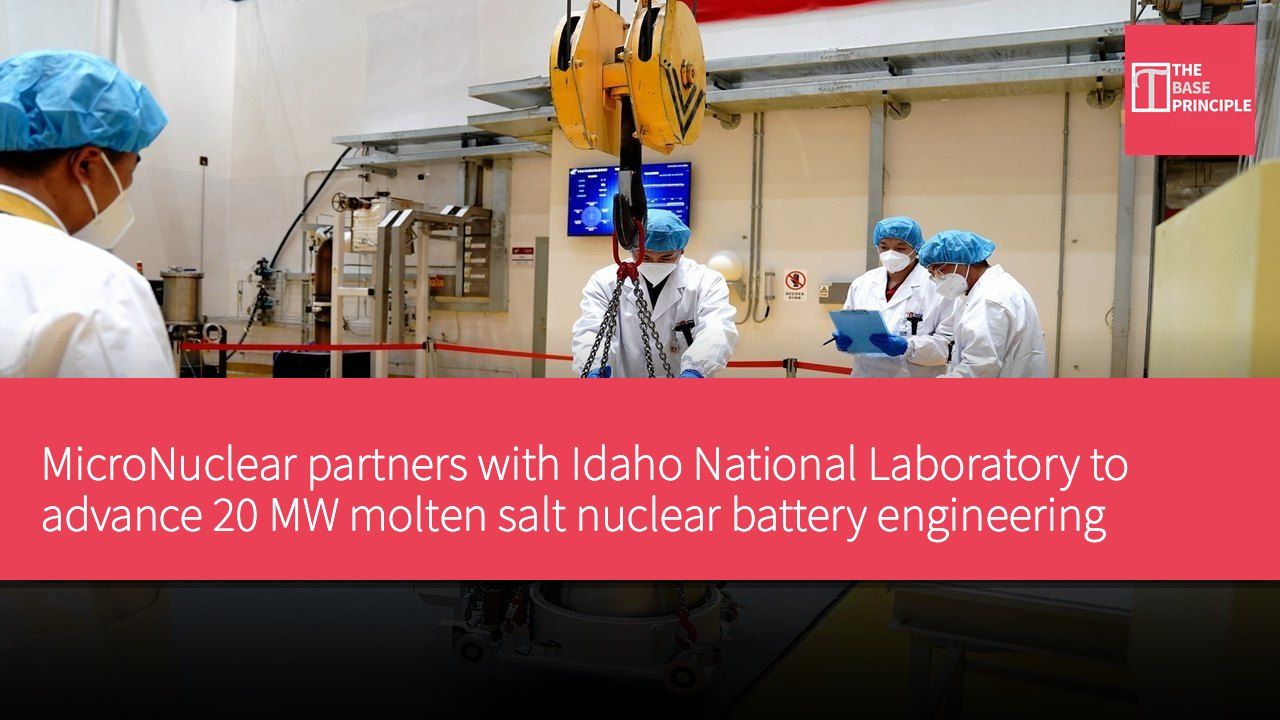
- MicroNuclear is partnering with Idaho National Laboratory to advance its molten salt nuclear battery program.
- The MsNB is designed as a compact molten salt microreactor delivering steady-state power.
- The system could support hydrogen production, though detailed information is lacking.
- Testing will take place at a U.S. Department of Energy national laboratory and requires multiple reviews.
MicroNuclear is advancing detailed engineering design, safety assessments, prototype fabrication and initial fission testing of its 20 MW thermal molten salt nuclear battery, work being carried out under a new partnership with the Idaho National Laboratory Foundation. The agreement brings together MicroNuclear, the INL Foundation, engineering firm EXP, nuclear manufacturer Premier Technology and Porter House. The group will jointly pursue engineering design, fabrication, nuclear quality assurance, operations, training, licensing and commercialization activities.
Design and applications of the molten salt microreactor
The MsNB is designed as a compact molten salt microreactor that uses natural circulation rather than relying on pumps to move its coolant. MicroNuclear says the system is intended to deliver steady-state electricity and process heat for critical infrastructure, military and government facilities, remote grids and industrial users.
The company envisions the unit as a 20 MW thermal system capable of operating at full power over an expected 10-year battery interval before being returned to a centralized facility for fuel and salt recovery and reuse. The collaboration aims to move the concept into a more structured phase of development, including detailed design work, safety documentation, applicable government reviews and regulatory pathways. MicroNuclear describes the MsNB as grid-protected, with physical and electromagnetic pulse protections incorporated into its broader microreactor offering. The company is targeting applications where reliable power or high-temperature process heat is difficult to deliver through traditional energy infrastructure.
Challenges for technology maturation and commercialization
According to the company, the system could also potentially support hydrogen production. However, the announcement provides no detailed information on the hydrogen production process, operating temperatures or expected efficiency. "We are well-positioned to move the molten salt nuclear battery from a promising technology onto a disciplined path of engineering, testing, licensing and ultimately development," said MicroNuclear CEO Paul Marotta. The development team will also work to establish a repeatable model for future deployment. If testing, licensing and other regulatory requirements are met, this could help translate the reactor concept from prototype development into a potential commercial program.
The INL Foundation will support early fundraising efforts and help facilitate access to Idaho National Laboratory. It also plans to present information about the MsNB through investor events. Contributions supporting testing may qualify for tax-deductible treatment, depending on applicable requirements. EXP will provide engineering capabilities, while Premier Technology brings advanced manufacturing and nuclear quality assurance experience. Porter House will contribute expertise related to deployment and commercialization. The companies say the joint effort is aimed at accelerating technology maturation and building out the documentation and manufacturing capabilities needed for future demonstrations.
Testing is expected to take place at Idaho National Laboratory or other U.S. Department of Energy national laboratories. These activities will be conducted under separate agreements rather than being automatically authorized by the partnership announced this week. As a result, the agreement marks a development step rather than confirmation that the MsNB has entered operational deployment. Before commercial use, the concept must pass through engineering, prototype testing, safety assessments, licensing and other regulatory processes.
Future potential of molten salt nuclear battery technology
MicroNuclear's molten salt nuclear battery program represents a new direction in nuclear energy technology, particularly in delivering steady-state electricity and high-temperature process heat. With rising demand for clean energy, advances in this type of technology could have a significant impact on the energy market. Although multiple tests and assessments are still required, the potential for commercialization has attracted a range of partners, reflecting industry expectations for the technology to mature.