
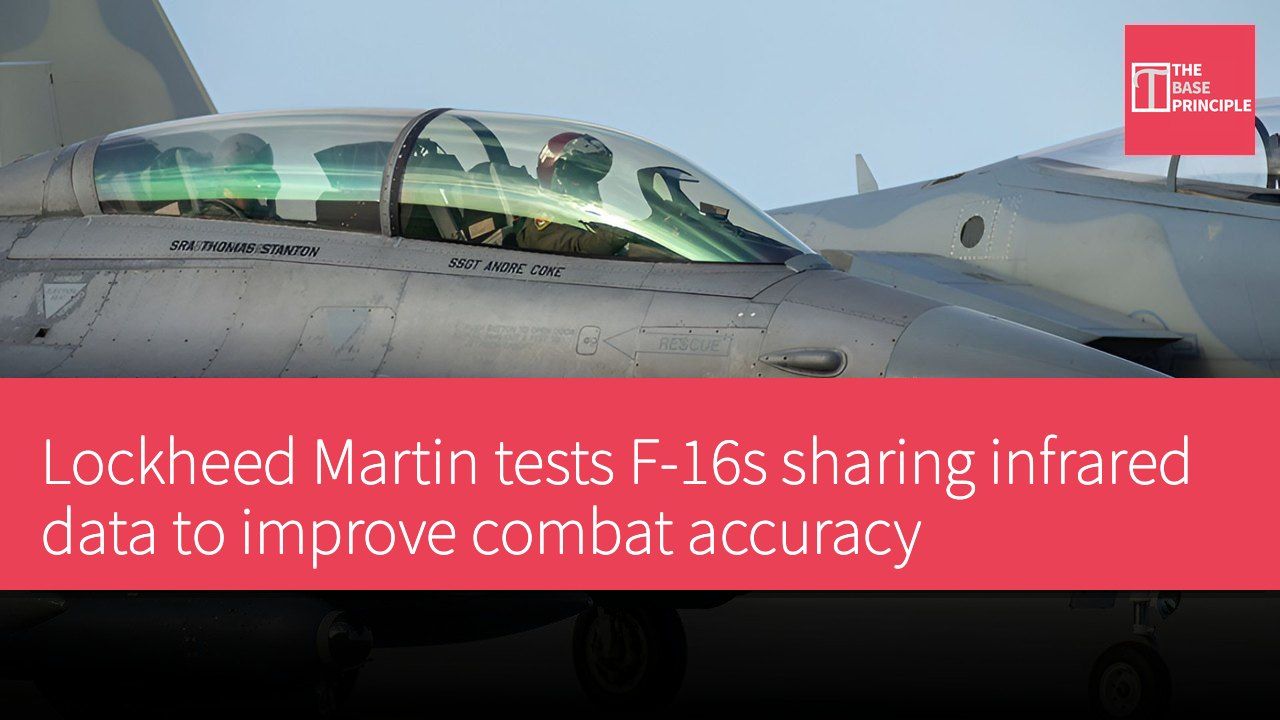
- F-16 fighters share infrared data via the Legion system to boost combat accuracy.
- The system can detect and track targets effectively when adversaries jam radar.
- Shared data addresses the challenge of passive sensors in estimating range.
- Future Legion systems will support manned-unmanned teaming.
Lockheed Martin has tested two F-16 fighters sharing infrared target data through a new pod-to-pod connection. The flight test was conducted in Tucson, Arizona, with support from the Air National Guard and AATC. Both aircraft were equipped with the Legion sensor system and carried a pre-production version of L3Harris's HiveLink. This setup allows the aircraft to exchange sensor information in flight. The shared data improves the accuracy of what each jet detects and tracks.
Legion System Capabilities and Advantages
F-16 fighters share infrared data through the Legion system, which serves as a passive infrared search-and-track sensor capable of detecting and tracking aerial objects without relying on the fighter's radar. This capability is particularly valuable when adversaries jam or deny radar operation. Legion can continue gathering information without transmitting, operating differently from conventional radar. The new connectivity adds another dimension to that capability. Two aircraft can combine their observations instead of handling each sensor picture individually, helping pilots judge target range faster and giving crews a clearer picture of where a target sits in three-dimensional space.
Lockheed Martin described the effect as giving pilots a rapid sense of "depth perception." The goal is to help crews identify important targets earlier.
Sharing measurement data also addresses an inherent technical challenge of passive sensing. Infrared systems can detect targets effectively but may struggle with precise range determination. Networked pods can draw on observations from different aircraft to improve that estimate. The end result is a more useful target picture for pilots without relying on active radar emissions.
Future Development and Applications
The HiveLink system was developed by L3Harris to provide connectivity in constrained operational environments. The system supports both line-of-sight and beyond-line-of-sight communications, combining mesh networking, CDL interoperability and flexible waveform support. This architecture gives Legion another channel for exchanging sensor information between aircraft. The Tucson test represents an early demonstration of the approach on the F-16. Lockheed Martin conducted the work under an Air National Guard contract, with engineers also evaluating system performance and interoperability during the flights.
As the Legion architecture pushes toward other platforms, transport capacity will prove especially important.
Legion is already serving the U.S. Air Force in podded configurations and operating in F-15 and F-16 fleets. Its modular design leaves room for additional hardware and software, with future development expected to add software-defined radios and multi-waveform gateways. The system's roots trace back to Lockheed Martin's earlier IRST work, systems that have accumulated more than 300,000 flight hours on F-14 and F-15 aircraft. Legion applies those lessons to a newer open-architecture design, letting engineers link the sensor with other systems and distribute threat information across a larger force.
Manned-unmanned teaming is also part of the development plan, potentially allowing Legion-equipped fighters to exchange information with unmanned aircraft. The current focus remains practical: the flight tests are intended to show how networked infrared sensing can shorten engagement timelines. Reducing pilot information load can also free up aircraft bandwidth for other mission needs, which is increasingly important when jets operate in highly contested electromagnetic environments. The tests, therefore, are not just about connecting two pods; they are examining how different infrared sensors can work together as a distributed targeting system.
How Shared Data Improves Combat Effectiveness
Through infrared data sharing, the F-16's Legion system significantly improves combat accuracy, especially when adversaries jam radar. The technology not only enhances target detection precision but also rapidly delivers the depth perception pilots need, helping them identify important targets earlier. As Legion continues to evolve, future iterations may team with unmanned aircraft, further boosting operational flexibility and efficiency, particularly in complex electromagnetic environments.