
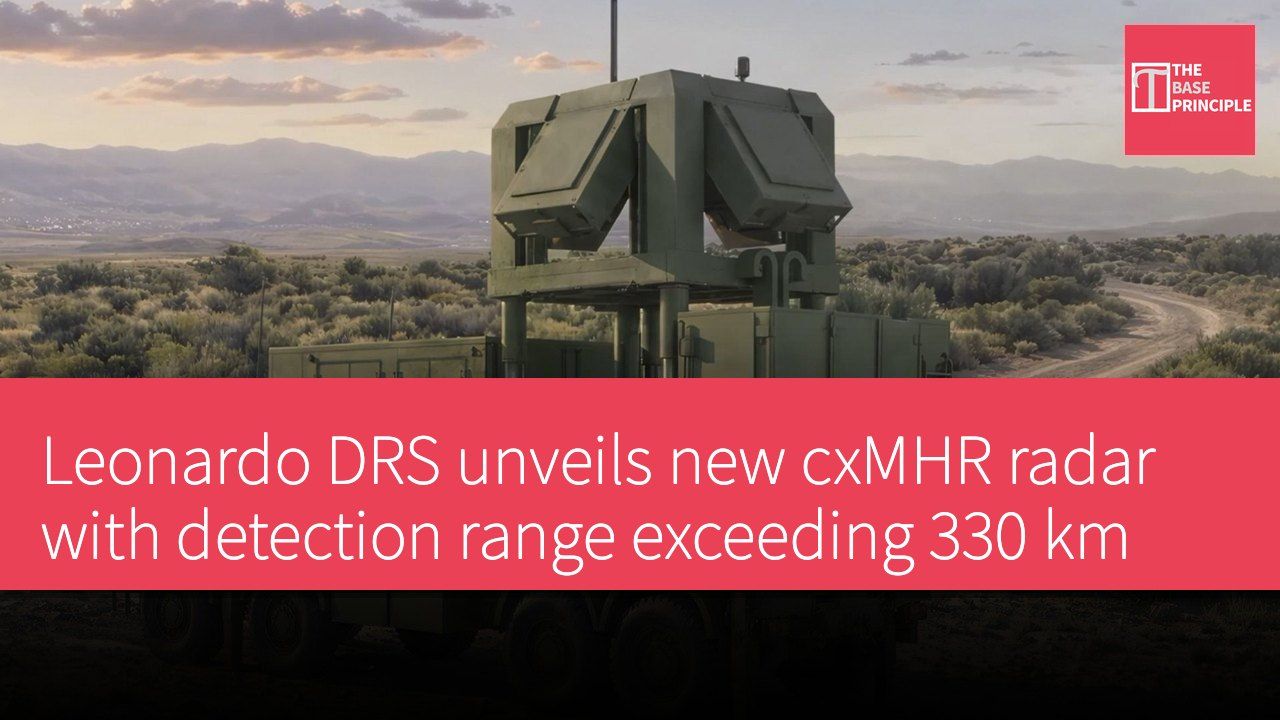
- The cxMHR radar system can detect multiple aerial threats, including drones and cruise missiles.
- The system provides continuous 360-degree coverage and long-range detection capability.
- The cxMHR integrates AI technology to enhance the precision and timeliness of target tracking.
- The radar supports multiple interfaces, enhancing the interoperability of modern defense systems.
Leonardo DRS has launched its new cxMHR radar system and begun initial production. The system is designed to help military forces detect and track drones, cruise missiles, rockets and other aerial threats as part of integrated air and missile defense networks. The company announced the milestone at the Association of the United States Army (AUSA) 2026 Annual Meeting and Exposition, held on Oct. 12 in Washington, D.C. The radar system is designed to provide continuous 360-degree coverage, combining long-range detection, target tracking and a transportable configuration in a single system.
Named the C-Band Extended Multi-Mission Hemispheric Radar, the cxMHR system uses four active electronically scanned array (AESA) panels and integrates identification friend or foe (IFF) equipment, command-and-control components and support hardware. The entire assembly is housed in an International Organization for Standardization (ISO) container, allowing Leonardo DRS to transport it by air, land or sea and deploy it on a single vehicle.
Technical features of the cxMHR system
The cxMHR radar system is designed to simultaneously detect, track and identify multiple aerial targets, including unmanned aircraft systems (UAS), loitering munitions, cruise missiles, rockets and tactical ballistic missiles. Leonardo DRS reports a detection range exceeding 90 kilometers (56 miles) for drones and loitering munitions, and exceeding 330 kilometers (205 miles) for transport aircraft. These figures apply to different target categories; the company did not provide equivalent range data for each listed threat. The radar uses C-band radio frequencies and a digital AESA architecture.
Unlike traditional mechanically rotating radar antennas, AESA systems steer their radar beams electronically, allowing them to scan and revisit areas of interest without relying on physical antenna rotation. This approach supports rapid updates to target tracking, a critical capability when monitoring multiple aerial threats that may operate at different speeds and altitudes.
Emphasizing the importance of interoperability
The cxMHR also integrates AI-driven tracking and classification technology, which the company says helps produce what it calls fire-control-quality tracks. In air defense, this refers to target data precise and timely enough to support the systems responsible for engaging threats. The radar itself is a sensor, not an interceptor. Leonardo DRS says the cxMHR is designed to meet Modular Open Systems Approach (MOSA) standards. This approach uses standardized interfaces and modular components to facilitate integration of equipment from different manufacturers and system upgrades over time.
According to the company, the radar supports multiple interfaces including FAAD, Medusa, SAPIENT, Lattice, ASTERIX, MICAD and RAFT. This interoperability is critical because modern integrated air and missile defense relies on layered sensors, command systems and weapons rather than a single radar or interceptor operating alone. A radar that can share data with existing networks helps commanders build a more complete picture of incoming threats and coordinate responses.
Leonardo DRS has already marketed a family of multi-mission hemispheric radar systems for missions including counter-drone operations, very short-range air defense and hemispheric surveillance. The cxMHR adds a C-band variant tailored for integrated air and missile defense. "The cxMHR provides our customers with a deployable, single-vehicle capability that delivers persistent 360-degree surveillance, long-range detection and fire-control-quality tracking against today's most challenging aerial threats," said Max Cohen, senior vice president and general manager of Leonardo DRS RADA Technologies.
The company displayed the cxMHR radar at AUSA 2026, which concludes on Oct. 14. The start of initial production marks a manufacturing milestone for the cxMHR, but Leonardo DRS did not disclose production quantities, customer orders, delivery timelines or operational deployment schedules in its announcement.
Strategic significance of the cxMHR radar
The launch of the cxMHR radar system marks an advance in military technology for countering emerging aerial threats. As threats such as drones and cruise missiles grow, radar systems with efficient detection and tracking capabilities become increasingly important. The cxMHR's modular design and AI-driven tracking technology can improve the response speed and accuracy of overall defense systems. Moreover, the system's interoperability allows it to integrate seamlessly with existing defense networks, which is critical for the coordination and efficiency of modern military operations.