
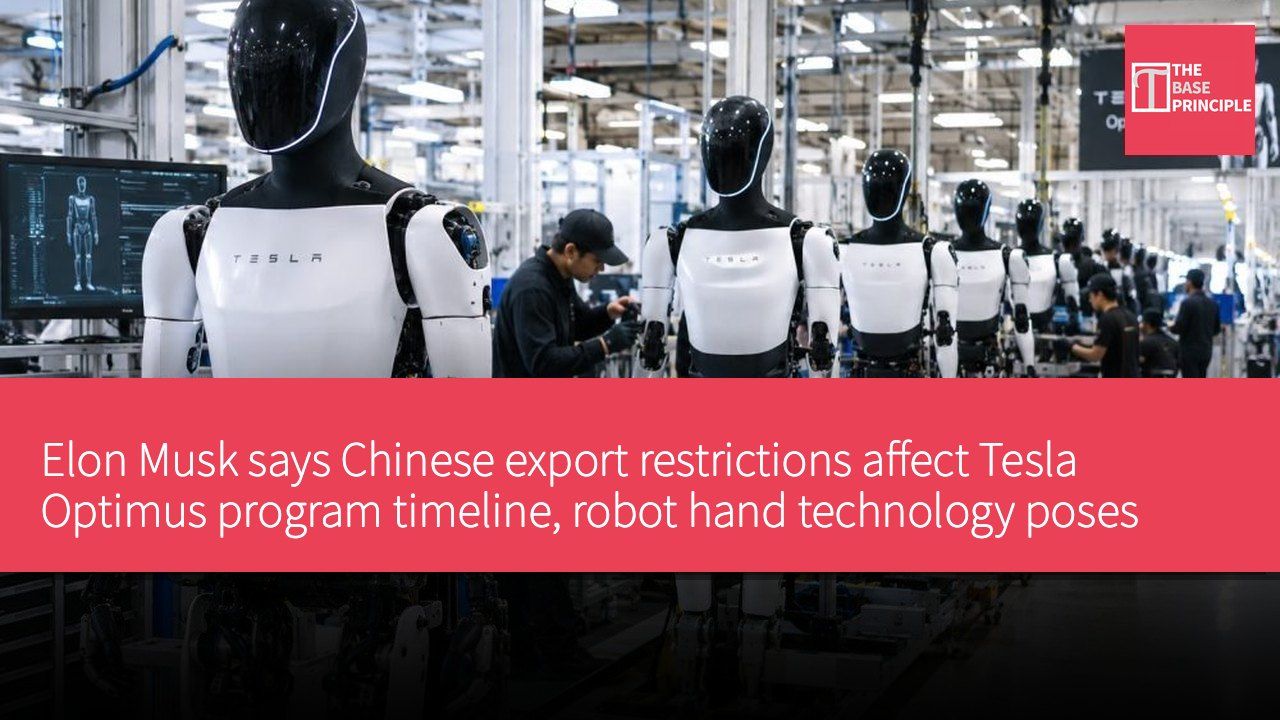
- Chinese export restrictions on electric motor magnets affected Optimus program timeline.
- Robot hand technology is the most challenging part of the Optimus project.
- Musk criticizes competitors' robot demos as unrealistic, emphasizes genuine AI capability.
- Tesla plans to bring supply chain domestic to solve production issues.
Elon Musk said Chinese export restrictions on magnets for electric motors have delayed Tesla's Optimus program by two to three months, and noted the robot's hands remain the most challenging part of the project. He made the remarks during a live on-stage interview with about 2,000 attendees at the X Takeover event at Giga Texas last Saturday. The discussion of hands began about 49 minutes into the livestream. Musk stated bluntly that a general-purpose humanoid robot requires fine motor skills, which is "extremely difficult, shockingly difficult."
He highlighted a problem he believes remains unproven: "One of the hardest things is being precise and applying force at the same time," such as driving a small self-tapping screw into wood. Touch sensors add another layer of difficulty because "actually getting touch sensors that can elastically deform and withstand high cycle life is quite difficult, and won't break after a few thousand cycles."
Robot hand technology challenges
Musk also criticized competitors' robot videos. He said: "Any robot demo that looks complex is pre-recorded, not real." He added that true artificial intelligence means showing a robot confronting something it has never seen before and still coping, just as FSD handles cities it has never driven in. Musk expects Optimus production ramp to be slower than new vehicle production ramps. He said: "The early part of the production ramp will be very slow, because unlike cars, there is no ready-made supply chain for robot parts."
This aligns with his reply on X in July, when he said Optimus production "will be extremely slow at first, because everything is new."
Supply chain and production plans
The disclosure on magnets provided concrete data for an issue Musk first raised in 2025. He said China "blocked the export of magnets for electric motors," which delayed the Optimus program by about two to three months. He then added: "We have robots without arms." Tesla's solution is to bring the supply chain domestic. He said: "Must be able to manufacture all parts domestically." According to a Teslarati report in April 2025, Musk linked the issue to permanent magnets in the arm actuators, because the motors must be as small as possible.
Even so, production is proceeding steadily, with an internal target reportedly exceeding 1,000 units per week by the end of 2026. Teslarati recently reported Tesla is qualifying Chinese suppliers for Optimus parts, and the company's hand design has also become the subject of new patent applications. Musk said he hopes Optimus will be available to the public by the end of 2027, though Tesla has not confirmed that date or released updated production figures.
Impact of export restrictions on production timeline
China's export restrictions have caused substantive delays to Tesla's Optimus program, particularly regarding magnets needed for electric motors. This not only affects the production timeline but also highlights the complexity of robot hand technology. Musk noted that robots need fine motor skills, which is technically extremely challenging. In addition, Tesla's supply chain strategy shifting to domestic manufacturing reflects an emphasis on production stability and efficiency, which is critical for future production targets.