
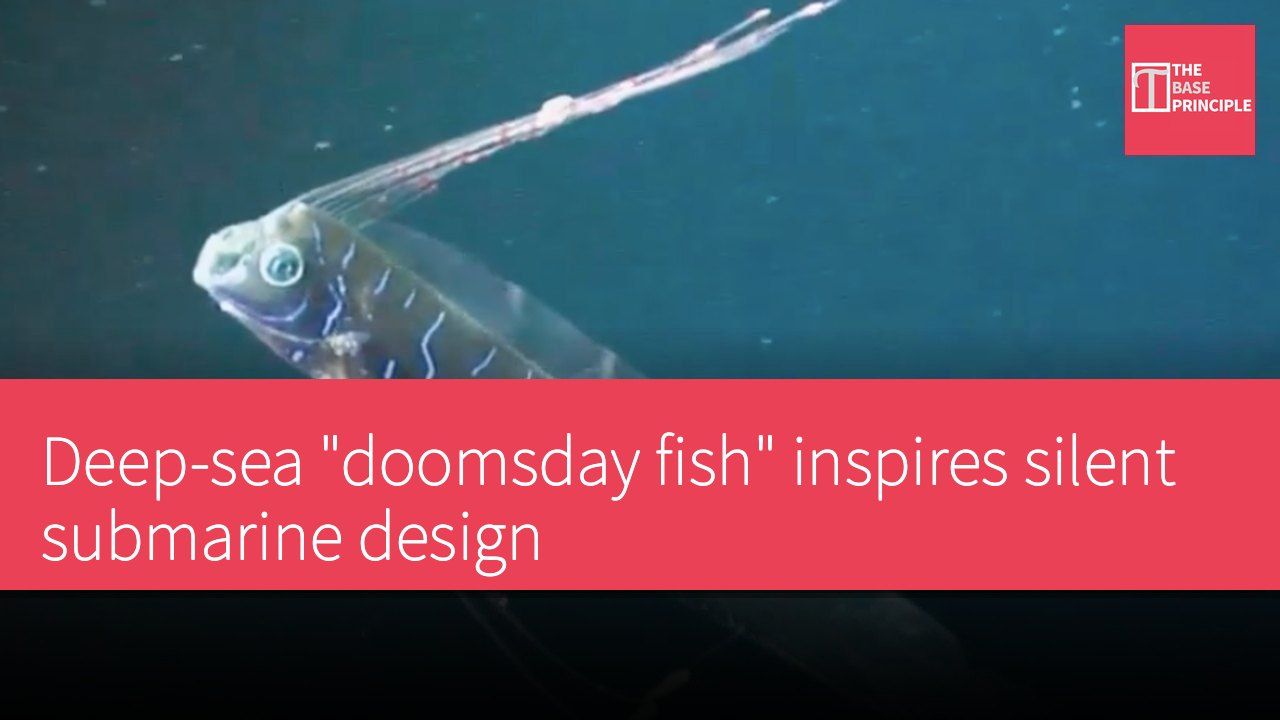
- Professor Shepherd designs silent submarine inspired by oarfish.
- Oarfish's dorsal fin mechanism provides precise control.
- Research team uses CT scans and anatomy to study oarfish structure.
- This research aids development of underwater monitors that don't disturb marine life.
Cornell University engineering professor Rob Shepherd is working to design a large, quiet underwater robot to monitor ocean health without disturbing marine life. He draws inspiration from the rare deep-sea oarfish, due to its unique swimming mechanism. The research aims to understand how the world's longest bony fish swims. Biomimetic propulsion creates smooth laminar flow, enabling underwater mapping and long-term marine life monitoring.
Naval propellers roar underwater, sending fish scattering. To build a stealthy ocean monitoring platform for the Office of Naval Research, Professor Shepherd needed a propulsion system that wouldn't startle marine life. His inspiration came from the mysterious giant oarfish, which can reach 26 feet and is also known as the "doomsday fish." Most elongated marine creatures swim by undulating their entire bodies like eels, but the oarfish remains nearly motionless. It relies entirely on a continuous dorsal fin to move forward and backward in silence.
Oarfish's unique locomotion mechanism
"If you swim in Cayuga Lake in the summer, boats passing by are incredibly loud," Shepherd noted. He added: "Taking a more biomimetic approach allows for more harmonious interaction with fish." To understand how this creature achieves such a feat, Shepherd collaborated with retired Cornell ichthyologist Willy Bemis. Because oarfish bodies typically disintegrate into fragile segments after death, studying intact specimens is difficult. The research team used CT scans, Smithsonian X-rays, and detailed anatomy to dissect the mechanism of the fish's long dorsal fin.
They discovered an astonishing natural engine hidden beneath the creature's skin. Hundreds of bone-like fin rays sit on specialized ball-and-socket joints that run along its back, functioning like miniature "joysticks." Each fin ray is powered by dedicated muscles and cartilage, giving every segment 360 degrees of rotational freedom. Connective membranes can send propulsion waves in opposite directions simultaneously. This unique locomotion mechanism gives the oarfish extremely precise control, allowing it to adjust speed and direction instantly without bending its body posture.
Practical applications of biomimetic technology
"They can continuously change the pattern of their dorsal fin rays, and do so very rapidly," Bemis said. Although ribbon-fin swimming has evolved independently about ten times in bony fish, this is the first study to document the species' rotating, joystick-like fin rays. Engineers are now translating these biological blueprints from paper into practice. By mimicking the oarfish's fluid control, Shepherd's team plans to build large, quiet robotic monitors capable of observing wild marine life without disturbing ocean ecosystems.
Nature provides millions of years of evolutionary testing, offering robotics battle-tested mechanical designs, energy-efficient propulsion, and adaptive behaviors. Researchers have previously designed various biomimetic robots. Geckos can climb smooth vertical surfaces without adhesives or suction cups, thanks to microscopic hairs on their feet called "setae." These microstructures generate molecular-level van der Waals forces that bond the footpad to surrounding surfaces. Stanford robotics researchers applied this concept to build Stickybot, a climbing robot with synthetic footpads modeled on gecko toes.
Specialized materials enable robot grippers to adhere securely to glass, smooth panels, and space equipment without leaving sticky chemical residues.
This new research was published in the journal Ichthyology & Herpetology.
Deep-sea creature inspires silent monitoring technology
The deep-sea oarfish's locomotion mechanism provides important insights for silent submarine design. This fish's dorsal fin movement enables precise control without disturbing marine life, which is crucial for monitoring marine ecosystems. As human concern for the ocean environment grows, developing underwater robots that don't affect marine life will help better understand and protect ocean ecology. This research not only demonstrates nature's ingenuity but also provides new directions for the future development of robotics technology.