
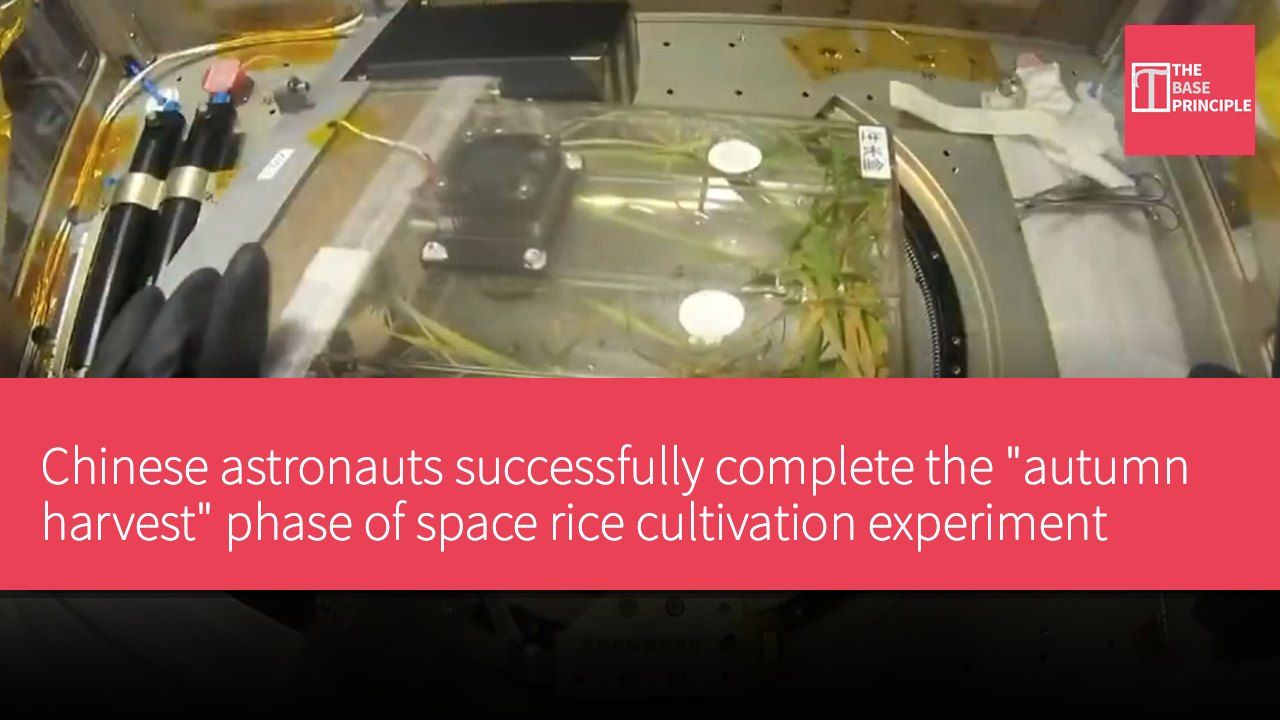
- Chinese astronauts successfully completed the "autumn harvest" experiment for space rice.
- The new plants will develop from seeds produced in a microgravity environment.
- Researchers are exploring the genetic stability and adaptability of rice in space.
- The ultimate goal is to reduce reliance on Earth for supplies.
Chinese astronauts at the Tiangong space station have completed what they refer to as the "autumn harvest" space rice cultivation experiment. According to reports, the astronauts successfully collected, sowed, and stored a batch of new rice. This achievement was reported on October 18, marking a significant milestone in the project's aim to enable continuous rice cultivation in space. The first generation of rice was grown from seeds brought from Earth, which were sown in orbit and have germinated, matured, flowered, and produced fruit in a microgravity environment. The seeds harvested from these plants are being used to cultivate a second generation of rice in orbit.
Importance of Developing New Plants
This process is crucial because the new plants will develop from seeds produced in a microgravity environment, rather than from seeds on Earth.
According to data from the Chinese Academy of Sciences, this experiment began in early 2026, with plans to complete two seed-to-seed cycles. This is not the first time rice has been grown on the space station (in fact, it was successfully done as early as 2022). The seeds produced by those plants were brought back to Earth, and researchers successfully cultivated three additional generations of rice. However, it is noteworthy that astronauts are studying the genetic stability of rice plants in a microgravity environment. Organisms on Earth have evolved under Earth's gravity, so the absence of gravity could theoretically affect the development and reproduction, growth, and maturation of plants.
They are particularly interested not only in genetic changes but also in epigenetics (how genes are expressed). They also want to observe how rice adapts over several generations in space.
Exploring Methods for Growing Crops in Space
Ultimately, they hope to observe the development of food crops like rice after several generations of growth in space. Researchers are also comparing seeds planted on Earth with the descendants of rice grown in space in 2022 to help determine whether early exposure to a microgravity environment has a lasting impact on the development of subsequent generations. Additionally, the team is studying two methods of growing crops in space to understand which method is more valuable under microgravity conditions. The first method is sexual reproduction, as previously mentioned. The second method is called asexual regeneration (ratooning).
This method involves harvesting rice while keeping the root system of the mother plant intact, allowing the plant to grow new shoots and ultimately produce more rice. This method may be more valuable because it does not require replanting crops. If the same plant can produce multiple rice harvests instead of just one season, it would be more efficient in the long run.
Which method (or a combination of both) is best remains to be seen, but the ultimate goal is to find ways to produce food in space to reduce reliance on Earth for supplies. It is important to emphasize that such experiments do not necessarily mean that the technology can be transferred to Mars or the Moon. There are significant differences between the conditions of the space station and those of other celestial bodies. This is a crucial part of solving this challenge, but it may not provide a definitive solution.
Future Potential of Space Rice Experiments
The space rice experiments conducted by Chinese astronauts not only represent advancements in agricultural technology but could also influence future methods of food production for space exploration. By cultivating rice in a microgravity environment, researchers can gain insights into how plants adapt to different growth conditions, particularly the effects of genetic changes and epigenetics. These findings could be crucial for sustainable living on Mars or other celestial bodies in the future, even though the current experimental conditions differ significantly from those on other planets.