
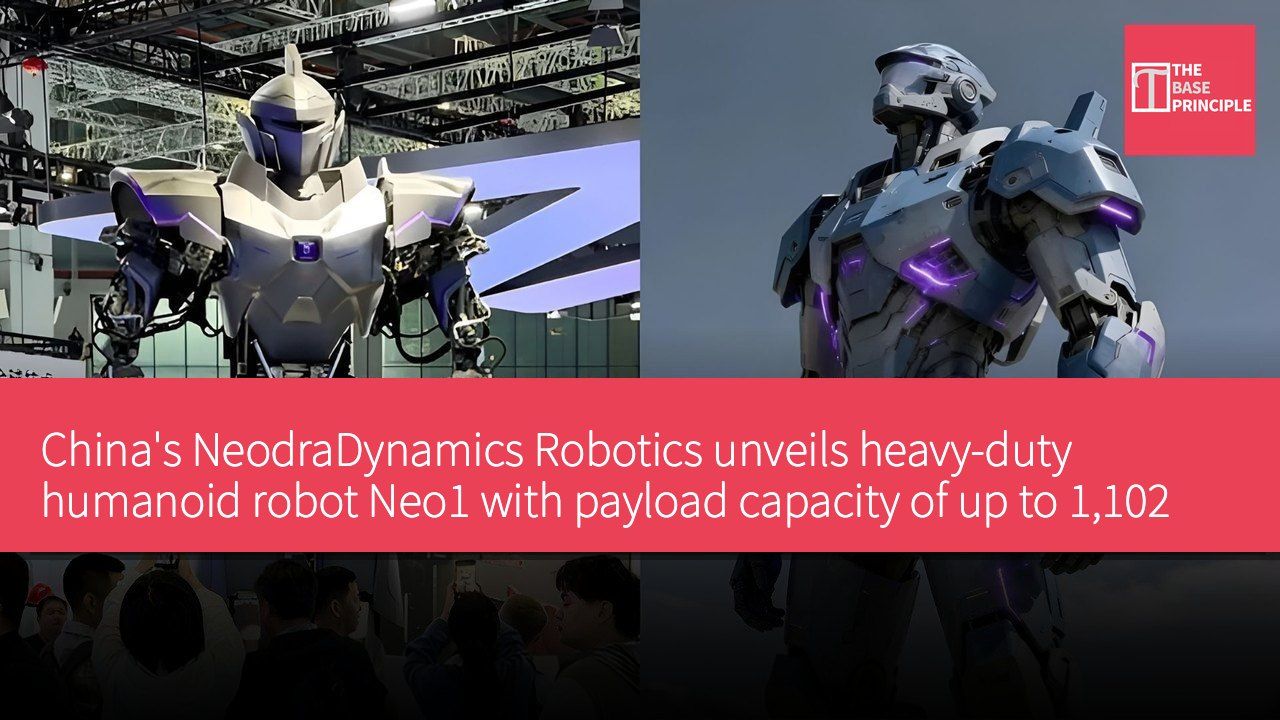
- Neo1 is a heavy-duty humanoid robot designed to handle industrial workloads.
- The robot features 41 degrees of freedom, enabling complex movements.
- Neo1 achieves a repeat positioning accuracy of ±0.0002 inches, suitable for controlled-motion assembly work.
- Hydraulic system design presents engineering challenges but delivers high force output and precise control.
China's NeodraDynamics Robotics has unveiled a heavy-duty humanoid robot designed to handle industrial workloads beyond the reach of conventional electric machines. The robot, named Neo1, stands in the 13-foot class and combines hydraulic actuators with an electric drive system to deliver powerful lifting force and precise motion control. NeodraDynamics showcased the machine alongside JD Industrial at the 2026 China International Industry Fair (CIIF). Its design targets harsh environments where workers face heavy loads, hazardous materials, or extreme operating conditions.
Combining hydraulic power with precision, Neo1 employs 41 degrees of freedom throughout its body, enabling complex movements. Thirty-nine joints rely on miniature digital hydraulic actuators developed by NeodraDynamics, while the electric drive system controls the remaining two rotary joints in the forearms. Each hydraulic actuator weighs approximately 2.2 lbs and is reported to generate sustained thrust measured in tons. According to the company, the system's dual-arm payload capacity reaches 1,102 lbs. Despite the emphasis on raw power, Neo1 also targets precision tasks.
NeodraDynamics claims the robot achieves a repeat positioning accuracy of ±0.0002 inches. This specification makes the platform suitable for assembly work requiring controlled motion under heavy loads.
Potential Application Scenarios
Hydraulic systems deliver high force output in compact packages but also present engineering challenges. Engineers must manage fluid pressure, sealing, heat, and control complexity. Neo1 combines hydraulic force with electric servo control to balance payload capacity and positioning accuracy. NeodraDynamics says the robot's applications extend beyond traditional factory production lines. The machine can be used for heavy component assembly and cargo handling at industrial ports. Its hydraulic architecture also targets operating environments that could challenge conventional robots, such as shock, contamination, or extreme conditions.
Nuclear facilities represent another potential use case. The company says radiation-hardened hydraulic modules can support nuclear fuel handling and equipment maintenance. Such deployments would require validation against the specific facility's radiation levels and safety requirements.
Advantages of Hybrid Drive Technology
Underwater engineering and mining are also among the company's envisioned use cases. Neo1's developers say its architecture can support subsea maintenance under high water pressure. In mines and disaster zones, the robot could assist with demolition, debris clearance, and other hazardous tasks. However, these applications represent intended capabilities rather than confirmed operational deployments. Available specifications do not establish the full robot's performance under sustained industrial use. Field testing will need to demonstrate durability, reliability, and practical utility.
Beyond electric-driven robots, most humanoids use electric motors to power their joints. This approach provides precise control but can struggle with the force demands of heavy industrial work. NeodraDynamics aims to expand the task envelope of humanoid platforms through hybrid drive technology. The company was founded by technical experts with Tsinghua University backgrounds and, according to its announcements, develops digital hydraulic components and complete robot platforms. Founder Yang Tao states the goal is not merely to replicate human anatomy. He argues robots should surpass human physical capabilities to perform operations humans cannot safely undertake.
Neo1 stands as a prominent example, though its specifications still require independent verification. Its ultimate industrial value will depend on the reliability of its heavy-load handling beyond controlled demonstrations.
Item Specification Height Approx. 13 ft Degrees of Freedom 41 Hydraulic Actuator Weight Approx. 2.2 lbs Dual-Arm Payload Capacity 1,102 lbs Repeat Positioning Accuracy ±0.0002 in
Neo1's Diverse Application Potential and Challenges
Neo1's design targets not only traditional factory production lines but also encompasses diverse potential application scenarios including nuclear facilities, underwater engineering, and mining. Operating environments in these fields are typically challenging, requiring robots to possess high durability and reliability. While Neo1's hydraulic system provides powerful payload capacity, ensuring its performance under extreme conditions in real-world applications remains to be further validated. As technology advances, the application of hybrid drive technology may expand the task envelope of humanoid robots, bringing new possibilities for future industrial automation.