
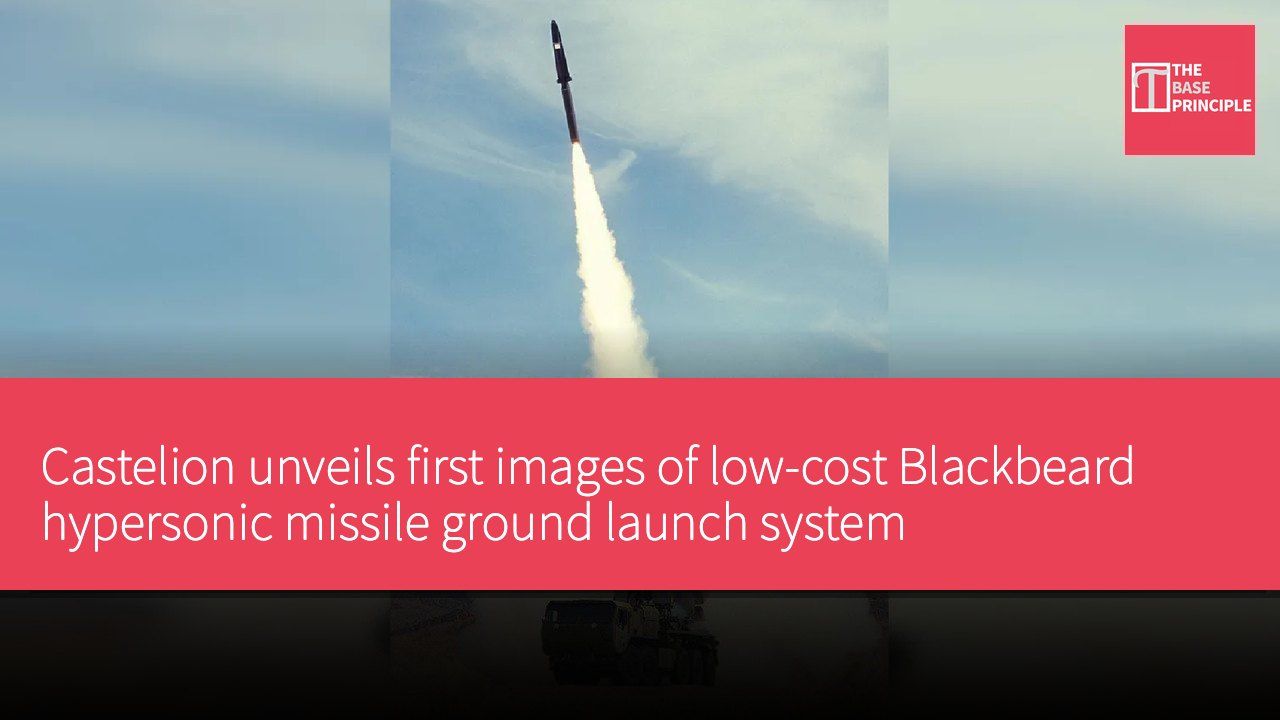
- Castelion displays first launch images of low-cost Blackbeard hypersonic missile.
- Army plans to use modified multiple launch rocket system for first ground-launch demonstration.
- Blackbeard missile cost significantly reduced, aims to provide affordable hypersonic strike capability.
- This effort reflects U.S. push for cost control in precision weapons.
Defense startup Castelion has released the first launch images of its low-cost Blackbeard hypersonic missile, showing a ground-launcher firing and revealing the containerized launch system the U.S. Army is developing. The photo, posted on the X platform, shows a Blackbeard missile launching from a launcher mounted on a high-mobility truck chassis, publicly revealing for the first time how Castelion plans to package and operate its ground-launched variant, dubbed Blackbeard GL.
The Army's plan includes using a modified multiple launch rocket system pod for the first ground-launch demonstration, followed by the Blackbeard GL prototype and a dedicated launch pod. Next will come flight tests using the M142 High Mobility Artillery Rocket System (HIMARS) fire-control system. Fiscal year 2027 budget documents list a live-fire test of a 'production-representative' Blackbeard GL and launch pod as the next major milestone.
Army's launch plan
Early images show a two-stage structure comprising a booster and an upper vehicle, consistent with a hypersonic glide or maneuvering payload. The ground-launched model lacks the cruciform tail fins at the rear of the air-launched version but otherwise appears similar. The launcher appears to use a compact enclosed container, aligning with the Army's interest in leveraging the multiple launch rocket system ecosystem and eventually integrating with HIMARS. The photo does not confirm the loadout, but based on its dimensions, The War Zone reports the container could hold at least two, and possibly up to four, missiles.
The truck appears to be an Oshkosh MKR18 Logistics Vehicle System Replacement, which Castelion says it is converting into a launcher for flight testing.
Lower-cost precision strike capability
The production weapon's propulsion and flight characteristics have not been disclosed. Castelion cites a range of nearly 500 miles, though ground-launched range may be shorter due to the lack of aircraft altitude and speed. The company emphasizes its test hardware may not represent the final system. The Army's interest is driven not only by performance but by cost. The service describes Blackbeard as an affordable, mass-producible hypersonic precision-strike capability to engage time-sensitive moving and hardened targets. The goal is to achieve roughly 80% of the capability of the planned Precision Strike Missile Increment 4 at a fraction of the per-unit cost.
Existing U.S. hypersonic weapons, such as the Army's Dark Eagle, use large dedicated launch equipment. A containerized launcher compatible with existing mobile fires would let the Army field hypersonic weapons without needing separate launchers, crews, transport, and loading infrastructure. Castelion is also working with the Navy to integrate Blackbeard onto the F/A-18E/F Super Hornet. In April, the company won a $105 million Navy contract to support integration and early operational capability, followed by a $23.4 million order for 50 pre-production missiles and their storage and transport containers.
In May, the Pentagon said that once Castelion completes testing and validation, it will award a two-year multi-year contract to produce at least 500 Blackbeard missiles per year, with options to extend to five years. The company is also seeking authorization and appropriations to procure more than 12,000 missiles over five years.
This effort reflects a broader U.S. push for lower-cost precision weapons, particularly when considering a potential large-scale conflict with China in the Pacific, The War Zone reports.
Item Specification Range Near 500 miles Launcher type Containerized launcher
Strategic significance of U.S. military weapons cost control
Castelion's Blackbeard hypersonic missile program not only demonstrates technological innovation but also reflects the U.S. military's prioritization of cost control in weapons system development. As global military competition intensifies, particularly the potential conflict with China, the United States needs to enhance its precision-strike capabilities in a more economical manner. This trend not only improves operational flexibility but also ensures military effectiveness under constrained resources. Blackbeard's design philosophy and compatibility with existing systems will facilitate rapid deployment and expansion of hypersonic weapon applications.