
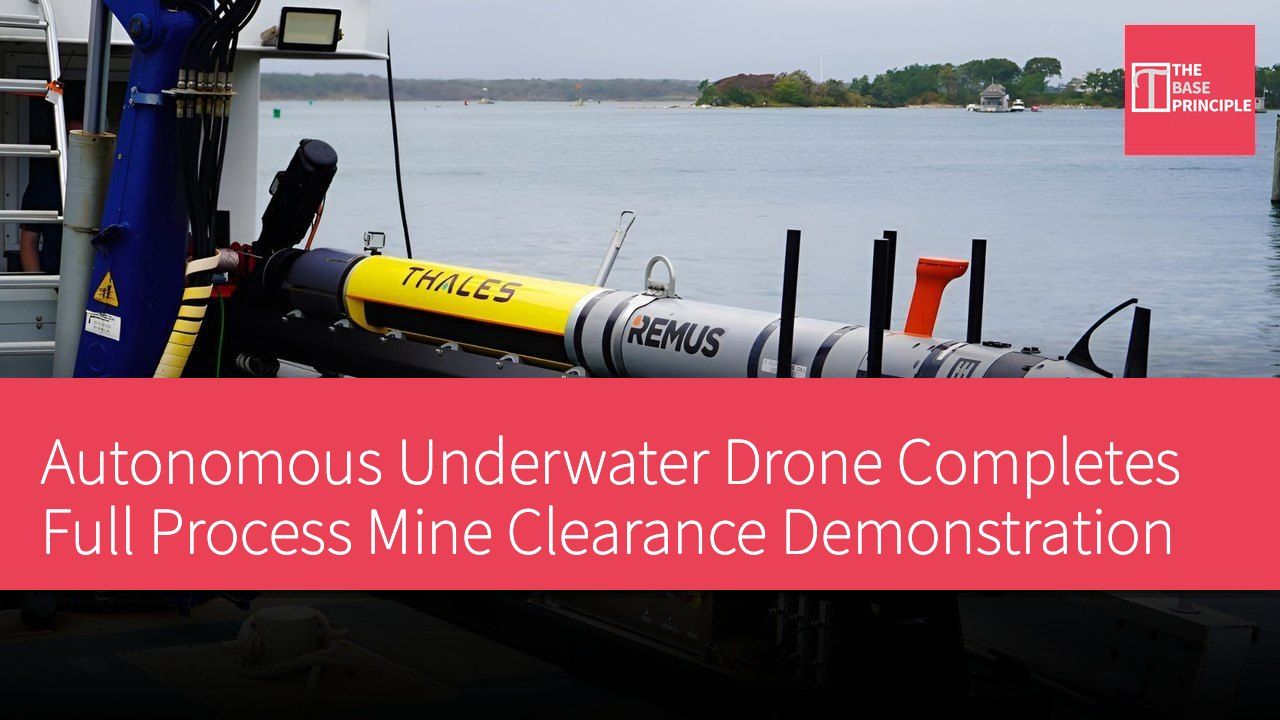
- The autonomous underwater drone completed the mine countermeasure demonstration, enhancing clearance efficiency.
- The system integrates the processes of underwater search, identification, and mine neutralization.
- The ANGLER system can engage and neutralize mines, reducing personnel risk.
- The demonstration showcased how different autonomous platforms can operate in coordination.
An autonomous underwater drone has successfully completed an end-to-end mine countermeasure demonstration, bringing naval forces closer to safer and faster mine clearance operations. The exercise integrated underwater search, sonar-based identification, and mine neutralization into a coordinated mission. HII and Thales conducted the demonstration using an integrated autonomous underwater system network and specialized mine countermeasure equipment. The setup centered around HII's REMUS 620 unmanned underwater vehicle (UUV) and Thales's Expeditionary PathMaster framework.
The system follows a complete workflow of search, fix, and finish, allowing operators to detect potential mine threats and coordinate their identification and subsequent neutralization. This approach also reduces the need to send manned platforms into suspected mine areas.
The Threat of Mines to Maritime Operations
Mines continue to pose a persistent threat to maritime operations, potentially restricting shipping routes, disrupting commercial traffic, and forcing naval vessels to avoid entire areas. Traditional mine clearance missions typically involve multiple platforms and repeated deployments to confirm threats. The integrated system aims to shorten this process, with its REMUS 620 UUV equipped with Thales's SAMDIS 600 multi-beam sonar to scan for potential mines in the underwater environment. HII's command and control software manages the vehicle and connects its operations with Thales's Expeditionary Portable Operation Center (ePOC).
ePOC serves as the central control hub for the mission, containing Thales's mission management system and sonar analysis software, along with HII's Odyssey mission management solution. Operators can monitor mission assets through a unified operational interface.
Once sonar detects a suspicious object, Thales's software analyzes the collected imagery. Its automatic target recognition technology assists operators in classifying and locating objects resembling mines. Personnel maintain oversight of the identification process and subsequent operational decisions. The final phase of the demonstration introduced Thales Advanced Acoustic Concepts's ANGLER underwater effectors. An accompanying remotely operated vehicle (ROV) quickly reacquired previously detected objects and conducted visual inspections to determine whether they posed a mine threat.
The ANGLER system provides means to engage and neutralize identified mines, allowing the mission chain to be completed without requiring sailors to approach suspicious explosives directly.
Automated Launch and Recovery Capabilities
The exercise also tested automated launch and recovery capabilities. HII's Sea Launcher system launched and recovered the REMUS 620, which carried the SAMDIS 600 sonar, adding another layer of automation to distant mine clearance operations. Thales's open Expeditionary PathMaster framework also supports equipment from multiple vendors, and its NATO-compliant framework enables allied navies to integrate various autonomous vehicles, sensors, and mine clearance systems, potentially making mine clearance capabilities across different naval fleets more adaptable.
This demonstration expands on the integrated exercises involving SAMDIS 600 sonar and REMUS 620 planned for 2025. Early work focused on sensor integration and underwater performance, while the latest exercises incorporated mission management, automatic target recognition, and mine neutralization. "We are collectively providing a faster, larger-scale mission path that keeps sailors away from mine threats," said Duane Fotheringham, president of HII's unmanned systems division. Sébastien Guérémy, vice president of Thales's underwater systems, noted that this exercise showcased how different autonomous platforms and specialized equipment can operate within a single framework.
This approach can help the U.S. Navy and its allies reduce personnel exposure in dangerous mine clearance missions and provide a more flexible way to deploy underwater systems in distant operations.
Autonomous Underwater Systems Enhance Mine Clearance Safety
Mines pose a continuing threat to maritime operations, with traditional clearance methods involving multiple platforms and repeated deployments, leading to inefficiencies. The autonomous underwater drone system demonstrated here significantly enhances the safety and efficiency of mine clearance operations by integrating underwater search and identification processes. Particularly, the ANGLER technology of this system can complete missions without requiring sailors to approach hazardous objects, thereby reducing personnel exposure risks. This holds significant implications for the U.S. Navy and its allies in executing missions in dangerous environments and may promote broader applications and collaborations in the future.