
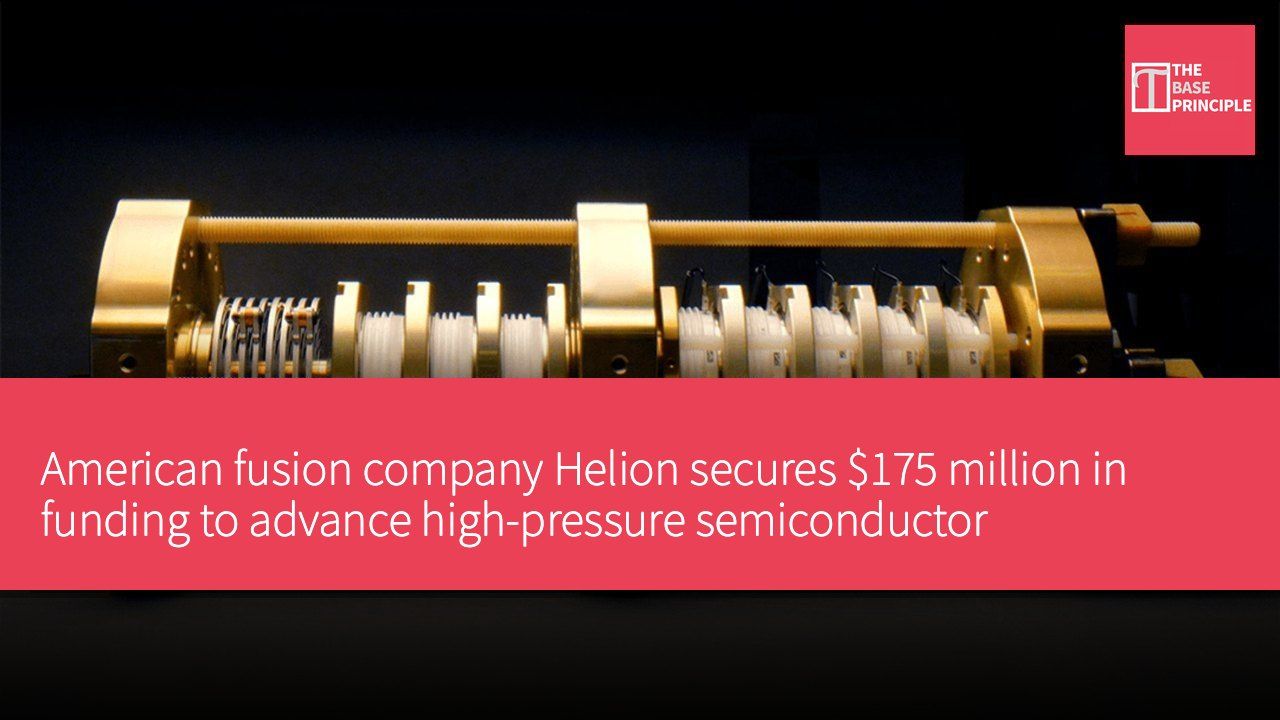
- Helion secures $175 million in funding to advance semiconductor development.
- The new semiconductor design aims to improve efficiency and performance standards.
- Funding will be allocated to research facilities in Washington and Vermont.
- Helion aims to provide power to Microsoft by 2028.
Fusion technology holds the promise of providing nearly limitless clean energy, but constructing mini-stars on Earth requires extreme electronic equipment. In this regard, American fusion developer Helion has made significant progress, reaching a preliminary agreement with the U.S. Department of Commerce to secure up to $175 million in federal funding. This funding is matched by $50 million from private investors under the CHIPS Act. The total $225 million will be used to fund domestic facilities and production lines to help build the specialized modules needed to operate commercial fusion reactors.
Helion's approach relies on high-power pulsed electric systems, which must repeatedly capture, switch, and release massive currents within milliseconds. Currently, the powerful semiconductors required for these tasks are produced only overseas. By manufacturing these semiconductors in the U.S., Helion hopes to eliminate the risks associated with overseas supply chains. The newly designed semiconductors are intended to operate at higher voltages, remain cooler under pressure, and function reliably over many years. Helion CEO David Kirtley stated, "The large-scale construction of fusion power plants requires us to accelerate the development of semiconductor technologies that are critical for achieving fusion."
Helion's Semiconductor Development Plan
He noted that this new funding will help produce chips that meet the precise efficiency and performance standards required by the company.
This investment will be allocated to two main centers. Everett, Washington, will receive over $100 million for the construction of research facilities and power module production lines. The project will focus on advanced packaging technologies that bundle multiple chips into compact units. An additional $80 million will be allocated to Burlington, Vermont. Helion will collaborate with industry partners to design specialized tools and production machinery to support large-scale manufacturing. The remaining funds will be used for automated assembly systems.
To protect public funds, the federal government will hold equity in Helion. Under the preliminary agreement, the Department of Commerce will receive non-voting shares valued at $175 million, linked to the company's recent Series G valuation. U.S. officials have stated that domestic chip facilities could also yield broader benefits. Bill Frawenhoft, executive director of the Department of Commerce, pointed out that breakthroughs in high-power switching technology will benefit the national grid and defense applications.
Potential Impact of Fusion Technology
The acquisition of this funding comes at a critical moment for advancing commercialization. Helion recently completed a $500 million investment round and reported that its plasma temperature reached 150 million degrees Celsius. Earlier this year, Washington state regulators issued key radiation and air permits, granting Helion permission to build its flagship "Orion" power plant's generator structure. Fusion releases immense energy by fusing light atomic nuclei, such as deuterium and helium, without producing long-lived radioactive waste. Although Helion has not published peer-reviewed results to confirm net power generation, it faces an ambitious commercial deadline: to provide 50 megawatts of power to Microsoft data centers by 2028.
Helion summarized in a press release: "Providing the grid with U.S.-made fusion energy could fundamentally change America's strategy, shifting from managing energy scarcity to harnessing the abundance of clean energy, opening new industries, enhancing national security, and improving the quality of life for all Americans."
Commercial Prospects of Fusion Technology
The funding secured by Helion is crucial for advancing the commercialization of fusion technology. As demand for clean energy rises, fusion is seen as a key solution for future energy needs. The development of new semiconductors not only enhances technological efficiency but also helps reduce reliance on overseas supply chains, thereby strengthening domestic production capabilities. This investment not only supports Helion's R&D plans but could also have far-reaching implications for America's energy strategy and national security, promoting the adoption of clean energy.