
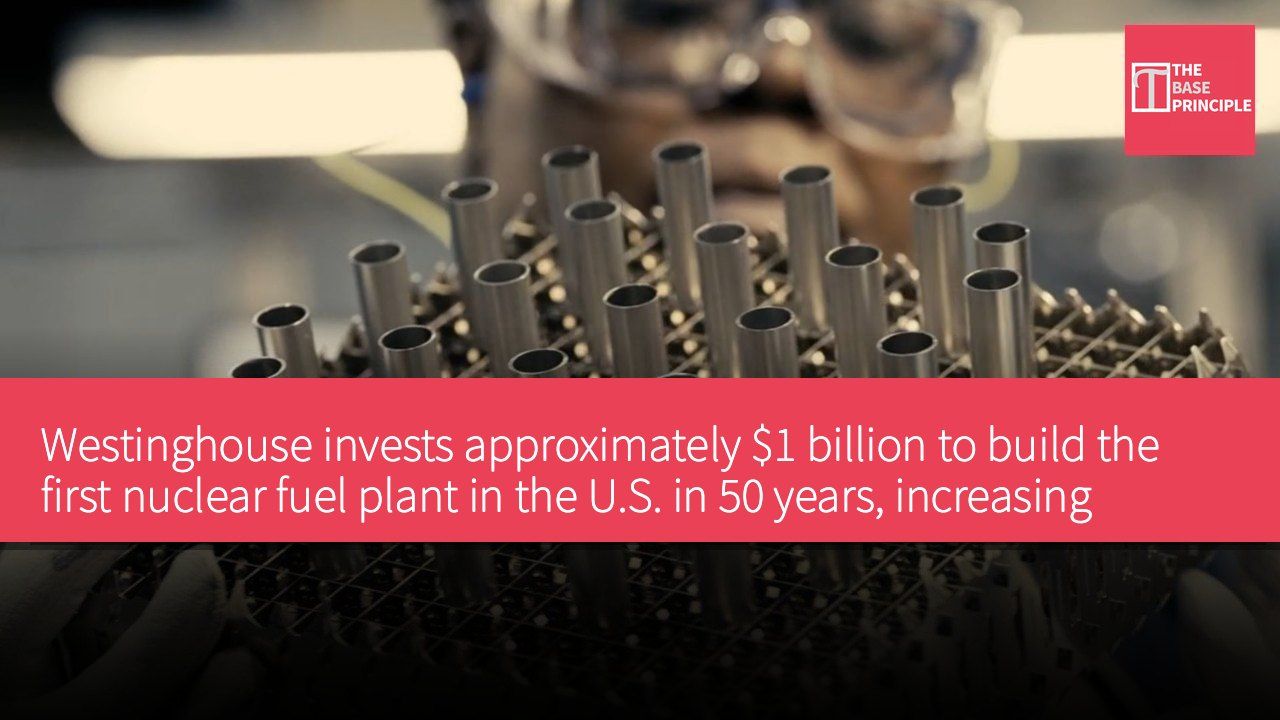
- Westinghouse is building a new nuclear fuel manufacturing facility in South Carolina, investing approximately $1 billion.
- The new plant will produce Low Enriched Uranium Plus (LEU+), enhancing the economic viability of commercial reactors.
- LEU+ fuel will support the UPRISE initiative in the U.S., boosting nuclear power capacity.
- Westinghouse is also advancing testing of the eVinci micro-reactor platform to gather empirical data.
Westinghouse Electric Company is investing approximately $1 billion to construct a new nuclear fuel manufacturing facility in South Carolina. The project will take place at the existing Columbia fuel processing facility in Hopkins, with operations expected to begin in 2030. This marks the first large-scale construction of a nuclear fuel plant in the U.S. in 50 years. The site will produce a specialized fuel grade known as Low Enriched Uranium Plus (LEU+).
Economic Benefits of LEU+ Fuel
The enrichment level of standard commercial fuel is below this threshold, while LEU+ raises the uranium enrichment to between 5% and 8%. This higher concentration alters the economic operation of commercial reactors. With more energy carried in the reactor core, power plants can extend the intervals between mandatory refueling outages. Longer operating times reduce daily costs for operators and provide stable baseload power to the grid.
Dan Sumner, President and CEO of Westinghouse, stated, "The Columbia LEU+ fuel plant represents our largest single manufacturing investment in the operational fleet and marks a transformational milestone for our company and the industry. By expanding our LEU+ fuel manufacturing capacity, we reinforce our commitment to support customers in producing more nuclear power while creating new opportunities in South Carolina." This manufacturing advancement supports the UPRISE initiative in the U.S., under which utilities aim to enhance the total power output of existing reactors through what is known in the industry as plant upgrades.
Technological Shift at the New Plant
The higher energy LEU+ fuel will provide the necessary thermal margin to expand the nation's generating capacity without the need to construct new reactor vessels. The Columbia plant will also supply finished fuel to the current commercial fleet and provide components for Westinghouse's AP1000 reactors worldwide.
While the broader Columbia facility has been producing pellets, rods, and complete components since 1968, the large-scale production of LEU+ marks a technological shift. This fuel is set to be commercially loaded into U.S. reactors for the first time in 2025, and the new plant aims to transition the technology from deployment in a single facility to widespread commercial use.
In addition to this manufacturing project, Westinghouse is advancing testing of its eVinci micro-reactor platform. During high-temperature runs conducted in September, engineers collected new empirical data to assess core behavior under extreme thermal conditions. The eVinci core achieved nuclear criticality at 1,225°F. In reactor physics, criticality is the threshold at which a nuclear fission chain reaction becomes self-sustaining. In this balance test, engineers can accurately observe the interactions between reactor physics and core conditions.
As testing progresses, the team recorded subcritical reactivity measurements at peak core temperatures reaching 1,852°F. Engineers utilized physical measurements collected during the core heating process to test the accuracy of their mathematical reactor models. Discrepancies between physical results and computer models can enable the technical team to adjust their simulation software before final prototype hardware is developed.
Overall, these two developments provide significant direction for the future. The new plant in South Carolina will expand fuel output and enhance the operational durability of large commercial power reactors, while eVinci testing will provide experimental data to improve the software for high-temperature micro-reactor systems.
Impact of the New Nuclear Fuel Plant on the Nuclear Industry
Westinghouse's investment in the construction of a new nuclear fuel plant marks a significant transformation for the U.S. nuclear industry, as it is the first large-scale construction of a nuclear fuel plant in 50 years. The LEU+ fuel produced at the new facility will enhance the operational efficiency of commercial reactors, extend operating times, and reduce operational costs, which is crucial for grid stability. Additionally, this initiative supports the UPRISE program in the U.S., aimed at increasing the total power output of existing reactors, demonstrating that nuclear energy continues to play a critical role in future energy supply.