
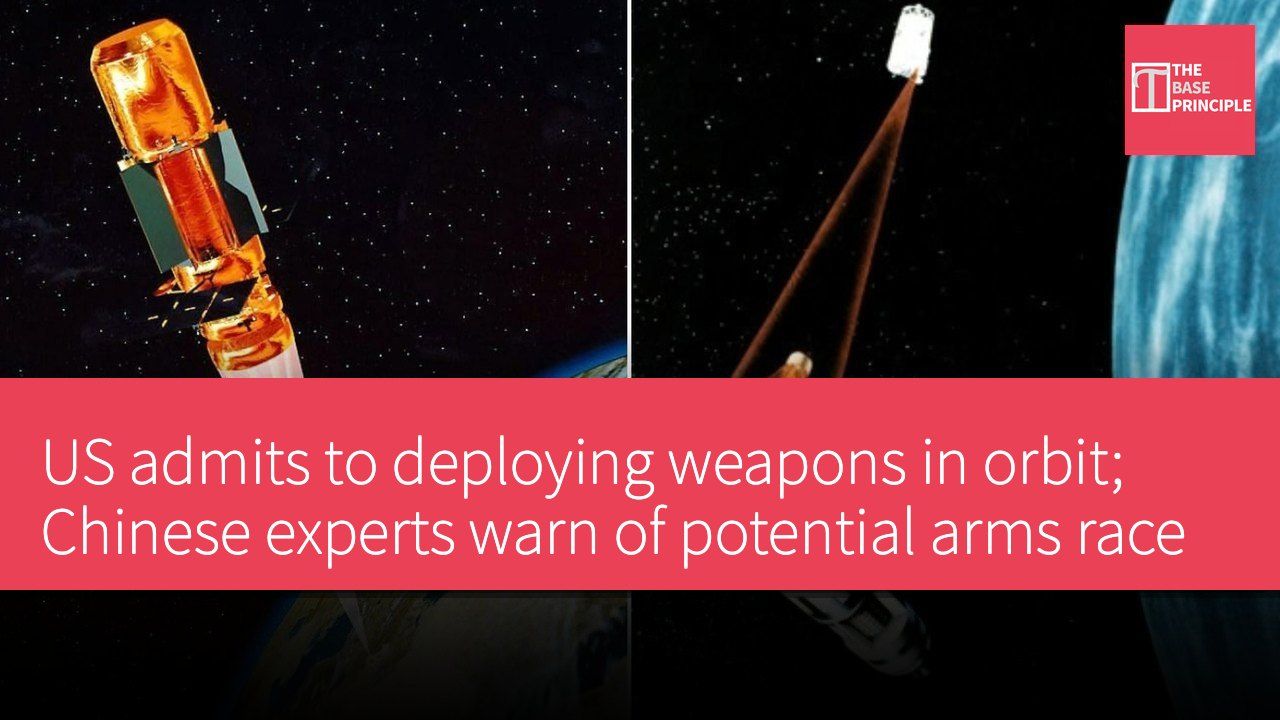
- The United States has admitted to deploying weapons in orbit, marking a major shift in military capability.
- Experts warn the move could undermine long-standing restraint and fuel an arms race.
- The Outer Space Treaty does not prohibit conventional weapons deployment, but the legal situation is complex.
- U.S. actions could trigger responses from China and other countries, further heightening tensions.
The United States' public acknowledgment of deploying weapons in orbit marks a significant shift in how Washington describes its military capabilities in space. Air Force Secretary Troy Meink said on September 14 that the U.S. possesses "on-orbit space control weapons" capable of defending against hostile action. However, he did not specify the systems or their locations of deployment. The statement quickly drew attention at the Beijing Xiangshan Forum, where defense experts warned that openly admitting to having weapons in orbit could undermine long-standing restraint and prompt other countries to expand their counterspace arsenals.
It remains unclear what specific weapons the United States currently has in orbit, and the Pentagon has not publicly confirmed which systems Meink was referring to.
For years, the United States has operated satellites and ground-based capabilities to protect its space assets while developing technologies that can jam or interfere with adversary satellites. According to experts cited by the South China Morning Post, the newly acknowledged weapons may involve non-kinetic systems such as jammers or spoofers. These technologies can disrupt communications, navigation or other satellite functions without physically destroying spacecraft. The U.S. government has not confirmed this interpretation. The distinction is critical because physically destroying satellites generates massive amounts of orbital debris. China's 2007 anti-satellite missile test, for example, produced thousands of trackable fragments and stands as the most prominent example of the long-term consequences of kinetic anti-satellite testing.
Thus, the U.S.' latest statement establishes the existence of weapons in orbit without detailing their specific capabilities.
Chinese Experts React to U.S. Moves
The timing of the announcement is particularly significant because the 13th Beijing Xiangshan Forum is being held from September 15 to 17, with one session focused on outer space security governance. At the forum, Guo Xiaobing, director of the Arms Control Research Center at the China Institute of Contemporary International Relations, described the deployment of conventional weapons in space as a long-standing taboo. According to the South China Morning Post, Guo said: "This taboo was broken yesterday. We stand at a watershed in history." Other experts went further, warning that the disclosure could trigger a new cycle of military competition. Almudena Azcarate Ortega, a senior project analyst at the Secure World Foundation, said at the forum that the deployment itself does not violate the 1967 Outer Space Treaty,
a treaty that prohibits the placement of nuclear weapons and other weapons of mass destruction in orbit or stationed in outer space, and does not impose a blanket ban on conventional weapons deployed in space. Nonetheless, she warned that the announcement could be escalatory because other countries may respond by deploying similar systems.
The legal situation under the Outer Space Treaty is more complex than the phrase "weapons in space" suggests. Article IV of the treaty prohibits states from placing nuclear weapons or other weapons of mass destruction in orbit or stationing them in outer space, and bars the establishment of military installations and certain military activities on the moon and other celestial bodies. It does not explicitly forbid conventional weapons from reaching Earth orbit. As such, the U.S. acknowledgment does not, on its own, constitute a treaty violation. However, other international law continues to apply to space activities. Ortega said at the Xiangshan Forum that the legal picture could change if such weapons are used in ways that cross the threshold of prohibited use of force.
The debate reveals a fundamental difference in how Washington and Beijing frame space security concerns. The U.S. has repeatedly warned about China's growing counterspace capabilities, including anti-satellite missiles, electronic warfare, directed-energy systems and other technologies that could threaten U.S. and allied satellites. Meanwhile, Beijing has criticized U.S. pursuit of outer space dominance. This creates a classic security dilemma: capabilities one country develops for defense may be read by another as preparation for attack. China has already responded publicly to the latest disclosure, with its foreign ministry urging Washington to stop what it called military expansion in outer space and warning against turning space into a battlefield.
Chinese state media warned, according to Reuters, that the move could intensify a global arms race.
Modern military power relies heavily on satellites for communications, navigation, intelligence, missile warning and battlefield coordination. That makes space systems increasingly important targets in any major conflict. The United States is expanding both its defensive and offensive space capabilities. Meink's September announcement came alongside discussions of new satellite constellations and space-interceptor plans aimed at placing missile interceptors in low Earth orbit. General Douglas Schiess, the senior officer of the Space Force, subsequently clarified the U.S. position, saying guardians now operate on-orbit weapons capable of defending against space attacks.
Potential Consequences of a Space Arms Race
The concerns raised at the Xiangshan Forum therefore go beyond a single newly disclosed weapon. They concern what happens when the U.S., China, Russia and other space powers increasingly believe their satellites could come under attack and begin deploying more systems on orbit to protect, jam or potentially cripple rival spacecraft. The U.S. disclosure does not prove a new space arms race has begun, but it shows that competition has moved past discussions of hypothetical future weapons. Some of the systems meant to contest control of space already exist on orbit.
Strategic Significance of U.S. On-Orbit Weapons
The United States' public acknowledgment of deploying weapons in orbit highlights its commitment to the militarization of space and could trigger arms races among other countries. As modern military forces grow more dependent on space systems, this move affects not only U.S.-China relations but could also alter the global military balance. Experts note that such developments could turn space into a new flashpoint for conflict and increase international tensions. Military activities in space by various nations will face greater legal and ethical challenges, especially regarding interpretation and application under the framework of the Outer Space Treaty.