
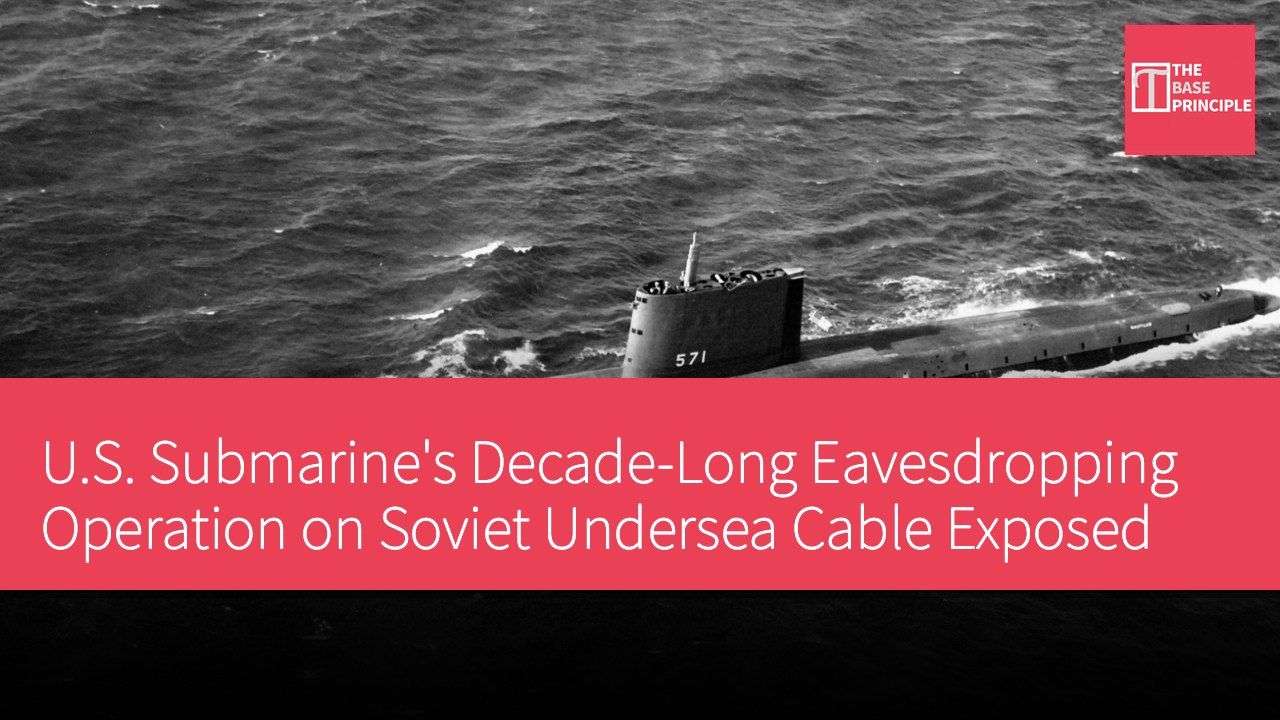
- The U.S. eavesdropping operation on the Soviet undersea cable lasted for nearly a decade.
- The operation, codenamed "Ivy Bells," involved collaboration among multiple agencies.
- The eavesdropping device was able to capture signals without cutting the cable.
- Pelton was sentenced to life in prison for leaking classified information.
According to published reports, the U.S. conducted a secret eavesdropping operation on a Soviet undersea cable for nearly a decade, until a former National Security Agency analyst leaked the information to Moscow. The operation, codenamed "Ivy Bells," was a collaborative project involving the Navy, the CIA, and the NSA. Divers worked from the submarine USS Halibut to install recording devices on the cable located in the Sea of Okhotsk, which the Soviets regarded as their territorial waters. This cable connected the Soviet submarine base in Petropavlovsk with the Pacific Fleet headquarters in Vladivostok, and most communications were unencrypted.
Many details of the operation remain classified, with specific dates and equipment information varying among different sources. Most publicly available information comes from the 1998 book "Blind Man's Bluff" by journalists Sherry Sontag and Christopher Drew, as well as interviews with Navy veterans.
How the Eavesdropping Device Worked
The operation of the eavesdropping device was based on the concept devised by Captain James Bradley, the Navy's Director of Undersea Warfare at the time. Bradley speculated that the Soviets would place telephone lines in deep water near the coast, believing this would go undetected. Sontag noted that the Soviets "had no idea we could get this close." To narrow the search area, the Halibut submarine looked for signs warning vessels not to anchor. Divers breathed a helium mixture, which leaves the body faster than nitrogen. This method, known as saturation diving, allowed them to work for hours at depths of about 400 feet.
Saturation diving allows divers to work for extended periods in high-pressure environments and undergo decompression at the end of the operation.
Matt Blitz, a writer for Popular Mechanics, reported in 2017 that the eavesdropping device operated through induction, a technology that could capture surrounding signals without cutting the cable. Cutting the cable could disrupt communications and alert the Soviets. The submarine returned several times a year to replace the equipment.
Background of the Operation's Exposure
The exposure of this operation stemmed from Ronald Pelton, a former NSA analyst who left the agency in 1979 due to financial issues and bankruptcy. According to court records, in 1980, he provided classified information to the Soviet embassy in Washington. Reports indicate he was paid US$5,000 (approximately HK$39,000) for details about "Ivy Bells," followed by an additional US$30,000 (approximately HK$234,000). A satellite image from 1981 showed the Soviets conducting salvage operations at the site, according to Popular Mechanics.
In 1985, KGB defector Vitaly Yurchenko confirmed that Pelton was the source of the intelligence. He was convicted in 1986 and sentenced to three concurrent life terms. According to the Federation of American Scientists, Pelton served 28 years and 343 days, making it one of the longest sentences for espionage.
Many details of the operation remain classified, leading related reports to rely primarily on a book and interviews with veterans. Different sources disagree on whether the eavesdropping began in 1971 or 1972 and the frequency of tape collection. Sontag has stated that this intelligence helped end the Cold War, though this claim cannot be verified. W. Craig Reed, author of "Red November," noted that submarines still possess the capability to conduct such missions, but whether such operations are currently underway remains classified.
Impact of the U.S. Eavesdropping Operation on the Cold War
The U.S. "Ivy Bells" operation illustrates the intensity of intelligence warfare during the Cold War. Through the submarine's secret eavesdropping, the U.S. was able to obtain Soviet communications, which were crucial for strategic decision-making. Although specific details of the operation remain classified, its influence cannot be underestimated. Pelton's leak highlighted the risks of intelligence work and raised concerns about national security. This incident not only affected the operations of the intelligence community but may also have had far-reaching implications for the end of the Cold War.