
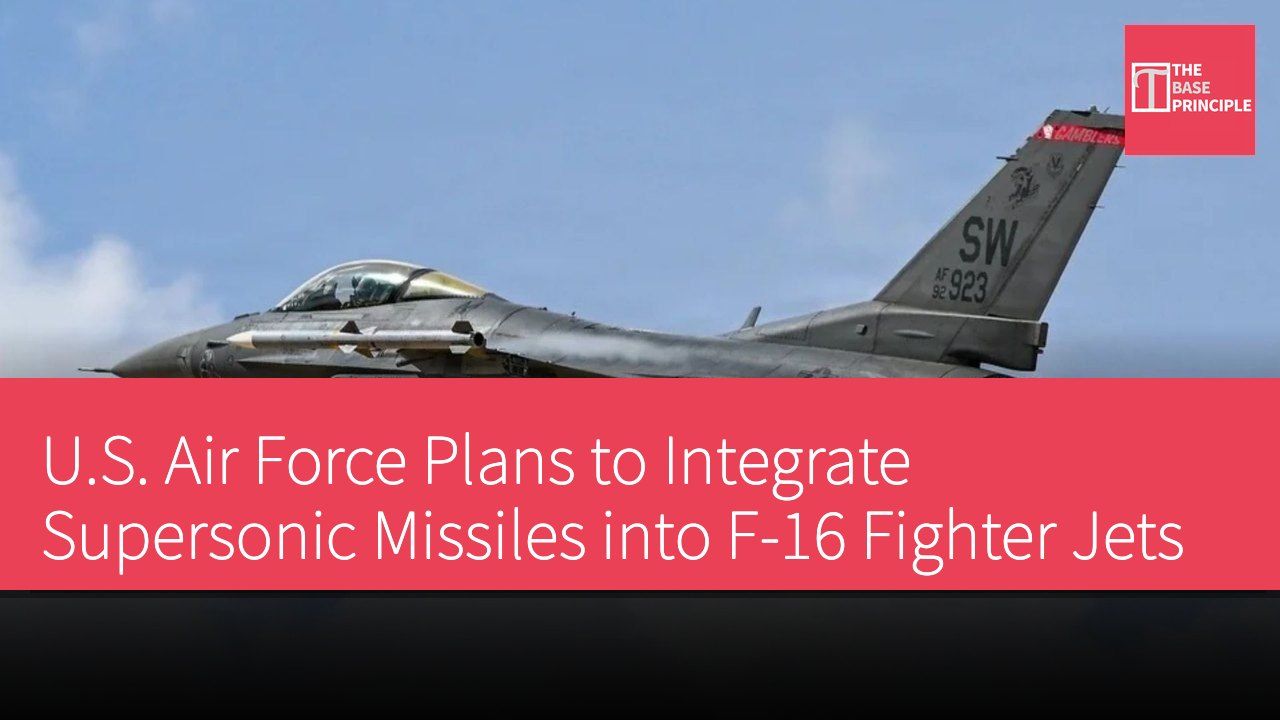
- The U.S. Air Force plans to integrate the supersonic Blackbeard missile into the F-16 fighter jet.
- The Blackbeard missile is designed to exceed five times the speed of sound and has long-range strike capabilities.
- Integrating the new missile involves addressing several technical challenges, including weapon control and flight safety.
- Castelion is also advancing integration plans for Blackbeard with the Army and Navy.
The U.S. Air Force is taking steps to integrate a supersonic strike weapon into one of its most widely used fighter jets. Defense technology company Castelion has received a contract modification from the Air Force Research Laboratory (AFRL) to begin integrating its Blackbeard missile into the F-16 Fighting Falcon. Castelion announced this development on October 26, stating that the award expands its existing collaboration with AFRL. The company has not disclosed the specific amount of the contract modification, the integration timeline, or the anticipated date for the missile's first launch from the F-16.
The Blackbeard missile is designed to exceed five times the speed of sound and is intended to maneuver in the atmosphere during long-range strikes. Castelion has placed particular emphasis on the weapon's cost-effectiveness and production capability, aiming to deploy supersonic strike capabilities in greater numbers than traditional expensive systems. Due to the speed and maneuverability of supersonic weapons, their flight paths may be difficult to predict, complicating air defense. However, actual performance depends on the weapon's flight characteristics, guidance systems, and the defenses it faces.
Features of the Blackbeard Missile
Castelion has not disclosed the complete technical specifications of the Blackbeard, including detailed range and guidance information. The company has received a contract modification to begin integration activities for Blackbeard with the F-16 and expressed gratitude for the Air Force's trust. Castelion is pursuing both air-launched and ground-launched configurations, with the ground-launched version designed to be compatible with the U.S. Army's M142 High Mobility Artillery Rocket System (HIMARS).
Integrating with the F-16 could extend the missile's range. The F-16 Fighting Falcon is a multirole fighter operated by the U.S. Air Force and air forces around the world. Adding Blackbeard to its potential weapon load could provide another launch platform beyond the U.S. Navy's F/A-18E/F Super Hornet. Air-launched weapons can be carried to the launch point and released later, potentially extending their range without requiring the aircraft to fly directly over the target.
Integration Challenges and Technical Considerations
However, integrating the new missile involves more than just installing it on the aircraft. Engineers must address weapon control, aircraft software, communications, flight safety, and testing to verify the interoperability of the systems. Castelion has not disclosed whether the F-16 integration work will include live-fire testing or whether the work will ultimately support aircraft operated by U.S. allies.
Developments in Other Military Branches
Related plans for the Navy and Army are already underway. The efforts with the F-16 add progress to Blackbeard's development in other U.S. military branches. In October 2025, Castelion announced it had signed integration contracts with the Army and Navy to adapt the missile for military platforms and demonstrate its capabilities in live-fire testing. Subsequently, the Navy advanced further, awarding Castelion a contract worth approximately $105 million in April 2026 for the integration of Blackbeard with the F/A-18E/F Super Hornet, including flight testing activities.
The service later ordered weapons for early operational capability and announced a production delivery order worth up to $200 million in September. The Army is pursuing a ground-launched version compatible with HIMARS. These efforts provide Castelion with multiple pathways to introduce Blackbeard into the U.S. military, although each platform requires its own integration and certification work.
Additionally, AFRL increased the existing Castelion contract by approximately $16.4 million in September, raising its total value from about $20.9 million to $37.2 million, continuing the development of a low-cost, mass-produced long-range strike weapon. Castelion has not confirmed whether the new F-16 activities fall under the same agreement.
Item Specifications Missile Name Blackbeard Speed Exceeds Mach 5 Launch Platforms F-16 Fighting Falcon, F/A-18E/F Super Hornet Compatible Systems M142 HIMARS
Strategic Significance of Supersonic Weapon Integration
Integrating the Blackbeard missile into the F-16 fighter jet demonstrates the U.S. Air Force's emphasis on supersonic weapons. The speed and maneuverability of such weapons can significantly enhance strike capabilities and pose challenges to enemy defense systems. The integration process must overcome several technical challenges to ensure system interoperability. Furthermore, the progress of integration plans with the Army and Navy reflects the U.S. military's strategic considerations for multi-platform utilization, further enhancing its military flexibility and combat effectiveness.