
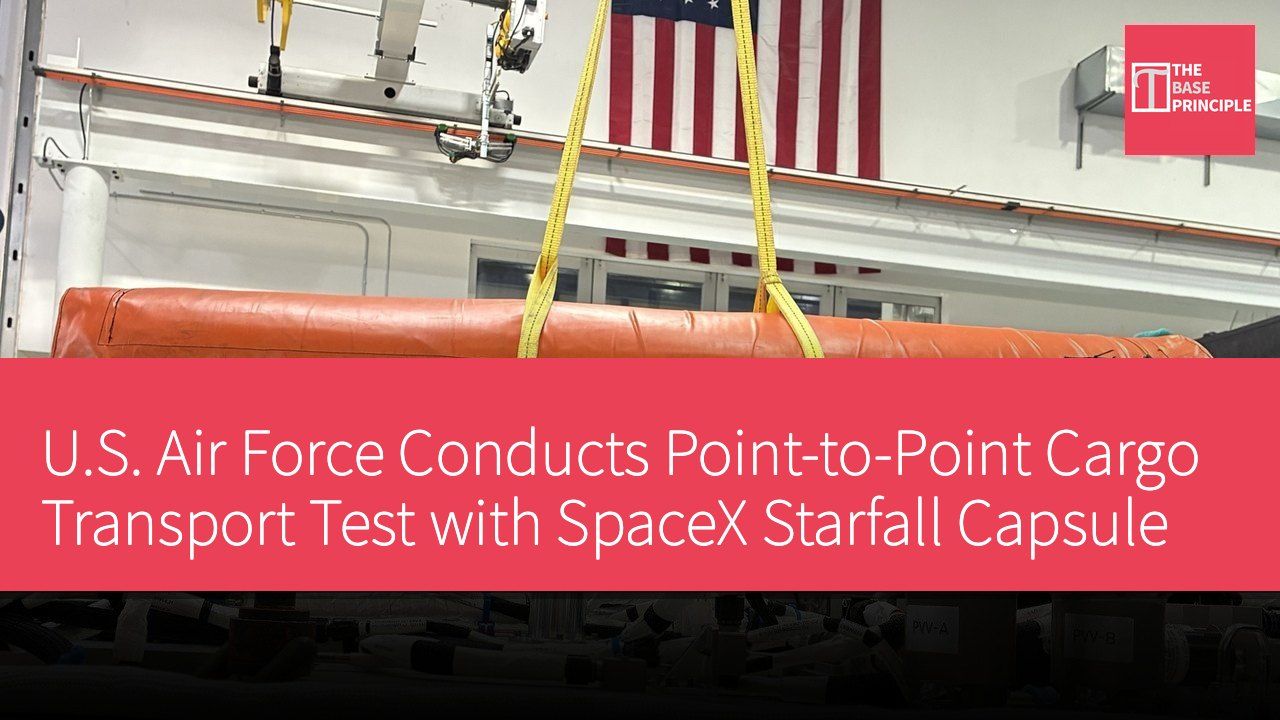
- The U.S. Air Force conducted a cargo delivery test with SpaceX Starfall to evaluate the transport capabilities of commercial rockets.
- The test utilized an instrumented capsule to measure various indicators of the cargo environment.
- AFRL's commander emphasized that this test serves as a demonstration of collaboration with the industry aimed at reducing risks.
- The program could provide joint forces with the capability for rapid access to challenging locations in the future.
The U.S. Air Force Research Laboratory (AFRL) conducted a point-to-point cargo delivery test using SpaceX's Starfall capsule, aimed at assessing whether commercial rockets can transport supplies globally. The test took place on October 20 during a commercial co-launch at Cape Canaveral Space Force Station. The rocket cargo initiative is a research and development project of AFRL, designed to determine if large commercial liquid propulsion rockets can quickly deliver supplies worldwide within tactical timelines. A key distinction from other programs is its total delivery capacity of several tons per launch.
Test Objectives and Equipment
This test employed an instrumented SpaceX Starfall capsule to measure temperature, shock, and vibration in the cargo environment. The capsule housed AFRL's flexible cargo bay design, capable of accommodating various payloads for global point-to-point delivery. Each cargo bay was equipped with representative mission equipment and environmental sensors to assess payload integrity during launch and reentry. Researchers paid particular attention to electronic devices and survival gear, including trackers with satellite communication (SATCOM) capabilities, batteries, reverse osmosis seawater desalination equipment, and emergency medical supplies.
Trackers with SATCOM capabilities report their location via satellite connections, while reverse osmosis desalination equipment can convert seawater into drinking water.
Importance of the Test and Future Applications
Engineers also examined whether the UNI-PAC III life raft could fit into the Starfall capsule for use in future tests. AFRL commander and Air Force Chief Technology Officer Brigadier General Douglas P. Victor stated that this launch is another demonstration of AFRL's collaboration with the industry. He noted that the goal is to "reduce risks, collect reliable data, and provide winning technologies for operational forces." Adam Remaly, director of AFRL's Technology Transition Office, described the test as a significant achievement in demonstrating the rocket cargo program's potential for rapid global transport.
He stated that collaboration across disciplines and the responsiveness of the defense industrial base are key to maximizing capabilities.
The development of this concept could provide joint forces with the ability to quickly access contested environments and challenging locations lacking runways or roads, with each launch capable of delivering several tons. Potential applications include contested logistics, long-range operations, rescue missions, disaster relief, and responses to chemical, biological, radiological, and nuclear hazards. AFRL indicated that incremental testing will help ultimately deliver critical cargo to any location globally with speed and scale. It is collaborating with multiple commercial suppliers and small businesses to seek near-term solutions, including SpaceX, Blue Origin, Rocket Lab, Sierra Space, Anduril, Inversion Space, and Outpost Space.
AFRL is also exploring how to leverage commercial investments in launch vehicles and commercial capsule reentry technologies for space manufacturing. It continuously evaluates the rocket and reentry capsule capabilities of commercial suppliers and explores the use of rapid delivery of critical Department of Defense supplies.
Impact of Commercial Rockets on Military Logistics
This test by the U.S. Air Force demonstrates the potential of commercial rockets in military logistics, particularly in the rapid transport of supplies. As the global security landscape evolves, rapid response capabilities become increasingly important. Through collaboration with commercial suppliers, AFRL can not only reduce transportation costs but also enhance responsiveness in crisis situations. This innovative approach could change the way future military operations are conducted, especially in scenarios requiring swift resource deployment.