
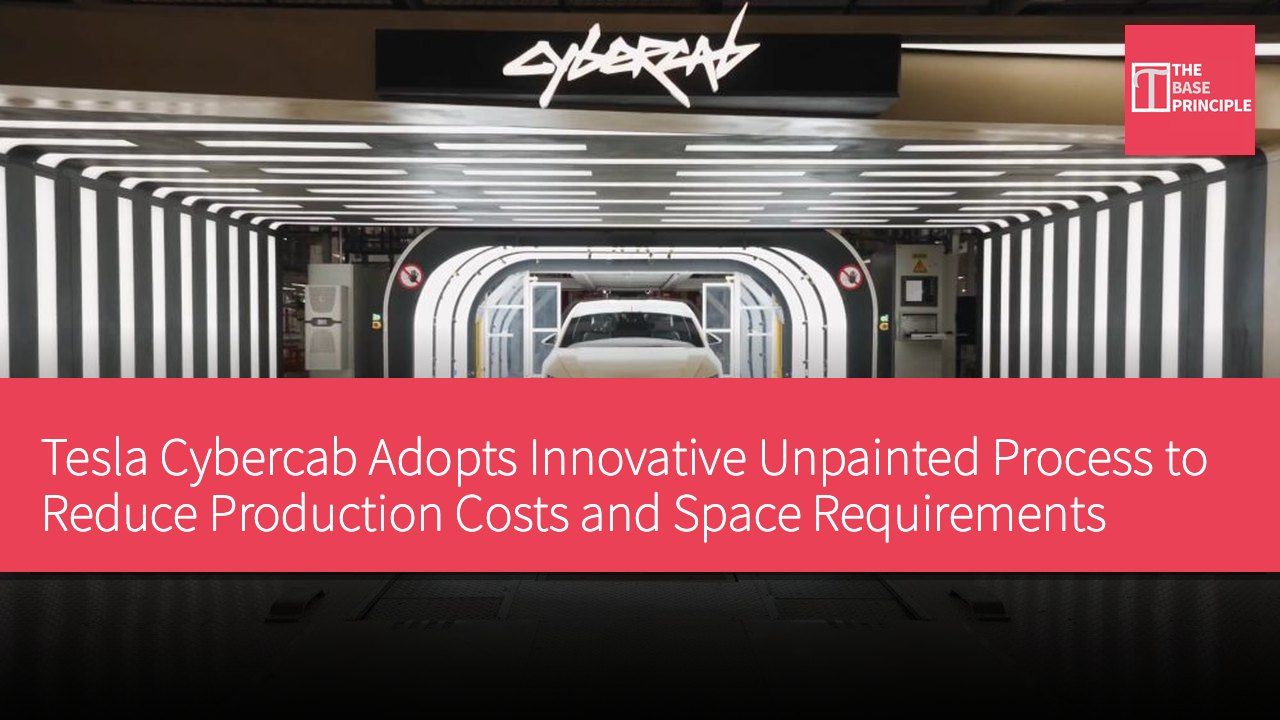
- The Cybercab uses an unpainted process, reducing production costs and space requirements.
- Traditional paint lines require significant investment and labor, which Tesla questions the necessity of.
- Using non-oxidizing aluminum alloys reduces the need for body painting.
- The new process decreases volatile organic compound emissions and enhances production efficiency.
Tesla's Cybercab completely bypasses the traditional painting process, marking an innovation in the production of fully automated vehicles. This decision has proven to be wise, as it lowers factory costs, improves ground space utilization, and simplifies the process, with Tesla relying on specialized alloys and in-mold coloring technology. Munro Live had the opportunity to tour the factory with Tesla Vice President Lars Moravy, who explained in detail the production process of the Cybercab at the Texas Giga factory, eliminating one of the most expensive and space-consuming elements in automotive manufacturing.
Traditional paint lines can require hundreds of millions of dollars in investment and a million man-hours to build. Moravy framed this choice around Tesla's core principle: "Question the need: Why do we need paint?"
Questioning the Necessity of Traditional Painting Processes
Moravy noted, "One of the most expensive components in a factory is the paint line... Building a paint line costs hundreds of millions of dollars and requires a million man-hours... Tesla's first rule is to question the need. Why do we need paint?... The alloys we use in castings... do not oxidize and lose strength over time." In contrast, the bodies of the Model Y and Cybertruck are fully painted and colored. In the Cybercab, only the side components undergo anti-corrosion immersion treatment, completely eliminating the need for paint, which helps reduce the factory footprint of each vehicle by about 50%.
This structural answer lies in the choice of materials. The aluminum alloys used in the front and rear castings of the Cybercab do not oxidize and lose strength over time like many conventional automotive aluminum alloys. Only the side modules around the hot-pressed steel receive an anti-corrosion electronic coating or immersion coating, while the front and rear modules completely omit the coating. In contrast, the bodies of the Model Y and Model 3 are fully painted and colored. The external color comes from the plastic workshop, which Tesla engineers describe as "our painting workshop" for the Cybercab. The body panels are produced through reactive injection molding, known as RIM.
The color is mixed into the polyurethane resin immediately before injection, so the panels are presented in Class-A surface color. Robots trim excess material to control sink marks and flow lines. This process avoids defects associated with traditional painting, such as orange peel and paint bleed.
Environmental Benefits of the New Process
While scratches can still be repaired with compatible coatings, the performance of these coatings is "essentially the same as paint." Because the color is part of the overall structure rather than a surface layer, shallow scratches do not expose contrasting primer. The golden secret of Tesla's Cybercab goes beyond just color. Tesla is also exploring related methods, including in-mold lamination and the application of printed films on stamped panels. The manufacturing benefits of removing the painting factory are significant, as this is combined with a "no-box" modular process that builds and tests front, rear, side, and center modules in parallel within a short time frame, reducing the factory footprint of each vehicle by about 50%.
The final assembly uses only about 25 automated workstations, far fewer than a typical Model Y production line, with an overall automation level of about 78%.
This approach also eliminates volatile organic compound emissions associated with traditional painting and reduces the coloring cycle from hours to minutes. The painting strategy for the Cybercab is clearly not just about aesthetics; it systematically removes capital-intensive, energy-consuming, and space-consuming steps when materials science and process design render them unnecessary. This is a concrete example of how Tesla applies first principles questioning to one of the most entrenched factory requirements in the automotive industry.
How Tesla is Changing Automotive Production Processes
Tesla's Cybercab demonstrates its breakthrough thinking in automotive production through the innovative unpainted process. This method not only reduces production costs and space requirements but also effectively minimizes the resources and labor needed in traditional painting processes. With advancements in materials science, Tesla is able to utilize non-oxidizing aluminum alloys, thereby omitting the painting process, which positively impacts production efficiency and environmental sustainability. This move not only reflects Tesla's questioning of traditional manufacturing processes but also provides a new direction for future automotive production.