
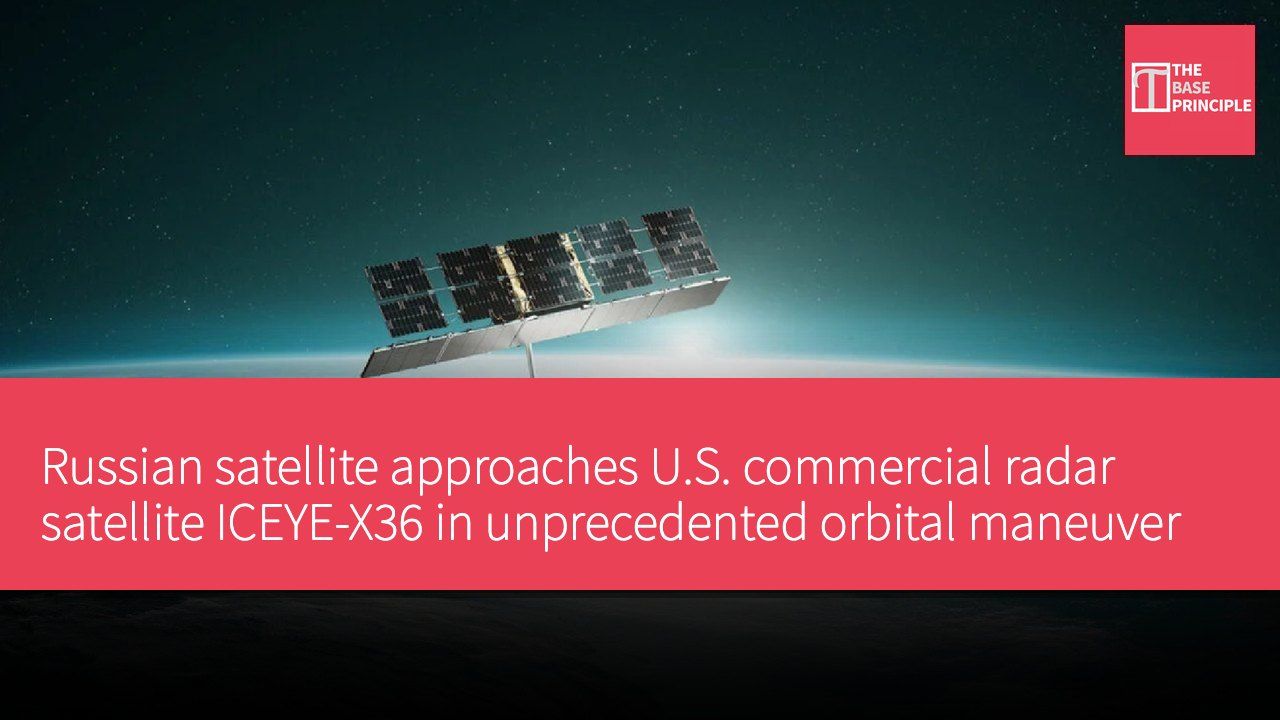
- The Russian satellite Cosmos 2612 approached the U.S. commercial satellite ICEYE-X36, coming within 500 meters.
- Experts describe this as an unprecedented non-cooperative approach maneuver.
- This action indicates that Russia may possess the capability to inspect and potentially interfere with other spacecraft.
- Policy experts warn that Cosmos 2612 could pose a threat to U.S. and European interests.
A satellite owned by the Russian government conducted maneuvers near a U.S.-operated commercial radar imaging satellite, which is believed to support Ukraine, coming as close as 500 meters (approximately one-third of a mile). According to a report from space tracking company LeoLabs, this has been described by experts as an unprecedented action in orbit. The report noted that the Russian satellite Cosmos 2612 performed a series of deliberate maneuvers relative to ICEYE-X36 between October 15 and 19, changing its position in front of and behind the commercial satellite.
The intent behind these maneuvers remains unclear.
Russian Satellite Maneuvering Actions
According to observations from LeoLabs, Cosmos 2612 began on a controlled trajectory, matching the orbital plane of ICEYE-X36, gradually approaching from a distance, adjusting speed and altitude to manage relative motion, and repositioning multiple times in front of and behind the target, rather than simply flying by. LeoLabs stated that this sequence demonstrates capabilities that could be used for inspection, characterization, tracking, or potential interference with other spacecraft. Adam Marsh, vice president of LeoLabs, described it as the first such contact and approach operation, calling it "the most advanced and potentially dangerous non-cooperative RPO (rendezvous proximity operations) we have observed."
According to astrophysicist Jonathan McDowell, the Russian satellite lingered near ICEYE-X36 for two days, coming within 3 miles (5 kilometers), before moving to about 62 miles (100 kilometers) away. Marco Langbroek, a satellite tracking expert at Delft University of Technology, stated that these maneuvers were "clearly intended" to bring the two satellites closer and synchronize their orbital periods, altitudes, and eccentricities.
Historical Context of Non-Cooperative Approaches
According to Victoria Samson of the Secure World Foundation, she is not aware of any prior instances of non-cooperative approaches, with earlier cases involving U.S. government satellites rather than commercial ones. McDowell also indicated that this appears to be the first rendezvous between two active satellites in low Earth orbit without the consent of one of the owners. Russia has previously tracked satellites, with Cosmos 2558 entering the same orbital plane as the U.S. military satellite USA 326 in 2022, and Cosmos 2588 launching near USA 338 in 2025.
ICEYE-X36 is a synthetic aperture radar satellite operated by ICEYE US, launched in 2024 in the United States. Samson noted that this makes it a U.S. satellite, or at least a satellite launched by the U.S. The Finland-based ICEYE announced in 2022 that it had signed an agreement with Ukraine to provide radar imagery, but has never disclosed the name of the satellite or confirmed the customer for ICEYE-X36. Cosmos 2612 was launched on April 16 from northern Russia as one of six military satellites, and the U.S. military has been continuously tracking the group since four satellites adjusted their orbits to align with ICEYE's spacecraft.
According to Clayton Swartz, a policy expert from the Center for Strategic and International Studies, policymakers should assume that Cosmos 2612 may take actions that threaten satellites. He stated that Russia's anti-space activities near Western satellites should be considered in conjunction with broader gray zone actions against U.S. and European interests. Samson also expressed skepticism about why the U.S. government remains silent, noting that Russia and the U.S. are not in a state of war.
Significance of Russian Contact with U.S. Commercial Satellites
The recent approach of the Russian satellite to the U.S. commercial radar satellite marks a potential increase in the risks of non-cooperative contact in space. Experts point out that this may represent the first uncoordinated rendezvous of satellites in low Earth orbit without the owner's consent, highlighting challenges to international norms of behavior in space. As the importance of commercial satellites in military and intelligence gathering rises, such actions could trigger broader geopolitical tensions, especially against the backdrop of strained U.S.-Russia relations.