
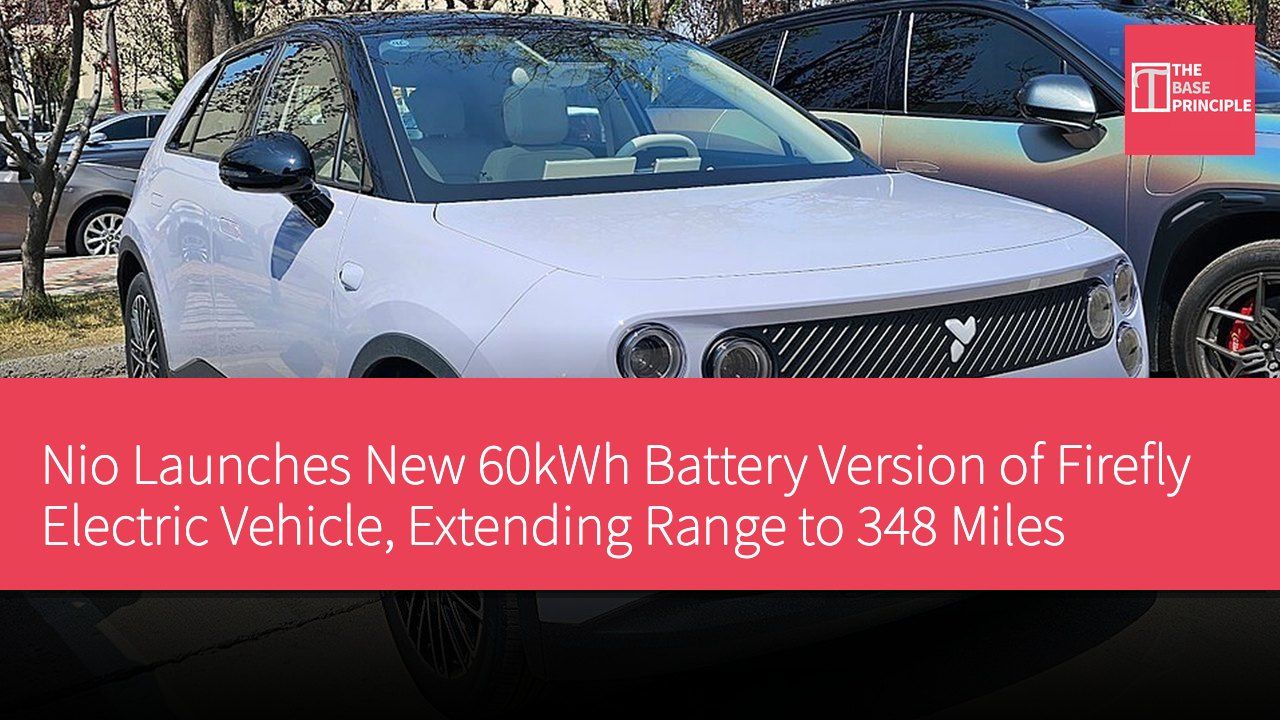
- Nio has launched a new 60kWh battery version, extending the range to 348 miles.
- The new battery has the same dimensions as the previous version, without increasing the overall weight of the vehicle.
- The new battery uses nickel-cobalt-manganese (NCM) chemistry, providing higher energy density.
- Customers can choose to purchase or lease the new battery, offering flexible options.
Nio has announced a new 60kWh battery version of its popular Firefly electric vehicle (EV), which increases the EV's China Light-Duty Vehicle Test Cycle (CLTC) range to 348 miles (560 kilometers), a significant improvement over the previous range of 261 miles (420 kilometers). Notably, the new battery has the same dimensions as the old version, and reports indicate that it does not increase the overall weight of the vehicle. This is crucial as it provides better performance within the limited space (of the battery) without adding weight.
The original battery capacity of the Firefly was 42 kWh, meaning the new battery's capacity represents an increase of nearly 43%. However, this is the storage capacity and does not necessarily translate directly to driving range. In fact, reports suggest that the range increase is about 33%. This is due to various factors, including the battery management system reserving some capacity to protect the new battery cells.
New Battery Technology Enhances Range
So how is this achieved? The new battery is designed by Contemporary Amperex Technology Co., Limited (CATL) and utilizes lithium-ion cells. These cells have an energy density of 187.2 Wh/kg, achieving a high volumetric efficiency of 73.4%. While it is not entirely clear, the second figure may relate to the effective utilization of the battery cells within the packaging rather than their actual volumetric energy density efficiency. If this is the case, it suggests that these cells occupy only part of the available space, with the remainder including structural support, cooling systems, and electrical connections.
Thus, CATL has successfully increased capacity by combining high-energy-density cells with more efficient packaging. In other words, you can obtain more power within the same physical space without increasing the weight of that space.
Modular Design Facilitates Upgrades
Another significant change is the chemical composition of the battery. The original 42 kWh battery used lithium iron phosphate (LFP), while the new battery switches to nickel-cobalt-manganese (NCM). The advantage of the latter is its higher energy density, but it also comes at a higher relative cost. Generally, the materials are more expensive, and compared to LFP, the lifespan may be affected. Nevertheless, NCM typically performs better in cold weather. NCM cells are generally more prone to thermal runaway, necessitating additional protection. However, Nio states that its new battery pack includes enhanced thermal protection and several technologies aimed at reducing long-term degradation.
Despite these trade-offs, the new battery reportedly can be installed in older Firefly models without the need to replace the entire vehicle. This modular design allows existing owners to upgrade their vehicles and may enable further upgrades in the future as battery technology improves. According to reports, Nio offers purchase and leasing options for the new battery version of the Firefly. Customers can purchase the new battery for $20,400 (approximately RMB¥136,800 (approximately HK$149,112)), while the old version is priced between $17,900 (RMB¥119,800 (approximately HK$130,582)) and $18,800 (RMB¥125,800 (approximately HK$137,122)).
Alternatively, customers can lease the new 60 kWh battery through its Battery-as-a-Service (BaaS) program for about $90 (RMB¥599 (approximately HK$653)) per month. For customers looking to upgrade their older Firefly, the full purchase cost is approximately $2,500 (RMB¥17,000 (approximately HK$18,530)), or BaaS customers would need to pay a service fee of $450 (RMB¥3,000 (approximately HK$3,270)).
Item Specification Battery Capacity 60 kWh Range 348 miles (560 kilometers) Energy Density 187.2 Wh/kg Volumetric Efficiency 73.4% Battery Chemistry Nickel-Cobalt-Manganese (NCM)
Market Impact of New Battery Technology
Nio's new 60kWh battery version not only enhances range but also optimizes performance without increasing vehicle weight. This innovation reflects advancements in battery technology, particularly in energy density and packaging efficiency. With the application of nickel-cobalt-manganese (NCM) batteries, Nio may gain a competitive edge in the market, especially in cold weather performance. The modular design allows existing owners to easily upgrade, which not only enhances customer loyalty but also provides possibilities for future technological updates, demonstrating Nio's commitment to continuous innovation.