
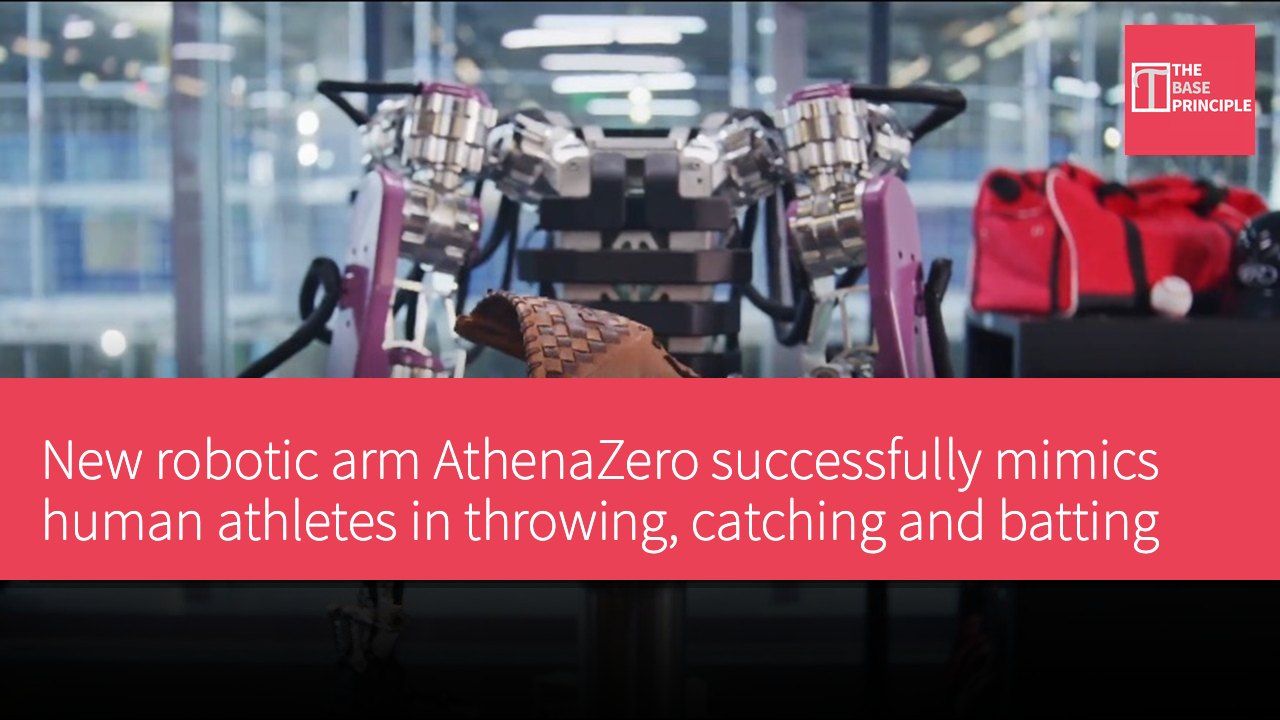
- AthenaZero can throw, catch and bat at near-human speeds.
- The robot's design prioritizes a balance between mass and stiffness to boost performance.
- AthenaZero can play catch in practice and adjust its swings in real time.
- The research highlights the importance of dynamic manipulation capabilities for robots.
A robot designed to emulate the movements of an athlete rather than a machine can now throw, catch and hit baseballs at speeds approaching those of human players. New research led by Andrew Morgan names this capability and defines the design philosophy behind it. The robot, called AthenaZero, is built to minimize mass and stiffness rather than maximize mechanical strength. The researchers note that while robotic control software has advanced steadily in recent years, hardware design has failed to keep pace. Despite increasingly sophisticated algorithms, most robotic arms are still built on the heavy, rigid mechanical philosophy that has defined industrial robots for decades.
Morgan and his colleagues set out to test a specific hypothesis: a robot built with lower end-effector mass and correspondingly lower inertia should be able to react more quickly and produce more powerful manipulation movements than heavier, stiffer competitors.
The design philosophy behind AthenaZero
To put this idea to the test, the team designed AthenaZero, a robot with two arms, two hands and a torso. Its overall end-effector mass is roughly comparable to that of an adult male. Comparisons with other existing robotic platforms show that the effective mass of AthenaZero's arms beyond the shoulder is closer to a human arm than to that of competing designs. This design choice translates directly into performance. AthenaZero can throw, catch and hit baseballs, with a maximum throwing speed exceeding 30 meters per second, enough to begin approaching human throwing capability.
Beyond standalone demonstrations, the researchers showed that two AthenaZero units can play a practical game of catch. A single unit paired with a human player can do the same, or the two can practice batting together. The robot does not simply swing at will; it adjusts its swing in real time based on the ball's projected trajectory and refrains from swinging entirely when a pitch is outside the strike zone.
Dynamic capabilities for robotic movement
The authors describe these baseball-specific skills as a kind of niche demonstration. They argue that the underlying demonstration matters far more than that. Striking the right balance between low inertia and mechanical simplicity, they contend, is essential to building robots capable of truly dynamic manipulation rather than only cautious, precise motion. Morgan and his colleagues suggest that these capabilities open a new dimension for robotic manipulation, one that could help machines adapt more effectively to unpredictable real-world scenarios beyond any baseball field. As the authors put it in the study, tackling core manipulation challenges from a dynamics-first perspective gives researchers the right tools to ask the right questions about robot movement.
Implications of the new robotic technology for athletic simulation
The design philosophy behind AthenaZero challenges the conventional notion of rigidity in robotic arms, emphasizing the importance of mass and inertia in athletic performance. This not only enhances the robot's agility in motion but also opens up new possibilities for future robotics. By simulating human movement, AthenaZero demonstrates how robots can adapt more effectively in dynamic environments, with potential implications for a range of application scenarios, including automation and human-robot collaboration.