
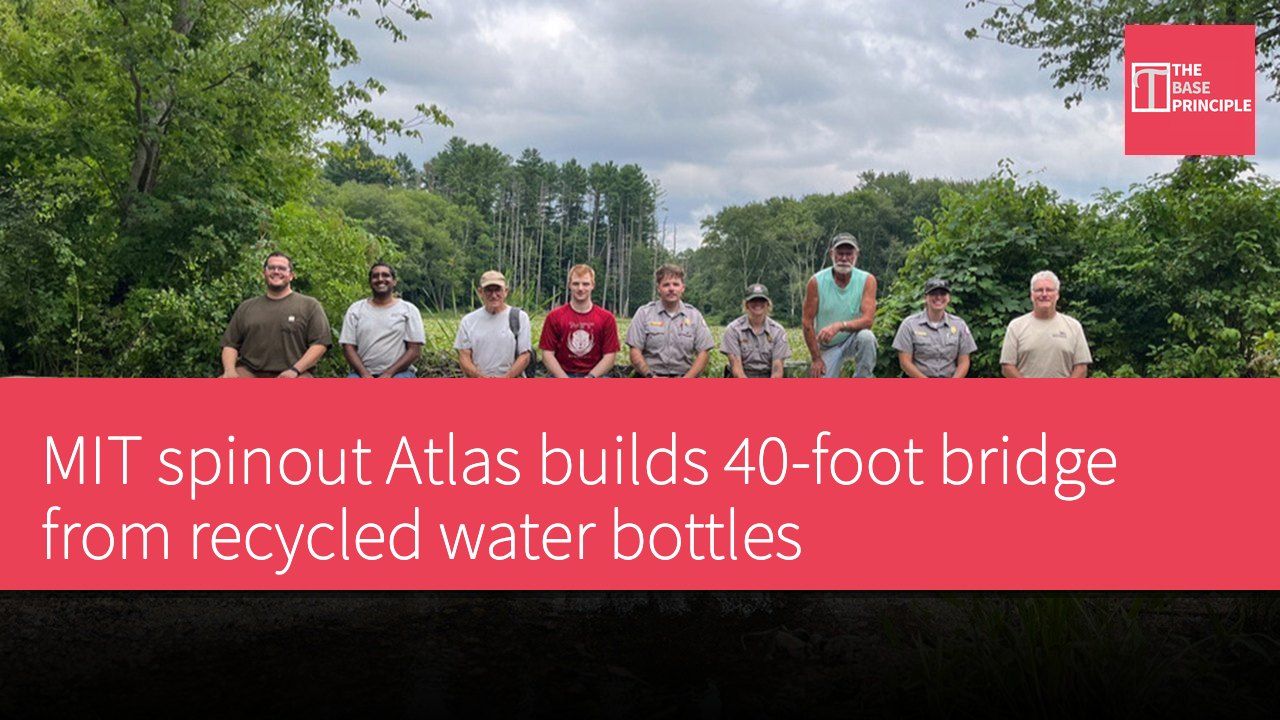
- Atlas has built a 40-foot bridge from recycled water bottles, demonstrating the potential of turning plastic into building materials.
- The company aims to convert plastic waste pollution into durable construction materials, reducing environmental impact.
- Atlas's waterless recycling technology removes permitting barriers, enabling plastic recycling worldwide.
- The company plans to deploy AI-driven robotic production systems globally to advance localized manufacturing.
Over a Massachusetts wetland, a new bridge has opened that shows no outward sign of being made from recycled water bottles. Spanning 40 feet, it is held up by structures produced from just that material. Atlas Building Composites, an MIT spinout, has developed an AI-driven robotic manufacturing platform that converts single-use plastic waste into durable building materials. The company recently delivered the structure to the U.S. Army Corps of Engineers. Atlas originated from MIT's Project HAUS, a research program within the university's Department of Mechanical Engineering whose name stands for "Home Architecture & Urban Systems."
The company combines waterless plastic recycling with large-scale composite additive manufacturing to produce components including residential foundations, decks, and structural supports for walls, floors and roofs.
Advantages of the waterless recycling technology
Atlas chairman and co-founder A.J. Perez said the company's mission is to convert plastic waste pollution into durable composites capable of building a billion homes. He noted that the goal is not merely to build housing or to recycle plastic in isolation. Traditional home construction already relies on logging, mining and other environmentally costly processes, which the company aims to avoid entirely. In Atlas's manufacturing process, shredded single-use plastic from water bottles and similar items is melted and fused with American-made fiberglass to produce composites stronger than wood.
The material is then shaped into finished parts using large 3D printers. Early research led by Perez at MIT showed that large composite support frames can be printed in 13 minutes and can support more than 4,000 pounds, exceeding major building standards.
Perez said Atlas's research system at MIT can currently produce 60 to 80 pounds of components per hour, while the production system built for Atlas factories can operate in the range of 150 to 200 pounds per hour. He noted that the robotic manufacturing platform can ultimately produce parts more cheaply than injection molding while offering greater flexibility. A central part of that flexibility comes from the company's ability to recycle low-quality plastic without using any water. Perez described the waterless approach as key to democratizing recycling.
It removes barriers such as permits from local water authorities, which typically complicate projects for new recycling facilities, allowing any country to pursue plastic recycling regardless of the availability of water resources.
Environmental benefits of localized production
Co-founder Matt Pouliot noted that plastic's durability is often viewed as an environmental liability, but in construction it becomes an asset. He said that once recycled material is built into a structure and put to work, it can serve for a long time, and that durability avoids the degradation that comes with repeated recycling cycles. Atlas plans to deploy thousands of AI-driven robotic production systems worldwide. Today, each factory unit can produce structural framing components for roughly one small home per day. Perez argued that concentrating production in a single large factory far away does not serve environmental or economic goals.
He argued that localized production creates more jobs and produces a smaller carbon footprint than shipping them from distant facilities. The company's Massachusetts wetland bridge was installed in less than a day. Atlas is now in talks with international franchise partners to roll out its manufacturing platform, called the Atlas Factory Stack, in more countries.
How Atlas is changing recycling in construction
Atlas uses innovative technology to turn recycled plastic into building materials, addressing plastic pollution while reducing the environmental impact of conventional construction. The introduction of waterless recycling simplifies the recycling process and allows operations under a wide range of water-resource conditions, which is critical for rolling out plastic recycling globally. In addition, localized production cuts transportation-related carbon emissions and creates more jobs, both of which are major challenges facing the construction industry today.