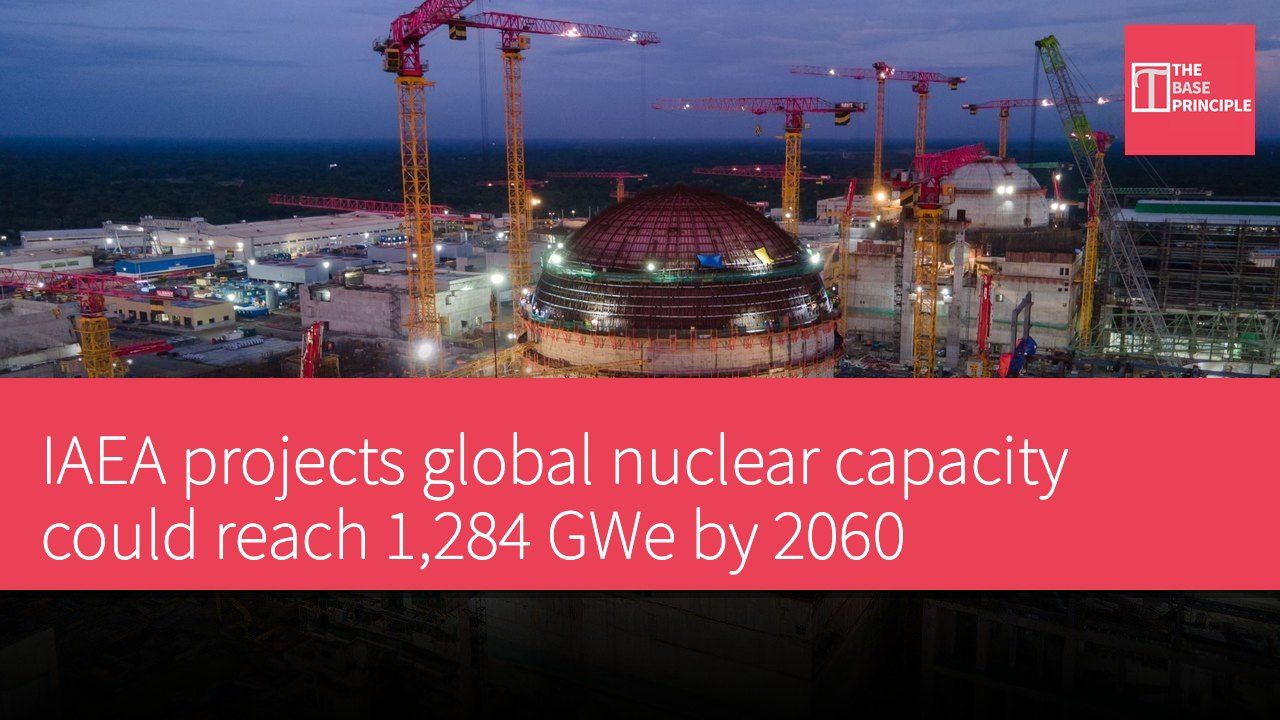
- The IAEA projects global nuclear capacity could reach 1,284 GWe by 2060.
- Small modular reactors will play an important role in nuclear power growth.
- Extending the lives of existing reactors will affect future nuclear capacity.
- Nuclear power's share of the global market has edged down as overall electricity generation grows.
The International Atomic Energy Agency (IAEA) has raised its long-term nuclear power forecast for the sixth consecutive year. In its latest projection, released at the agency's 70th General Conference in Vienna, the organization said global nuclear capacity could reach 1,284 GWe by 2060 under its highest-case scenario. The increase could involve the construction of several hundred small modular reactors (SMRs). The report, "Energy, Electricity and Nuclear Power Projections to 2060," marks the first time the IAEA has extended its nuclear capacity outlook to 2060. In the high case, global nuclear capacity would be 3.4 times the level at the end of 2025.
By the end of 2025, there were 413 operating nuclear reactors worldwide, with a combined generating capacity of 377.1 GWe. The IAEA now projects that in the high case, nuclear capacity could reach 1,045 GWe by 2050, up from its earlier forecast of 992 GWe. By 2060, capacity could rise to 1,284 GWe. The low case is more conservative, projecting 641 GWe in 2050 and 696 GWe in 2060.
Previously, the low-case projection for 2050 stood at 561 GWe. The projections take into account current reactors, possible licence renewals, planned retirements and construction projects likely over the coming decades. The high case assumes stronger commitments to nuclear power by countries, while the low case expects current trends to continue with limited policy shifts.
The Role of Small Modular Reactors
IAEA Director General Rafael Mariano Grossi said: "The IAEA's projections demonstrate the increasingly important role of nuclear power in meeting growing global electricity demand. To realize this potential, investment in new nuclear capacity and extensions of reactor lifetimes will be essential." Small modular reactors are expected to play a significant role in this growth. The IAEA defines SMRs as reactors with a capacity of no more than 300 MWe, and more than 100 designs are currently under development.
In the high case, SMRs could account for 28 percent of new nuclear capacity added by 2060, or roughly 284 GWe. If each SMR averages 300 MWe, that would require about 946 reactors; at 250 MWe, around 1,136 reactors would be needed. SMRs will also play a meaningful role in certain regions. In North America, about 60 percent of added nuclear capacity could come from SMRs, while in Southeast Asia and in Latin America and the Caribbean, that share is projected at 40 percent.
The Impact of Reactor Life Extensions
Extending the operating lives of existing reactors will also shape future capacity. In the high case, roughly 70 percent of currently operating nuclear capacity would still be running in 2060. The low case projects that nearly two-thirds of existing reactors would be retired on schedule. The IAEA noted: "Where feasible, life extension of existing reactors is the most cost-effective source of baseload low-emission electricity, particularly important for regions with aging nuclear fleets." Financing is another key factor. Since 2022, the energy crisis has shifted focus toward nuclear power amid growing concern about energy security and interest in diversified electricity sources.
Although demand for nuclear power is shifting, global nuclear generation in 2025 rose 1 percent from 2024. But with overall global electricity generation growing 2.7 percent, nuclear's market share fell from 8.7 percent to 8.4 percent. The IAEA said: "The upward revision of projections reflects a growing recognition of the role nuclear power can play in supporting energy security and long-term economic growth. The renewed engagement of international financial institutions such as the World Bank Group and the Asian Development Bank signals a broader shift, and other international financial institutions are beginning to follow suit."
The IAEA noted that the energy crisis since 2022 has heightened concerns about energy security and affordability, and that disruptions to oil and gas flows have had a major impact on energy security and global energy markets. In response, interest has grown in diversifying electricity generation, including nuclear power.
The World Nuclear Association holds a more optimistic view, estimating that global nuclear capacity could reach 1,457 GWe by 2050 if countries meet their targets and current reactors continue to operate.
Key Factors in Nuclear Power's Future
The IAEA's projections point to a growing role for nuclear power in meeting global electricity demand, particularly against a backdrop of energy security challenges. The development of small modular reactors is seen as central to future nuclear growth, capable of addressing the needs of different regions. Extending the lives of existing reactors is also considered a cost-effective way to expand nuclear capacity, especially for areas with aging fleets. With international financial institutions renewing their focus on nuclear power, the sector's development potential going forward is worth watching.