
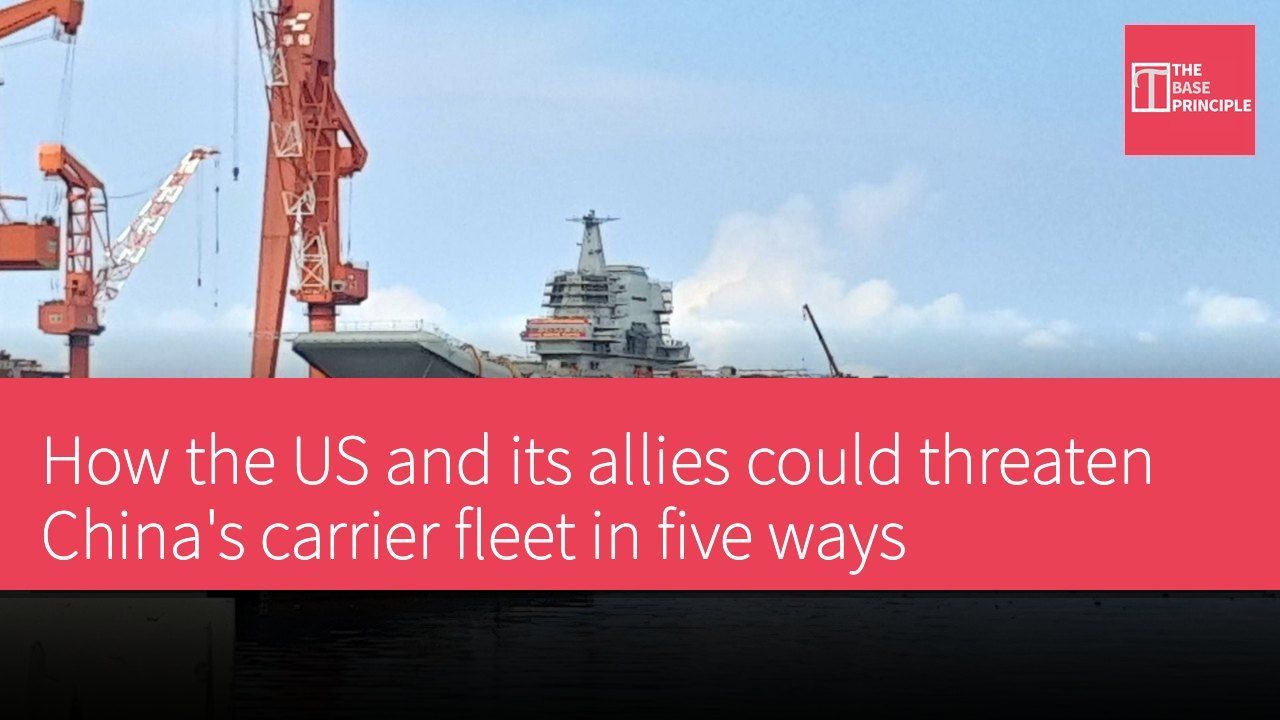
- China's carrier fleet poses a threat to the US, particularly in the Western Pacific.
- The US and its allies could concentrate their forces against Chinese aircraft carriers, creating a sustained threat.
- Unmanned surface vessels could add pressure on Chinese ports and the navy.
- The report recommends that the US adjust its fleet structure to address China's expansion.
China has spent recent years building a force designed to threaten US aircraft carriers, especially in the Western Pacific. A new analysis from the Center for Strategic and International Studies (CSIS) argues that the United States and its allies can adopt a similar playbook aimed at China's growing carrier fleet. The analysis, titled "Flipping the Script," was published by CSIS in August. The report recommends treating Chinese aircraft carriers as the focal point of a distributed network of US and allied submarines, missiles, aircraft, unmanned systems, and intelligence assets.
China has developed a combination of submarines, ballistic and cruise missiles, aircraft, sensors, and other systems aimed at threatening US carrier strike groups operating near the country. CSIS argues that if the United States and its Pacific allies concentrate their capabilities on Chinese aircraft carriers, those carriers will face many of the same challenges. The report identifies five main areas for doing so.
Under-sea threats
Under the sea is the first. US nuclear-powered submarines could be paired with conventional submarines from Australia, Japan, and South Korea to create what CSIS describes as a persistent threat to Chinese carrier groups. Land-based anti-ship missiles provide another layer. Positioned from Japan to the Philippines, these weapons could threaten Chinese ships approaching critical sea lanes, with allied intelligence, surveillance, and reconnaissance systems supplying targeting information. The approach would also draw on air-launched anti-ship missiles backed by satellite surveillance, along with electronic and cyber operations aimed at disrupting Chinese command-and-communications networks.
The role of unmanned systems
Unmanned surface vessels could add yet another layer of pressure around Chinese ports and naval facilities. Integrating these systems is intended to make operating large carriers near Taiwan, in the South China Sea, or beyond the first island chain increasingly difficult and costly.
Adjustments to the US fleet
The US Navy's distributed proposal would also require changes to its structure. CSIS argues that the US needs more unmanned underwater systems, additional allied bases for naval drones, and deeper weapons stockpiles such as torpedoes. The report also recommends building a fleet of 300 manned vessels and 300 unmanned vessels, an adjustment from the currently planned roughly 350 manned ships and 150 unmanned surface and underwater systems. It further calls for the US Army and Marine Corps to contribute land-based anti-ship missile units and to promote co-production of precision weapons among allies.
The underlying idea extends beyond carriers alone. By dispersing weapons across submarines, aircraft, land-based forces, unmanned systems, and allied bases, the United States can create multiple threats China must consider simultaneously.
The proposal comes against the backdrop of a still-expanding Chinese carrier force. China currently operates three aircraft carriers, and a 2025 Pentagon assessment cited by Defense News projects that the People's Liberation Army Navy could build six additional carriers by 2035. CSIS argues that China's growing carrier fleet should not be viewed only as a threat to American naval power. Those carriers themselves could also serve as high-value targets, particularly because they are expensive and difficult to replace. The report therefore reframes the carrier question. Washington and its allies could seek to create a comparable threat environment around China's own fleet rather than focusing solely on protecting US carriers from Chinese anti-access systems.
How the US can respond to China's carrier expansion
The expansion of China's carrier fleet poses a serious challenge to the United States and its allies, particularly in the Western Pacific. The CSIS report stresses that the US and its allies can respond to this threat in several ways, including undersea operations, the use of unmanned systems, and adjustments to fleet structure. This is not only a counter to Chinese carriers but also the creation of a multi-pronged threat environment that forces China to weigh defense on multiple fronts. The success of such a strategy will hinge on cooperation between the United States and its allies and on how resources are allocated, with significant implications for maintaining regional stability.