
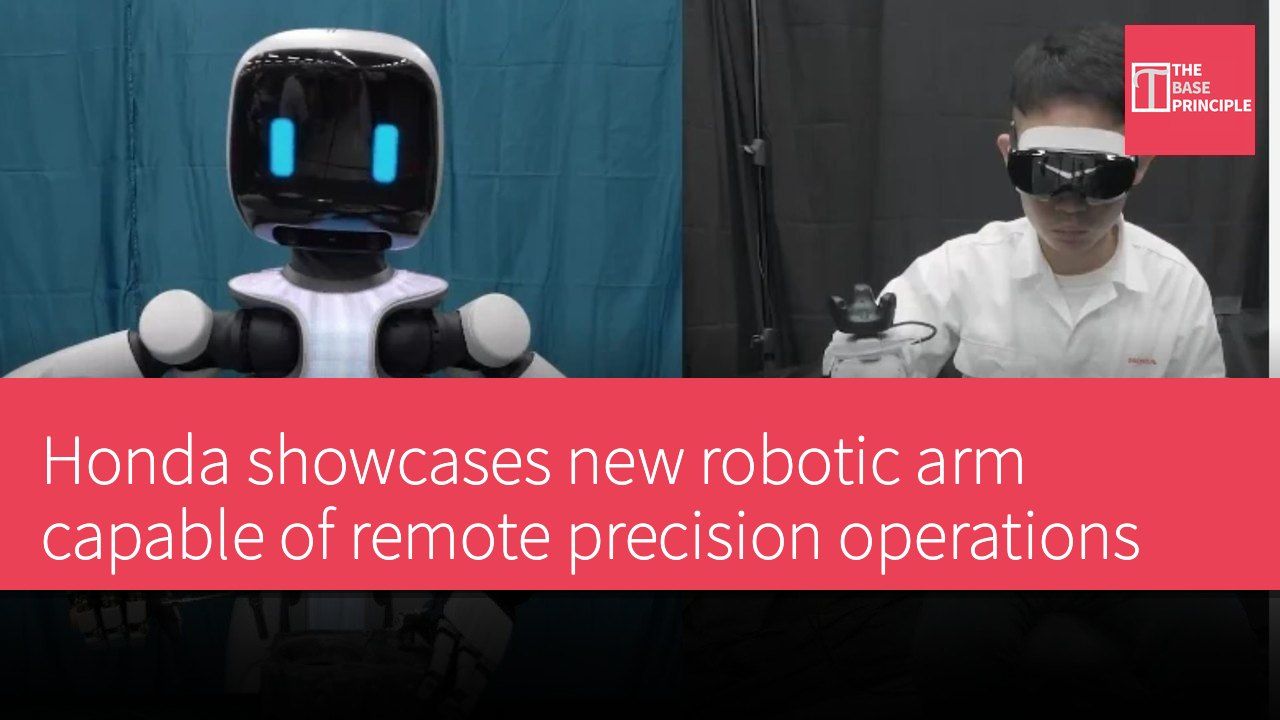
- Honda showcases new robotic hand capable of remote precision operations.
- Robotic hand features 16 movable joints with motion speeds up to 180 degrees per second.
- Honda has conducted over 450,000 durability tests, demonstrating its stability.
- The technology can be applied to multiple fields including medical, industrial maintenance, and disaster response.
Honda Motor Co. has showcased a robotic hand designed to tackle tasks requiring human-like precision and strength. The demonstration took place at Japan's CEATEC 2026 exhibition, showcasing technology that enables people to perform physical work remotely. This Honda avatar robot combines a multi-fingered hand with an assist system to help users control its movements. Honda envisions applications for the technology including equipment maintenance, medical support, disaster response, and space operations. The demonstration highlights the persistent challenges facing robotics: although robots are increasingly able to navigate complex environments, stably manipulating everyday objects remains difficult.
Honda's humanoid robotic hand features 16 movable joints, each capable of continuous motion speeds up to 180 degrees per second. This motion allows it to maintain the strength needed for high-intensity physical tasks while performing delicate manipulations. Each fingertip can exert a sustained force of up to 50 newtons. Six-axis force sensors measure fingertip force and torque, helping the system interpret physical interactions. The hand also integrates 288 tactile sensor channels distributed across the fingers and palm, providing detailed contact information to help operators better control objects.
Honda has subjected the mechanism to more than 450,000 durability tests, including 24,000 cycles of lifting an 11-pound weight. The engineering challenge goes beyond simply producing a credible grip. An effective robotic hand must maintain control through repetitive motion, withstand physical stress, and handle objects of varying shapes and resistance. Honda says its design can handle tasks ranging from threading a needle to tightening screws, as well as operating scissors and lifting heavier objects, giving it a wide range of potential uses.
Potential Applications for Remote Operation
Honda's avatar concept aims to let people interact with physical environments from a distance. Operators can manipulate equipment through the robotic system without needing to be physically present at the worksite. This approach would be particularly useful when experts need to reach remote facilities or respond to emergencies. For example, medical specialists could provide remote support without traveling to the scene. Industrial maintenance is another potential scenario, where technicians could operate tools in hard-to-access areas, reducing the need to send personnel into hazardous environments.
Disaster response and space exploration face similar challenges. The robotic hand would allow operators to manipulate objects at locations posing severe risks or that are inaccessible to humans. Honda's broader vision centers on giving people greater freedom in where they work. Its avatar technology aims to let users perform physical tasks without the constraints of travel and location.
Challenges in Robotics
Humanoid robotics has made significant progress in walking and locomotion. Modern robots can walk, run, and perform increasingly complex movements, but those capabilities do not automatically translate into effective work. Manipulation introduces a different set of demands: robots must control contact forces, adjust their grip, and cope with unpredictable objects. Honda's combination of joint actuation, tactile sensing, and force measurement addresses several of those demands. However, real-world effectiveness will depend on how consistently the system performs outside controlled demonstrations.
Prospects and Challenges for Honda's Robotic Hand
Honda's new robotic arm demonstrates the potential of remote operation technology, particularly in fields such as medical care and industrial maintenance. This technology can not only improve work efficiency but also reduce the risk of personnel entering hazardous environments. However, robotics still faces challenges in practical application, including how to stably operate in various environments and handle different objects. Although Honda has conducted extensive testing, future performance consistency requires further verification, which is critical for its commercial deployment.