
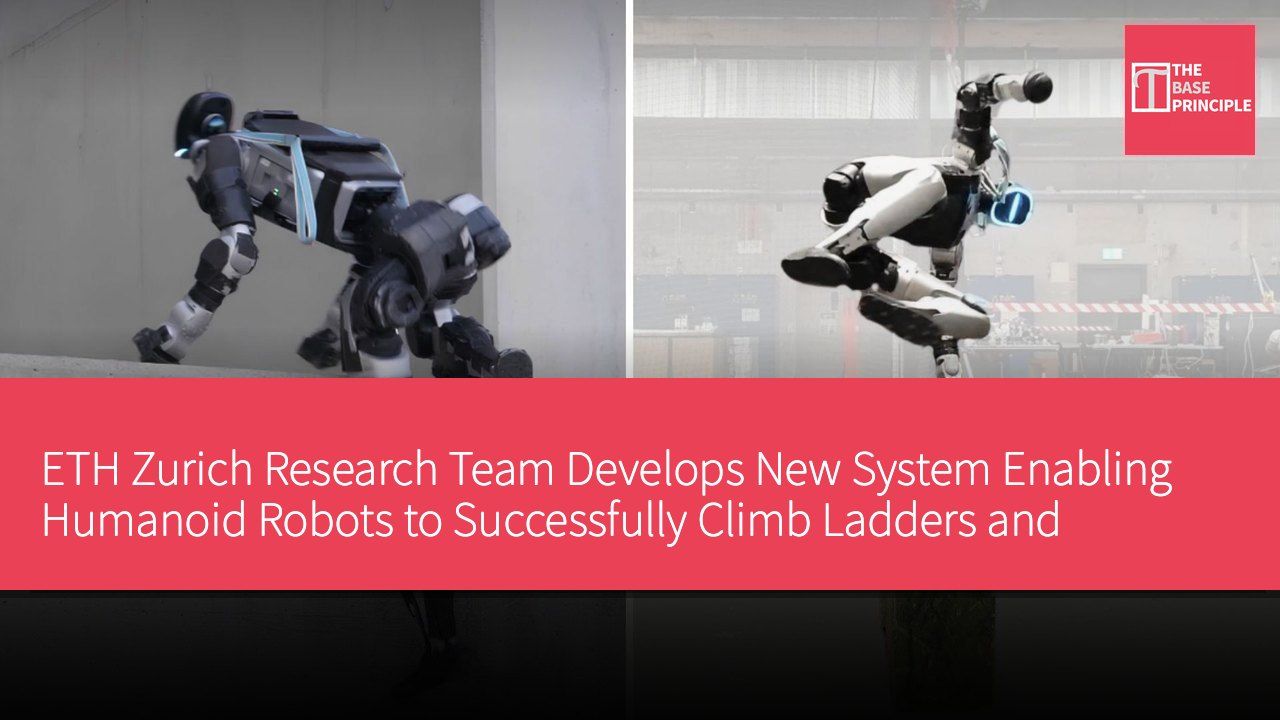
- The new system enables humanoid robots to climb ladders and overcome obstacles.
- The technology, called Attention-based Contact Planning (ACP), adjusts movements.
- The system combines reinforcement learning and motion imitation to enhance robot control capabilities.
- In simulations, the system's success rate significantly exceeded that of traditional methods.
ETH Zurich and its partners have developed a control method that enables humanoid robots to climb ladders, overcome obstacles, and recover from falls using a single learning strategy. The system was demonstrated on Unitree's G1 humanoid robot, showcasing a method that supports various challenging movements. This approach focuses on planning contact with the environment rather than specifying every movement in advance. In simulations, this method achieved a higher success rate across eight obstacle courses compared to comparative methods, highlighting its potential to improve humanoid robot mobility.
Technical Features of the New System
The new system allows humanoid robots to climb ladders, overcome obstacles, navigate narrow spaces, and recover from falls using a single learning strategy. This technology, known as Attention-based Contact Planning (ACP), helps robots determine where to place their hands, feet, knees, elbows, and pelvis in the surrounding environment. The system was tested on Unitree's G1 humanoid robot, demonstrating how contact planning and reinforcement learning help the robot adjust its movements based on different terrains without following a predetermined sequence of actions.
ACP combines reinforcement learning and motion imitation to address the challenges of whole-body robot control. Reinforcement learning allows the robot to improve through repeated trials and feedback, while motion imitation teaches it to follow recorded actions. However, reinforcement learning can struggle with complex coordination, and imitation-based systems may find it difficult to adapt to unfamiliar obstacles. The research team noted that instead of generating a complete sequence of body movements, ACP predicts suitable contact points on the surrounding terrain. Another controller then coordinates the robot's joints to reach these points.
For example, when climbing a ladder, the robot must identify the rungs suitable for its hands and feet. Its controller then coordinates the movement of its arms, legs, and torso between these points while maintaining support. This approach enables the robot to adjust its movements without adhering to a fixed climbing sequence. The contact planner uses an attention-based neural network to process terrain information, the robot's internal state, and user-provided goals. Its inputs include joint positions, joint velocities, and body orientation. The system plans contact for nine body parts, including two hands, two elbows, two knees, two feet, and the pelvis.
This allows the robot to use its upper body for support when walking alone is insufficient.
Operation and Training Process of the System
The researchers also developed a LiDAR-based mapping system that converts sensor measurements into local height maps and estimates their reliability. This helps the robot identify narrow surfaces, such as rungs, that may be overlooked. The system runs on a Jetson Orin NX computer, capable of processing 20,000 points of LiDAR scans within 30 milliseconds, updating the scans at a frequency of 10 Hz. The researchers stated that training is divided into three phases. First, the overall controller learns to execute contact planning using 13.2 minutes of adjusted human motion data.
Next, the researchers jointly train the contact planner and the controller. Finally, reinforcement learning helps the system adapt to procedurally generated environments beyond the original demonstrations.
Successful attempts provide additional training examples. During deployment, the robot does not need to reference actions. It uses onboard observations and specified goals to plan contacts and generate movements. Actual demonstrations show that the G1 is capable of climbing ladders and stairs, overcoming rocks, crawling, traversing obstacles, and recovering after falls. The system achieved an average success rate of 92.5% in simulations across eight complex obstacle courses, while the success rate of the MGMT baseline (motion generation and tracking method) was 58.8%. These figures represent simulated performance rather than real-world success rates.
The researchers noted that the system currently focuses on terrain-based interactions and local movements toward goals. Tasks involving overhead contact, hanging, and manipulation will require more advanced three-dimensional perception technologies.
Item Specification Success Rate (Simulation) 92.5% MGMT Baseline Success Rate 58.8% Human Motion Data 13.2 minutes
Breakthroughs and Challenges in Humanoid Robot Technology
The Attention-based Contact Planning system developed by the ETH Zurich research team demonstrates the potential of humanoid robots in complex environments. This technology not only enables robots to climb ladders and overcome obstacles but also to recover after falls, showcasing their flexibility and adaptability. Despite the high success rate in simulations, real-world applications still face various challenges, such as achieving more precise three-dimensional perception in dynamic environments. Advances in these technologies will have a profound impact on future robotic applications, particularly in rescue and exploration missions.