
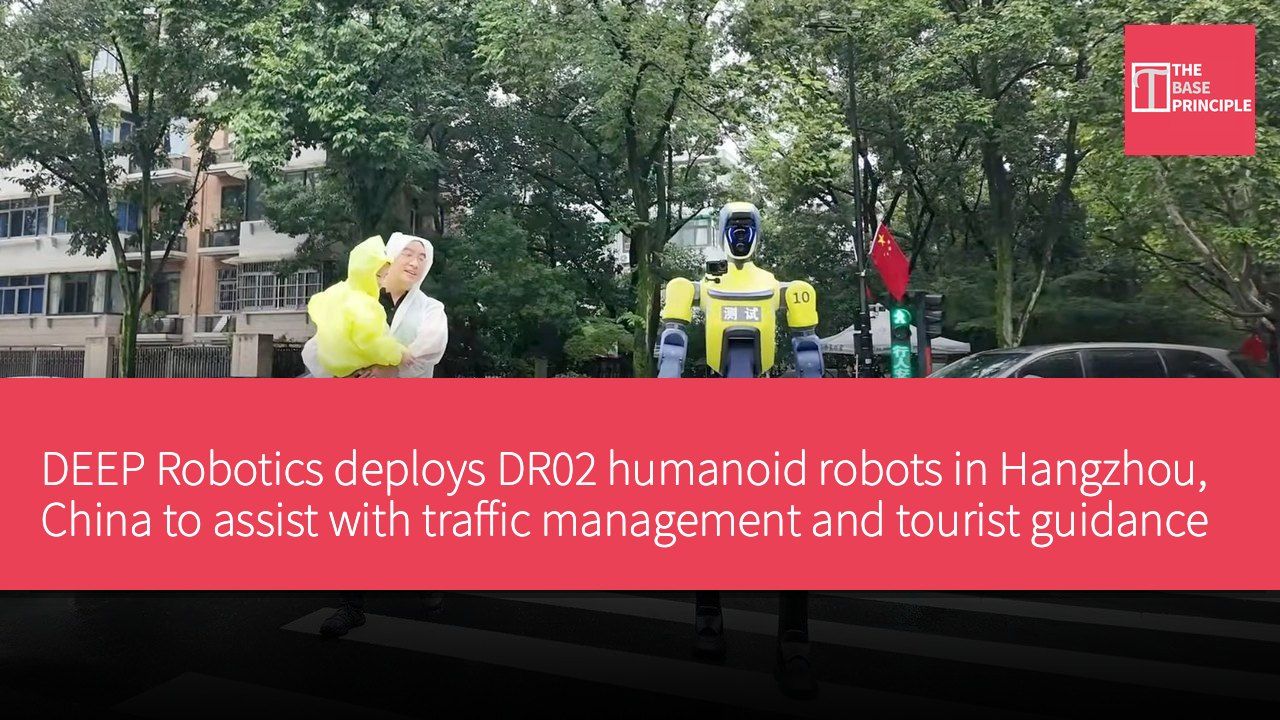
- DEEP Robotics deploys DR02 humanoid robots in Hangzhou to assist with traffic management and tourist guidance.
- DR02 robots can operate in crowded and rainy conditions, assisting traffic personnel.
- Robots possess environmental perception and motion control capabilities, supporting various outdoor operations.
- Test results will influence how DR02 is applied in future traffic management.
DEEP Robotics has deployed its DR02 humanoid robots in Hangzhou, China to assist with managing busy traffic intersections and tourist attractions. The robots were tested in early October in the Xihu District, when rain and increased visitor numbers added to the workload of local traffic personnel. The DR02 robots were deployed on major roads and at the Xixi National Wetland Park, assisting with directing traffic, maintaining order, and answering basic public inquiries. This deployment demonstrates how humanoid robots can support traffic management in busy urban environments, particularly during periods of high pedestrian and vehicle flow.
The DR02 robots assisted traffic personnel at busy intersections and tourist attractions, testing their navigation and public interaction capabilities in crowded streets and rainy conditions. The tests took place in early October, when increased tourist and vehicle volumes placed additional pressure on local traffic teams. The robots operated on Lingyin Street and at the Xixi National Wetland Park, with tasks including directing traffic, reminding road users to follow traffic rules, maintaining order, and answering basic questions from residents and tourists. This deployment provided an opportunity to evaluate the DR02's combined capabilities in environmental perception, motion control, and human interaction.
DR02 Robot Operational Capabilities
The DR02 robot stands approximately 175 centimeters tall, weighs 143 pounds (65 kilograms), and is designed to operate in outdoor environments. Its IP66 protection rating resists dust and powerful water jets, supporting operation in wet weather. The robot can also operate in temperatures ranging from -20 to 55 degrees Celsius, providing a wide outdoor operating range. Its mobility is a key component of the system; the DR02 can walk at speeds up to 1.5 meters per second and climb stairs approximately 25 centimeters high and slopes of 20 degrees.
These capabilities enable it to traverse environments including uneven terrain, elevation changes, pedestrians, and other obstacles.
The robot uses a combination of wide-angle lenses, depth cameras, and Light Detection and Ranging (LiDAR) sensors to perceive its surroundings. These sensing systems provide information about nearby people, vehicles, and objects, helping the machine assess its environment and adjust its movement. Its onboard computing system is reported to perform 275 trillion operations per second, supporting the processing power required for perception and motion.
How the Robot Assists with Traffic Management
During testing, the DR02 demonstrated several traffic-related functions. It can remind cyclists to stay behind the stop line, announce when traffic signals turn green, and identify issues such as riding without helmets, overloaded bicycles, and pedestrians crossing the stop line. The robot does not issue fines but instead encourages road users to follow traffic rules through verbal reminders and gestures. The system was also tested in public-facing roles; beyond traffic direction, the robot assisted with managing tourist flows and answering basic inquiries in multiple languages, meeting the needs of residents and visitors.
These tasks require the robot to interpret its surroundings while conveying instructions in ways people can understand. The tests aim to evaluate the DR02's effectiveness in recognizing situations, coordinating movement, and interacting with humans, providing a reference for larger-scale future deployments. By assigning robots to repetitive advisory duties, traffic personnel can devote more time to responsibilities such as accident investigation and enforcement. The Hangzhou tests demonstrate the practical application of humanoid robots, combining mobile navigation, environmental perception, and public interaction. However, the deployment remains in a trial phase, and its results will help determine how the DR02 is used in future traffic management operations.
Potential of Humanoid Robots in Traffic Management
As urbanization accelerates, traffic management faces growing challenges. DEEP Robotics' DR02 robot demonstrates how advanced technology can be leveraged to alleviate these issues. Its environmental perception and motion control capabilities enable it to operate effectively in complex urban environments and interact with the public. This not only reduces the burden on human traffic management personnel but also enhances public safety and efficiency. In the future, if test results show the DR02 performs well, it could promote wider adoption of similar technologies, advancing smart city development.