
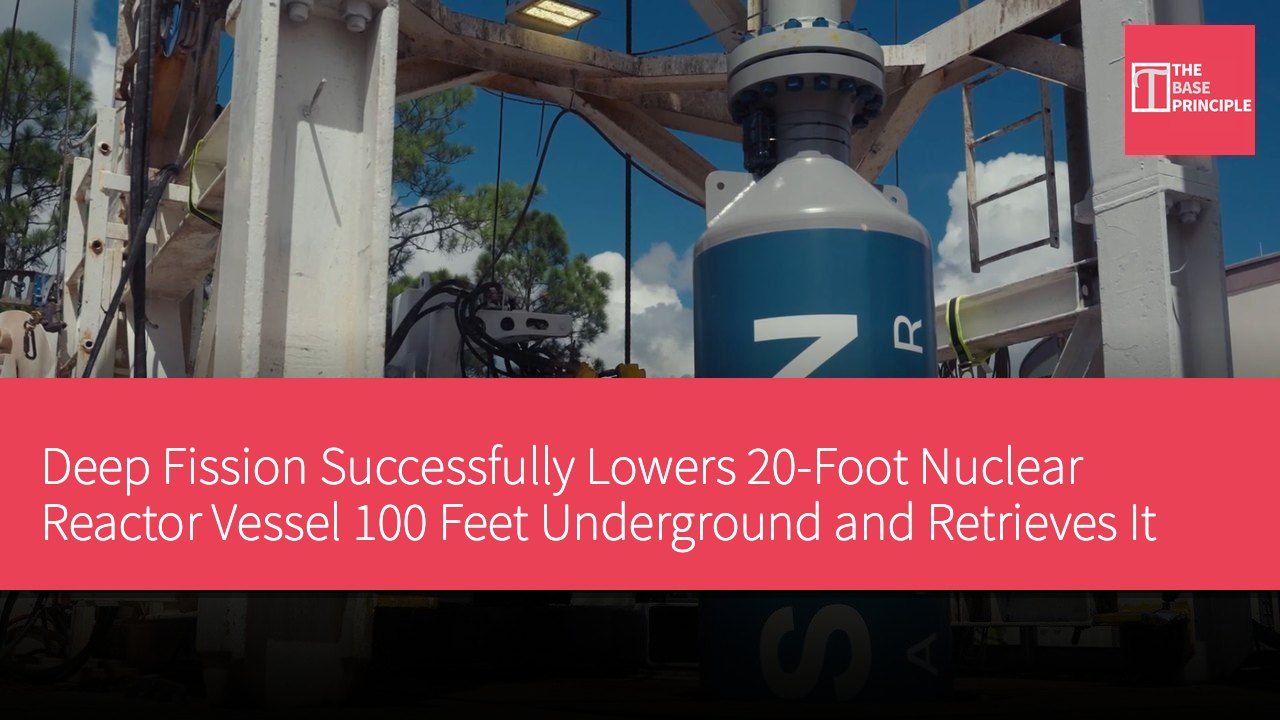
- Deep Fission successfully lowered and retrieved a 20-foot reactor vessel 100 feet underground.
- The demonstration used commercial drilling equipment without the need for new technology.
- The Gravity reactor will use low-enriched uranium fuel and be placed deep underground.
- Deep Fission still needs to validate the system's commercial operation and regulatory requirements.
Deep Fission successfully lowered a 20-foot reactor vessel 100 feet underground and retrieved it using commercial drilling equipment, testing a key part of its plan to bury small nuclear reactors a mile deep. The demonstration, conducted on September 3, involved a commercial drilling and assembly team placing the full-size vessel into a 34-inch diameter borehole. The team then adjusted the vessel's depth before bringing it back to the surface. The test focused on whether a large reactor vessel could be operated underground using existing drilling equipment.
Deep Fission stated that the demonstration did not require the invention, customization, or modification of equipment specifically for nuclear use. The vessel is a full-size non-nuclear replica designed to house the company's Gravity reactor core, and it does not contain nuclear fuel, so the test focused on validating the physical deployment and retrieval process rather than the reactor's operation.
No New Technology Needed for Demonstration
"The most important thing about this demonstration is what we didn't have to do," said Liz Muller, CEO and co-founder of Deep Fission. "We didn't have to develop new technology. We're using commercially available drills and assembly equipment that are on the market today, and our reactor uses pressurized water technology that has been operating in the nuclear industry for decades." Deep Fission's reactor concept combines proven pressurized water reactor technology with an underground deployment system. The Gravity reactor will use standard low-enriched uranium fuel, and the company's main innovation lies in placing the reactor deep underground.
The proposed reactor would be located in a water-filled borehole about a mile deep. Deep Fission claims that the water column and surrounding rock can provide containment, operating pressure, heat transfer, and emergency cooling. This setup could reduce the need for the surface infrastructure typically associated with nuclear power plants. The company's design shifts most of the systems underground rather than building large reactor facilities on the surface. The company believes this can simplify construction, reduce costs, and shorten deployment time while providing additional safety margins.
The Potential Advantages of Underground Reactors
The latest test does not prove that a commercial reactor can operate underground. Deep Fission still needs to validate a broader system, including drilling, reactor integration, regulatory requirements, and eventual commercial operation. The company recently received approval from the U.S. Department of Energy for its nuclear safety design of the Gravity reactor and is advancing the project under the DOE's Reactor Pilot Program, with its first reactor project being developed in Parsons, Kansas. This underground approach is also aimed at supporting deployment closer to customers who need reliable power.
Deep Fission is targeting utilities, industrial customers, and data centers seeking low-carbon baseload power. Muller stated, "Our innovation is in how we put proven pieces together, not in inventing things that have never been built. That's the difference between a science project and a deployable thing." The company now needs to shift from mechanical demonstration to the more difficult task of proving that its underground reactor design can meet engineering, safety, licensing, and commercial requirements.
The Future Challenges of Underground Nuclear Reactors
Deep Fission's demonstration has showcased the potential of deploying nuclear reactors underground, which could reduce the need for surface infrastructure and enhance safety. This innovative approach could change the way nuclear energy is utilized, especially in the context of the drive for low-carbon power. However, the company still faces many challenges, including ensuring the commercial operation of the reactor and meeting regulatory requirements. As the technology develops, the successful implementation of this model could open up new possibilities for the future of nuclear energy.