
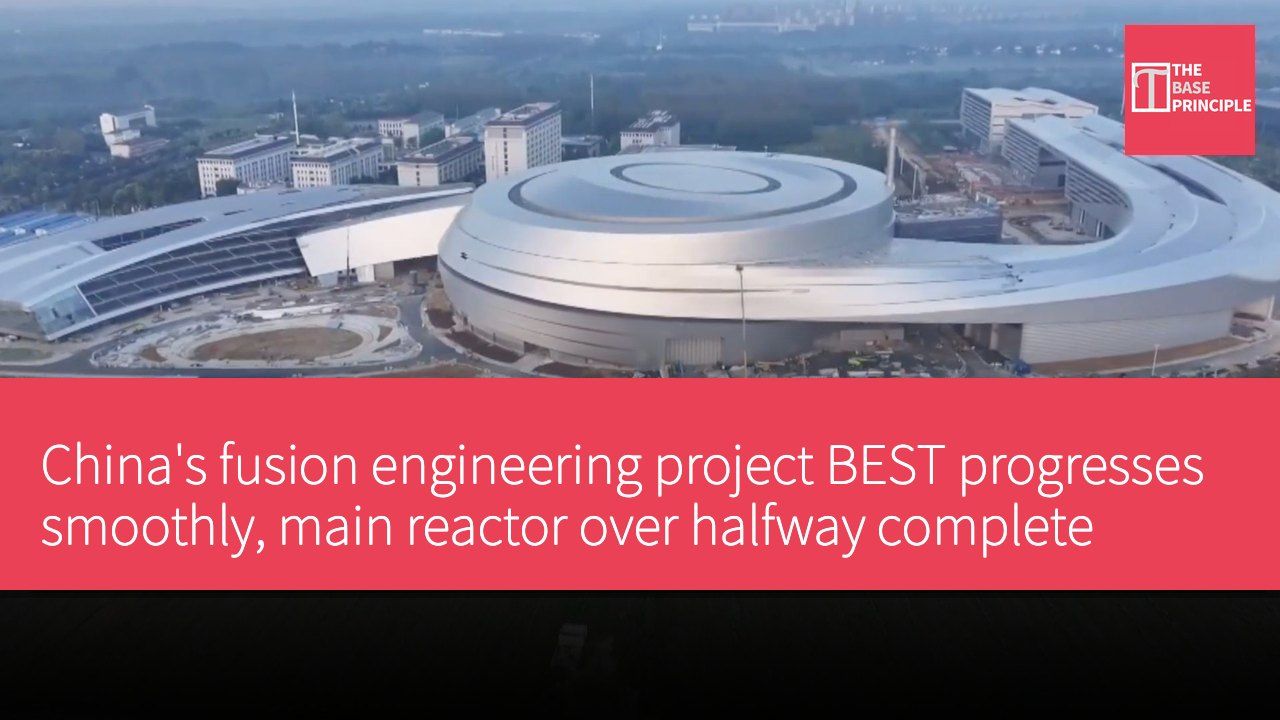
- China's fusion project BEST has officially launched, marking significant progress.
- Main reactor more than halfway built, expected completion by end of 2027.
- The device relies on superconducting magnets to create powerful magnetic fields that levitate plasma.
- Private firms are also conducting fusion experiments, underscoring China's dual-track strategy.
A major fusion-focused engineering base in eastern China has officially commenced operations. The project marks a clear bridge between small-scale laboratory experiments and industrial-scale power demonstrations. Technicians have taken possession of the dedicated campus in Hefei, Anhui province. The site will house the Burning Plasma Experimental Superconducting Tokamak, known as BEST. China Central Television reported the device is designed to demonstrate for the first time that fusion can generate usable electricity.
Engineers plan to conduct a power demonstration around 2030.
Main reactor construction progress
Fusion attempts to mimic the sun's energy reaction. The process forces light atomic nuclei together at extreme temperatures and pressures, releasing vast amounts of energy. Unlike existing nuclear fission plants, fusion produces no long-lived transuranic waste or spent fuel rods and carries no risk of a runaway meltdown. The Hefei assembly team has completed more than half of the main reactor's construction. Project leaders expect overall construction to finish by the end of 2027. Technicians have now entered the most complex phase inside the reactor core.
The device relies on massive superconducting magnets to create powerful magnetic fields that can levitate a superheated plasma cloud, keeping it from touching interior surfaces. The core reaction occurs inside a reinforced vacuum vessel. A thermal shield surrounds the vessel to prevent heat loss. Engineers are currently installing precision instruments and sensors inside the vessel. A report from China International Daily highlighted: "The vacuum vessel is the 'furnace' where fusion reactions occur, while the thermal shield acts as a super-insulation layer to block heat." The project builds on operational data gathered from China's earlier test reactor, known as EAST.
The device set a world record in January 2025 by successfully heating plasma to 100 million degrees Celsius (180 million degrees Fahrenheit) for 1,066 seconds.
Hefei researchers also completed comprehensive testing of two large superconducting magnets this summer, proving critical electrical systems function under load. State-owned institutions are not working alone. Private clean-energy firm ENN Group announced its own milestone this week using a spherical device called EXL-50U. The company said the machine produces more than 100 million fusion reactions per second. This marks the first time a private company has achieved such a reaction rate using proprietary hardware. The firm is testing an alternative fuel mixture of hydrogen and boron-11.
Mainstream projects use two heavy hydrogen isotopes, deuterium and tritium; that standard reaction yields high-energy neutrons that damage reactor walls over time. The hydrogen-boron reaction sidesteps this problem. The process produces non-radioactive helium particles, causing far less damage to structural materials.
China's dual strategy
The work in Hefei and parallel private-sector experiments underscore China's dual strategy. The country is backing both state-led engineering and commercial ventures simultaneously, aiming to secure an early lead in the global race for commercial fusion power.
Project Specification Reactor type Superconducting tokamak Device name BEST Peak plasma temperature 100 million degrees Celsius Duration 1,066 seconds
Future potential of China's fusion technology
China's sustained investment in fusion technology demonstrates its emphasis on clean energy. Progress on the BEST project represents not only a scientific and technological breakthrough but also highlights China's ambition in the global fusion race. As main reactor construction accelerates, a power demonstration is expected within the next few years, offering new possibilities for global clean energy development. Moreover, private-sector participation injects fresh momentum into technological innovation, underscoring the nation's diversified strategy for advancing fusion technology.