
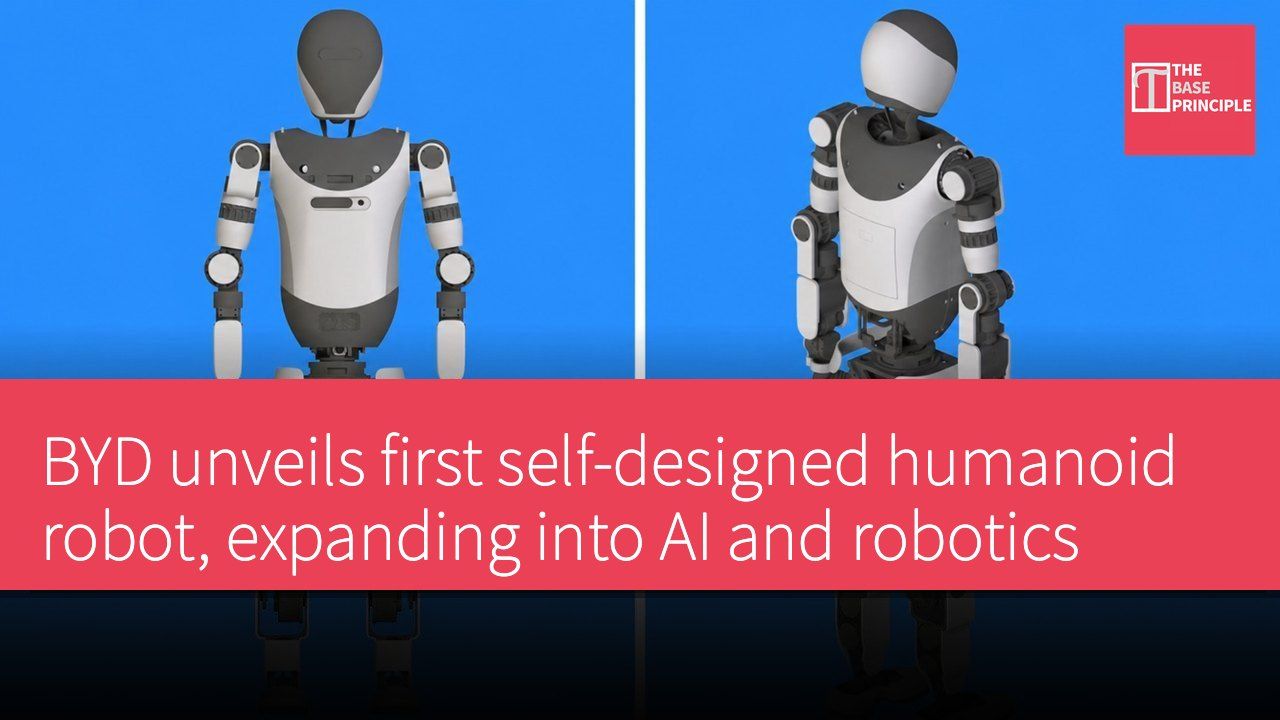
- BYD unveils first self-designed humanoid robot, showcasing its progress in artificial intelligence.
- New robot design features walking, balancing, and environmental interaction capabilities, suitable for various applications.
- BYD aims to leverage its manufacturing expertise to develop embodied AI robots, tackling technical challenges.
- Company plans to deploy humanoid robots at dealerships for customer service tasks.
Robot Design Features
These features could support tasks such as picking up objects, making gestures, and pointing to information. However, the released design does not confirm the robot's reliability in performing these tasks under real-world conditions, or whether these specifications will carry over to the production model. As automakers and tech companies invest in embodied artificial intelligence — technology that combines physical systems capable of perceiving and interacting with the real world — humanoid robots face more complex challenges than software-based AI. They must coordinate perception, decision-making, and physical movement while maintaining balance and adapting to changing environments. BYD aims to apply its manufacturing expertise to develop such robots. BYD's humanoid robot project is part of its long-term research efforts, with a dedicated team established in 2022 to develop the hardware and software needed to make embodied AI practical.
BYD's Investment Strategy
The company has also invested in other firms in the field. BYD invested in Agibot in August 2023 and acquired a stake in Percibot in April 2025, expanding its ties to China's growing robotics industry. The company is also exploring industrial applications through its manufacturing operations; its Changsha factory previously used Ubtech's Walker S1 humanoid robots for material handling and identification tasks, providing an example of how humanoid systems can be tested in real production environments. BYD executives previously stated the company may deploy humanoid robots across its dealership network, with potential tasks including greeting customers, explaining vehicle features, and demonstrating infotainment systems. Such applications would allow BYD to test whether humanoid robots can perform routine customer service work without requiring major changes to existing facilities. For now, BYD has not announced a production timeline, nor confirmed whether the newly released design represents the final version of its Xiao Di humanoid robot, leaving questions about its commercial launch and which features will make it into the production model.
Potential of BYD's Humanoid Robot Plan
BYD's entry into humanoid robotics underscores its emphasis on AI technology, which could not only enhance its corporate image but also give it an early advantage in future market competition. As technology advances, embodied AI applications will become increasingly widespread, particularly in the service sector. BYD's investment and partnership strategy indicates it aims to establish a solid foothold in this emerging market and validate technical feasibility through practical applications. Such development could not only drive the company's own innovation but also help advance the broader robotics industry.