
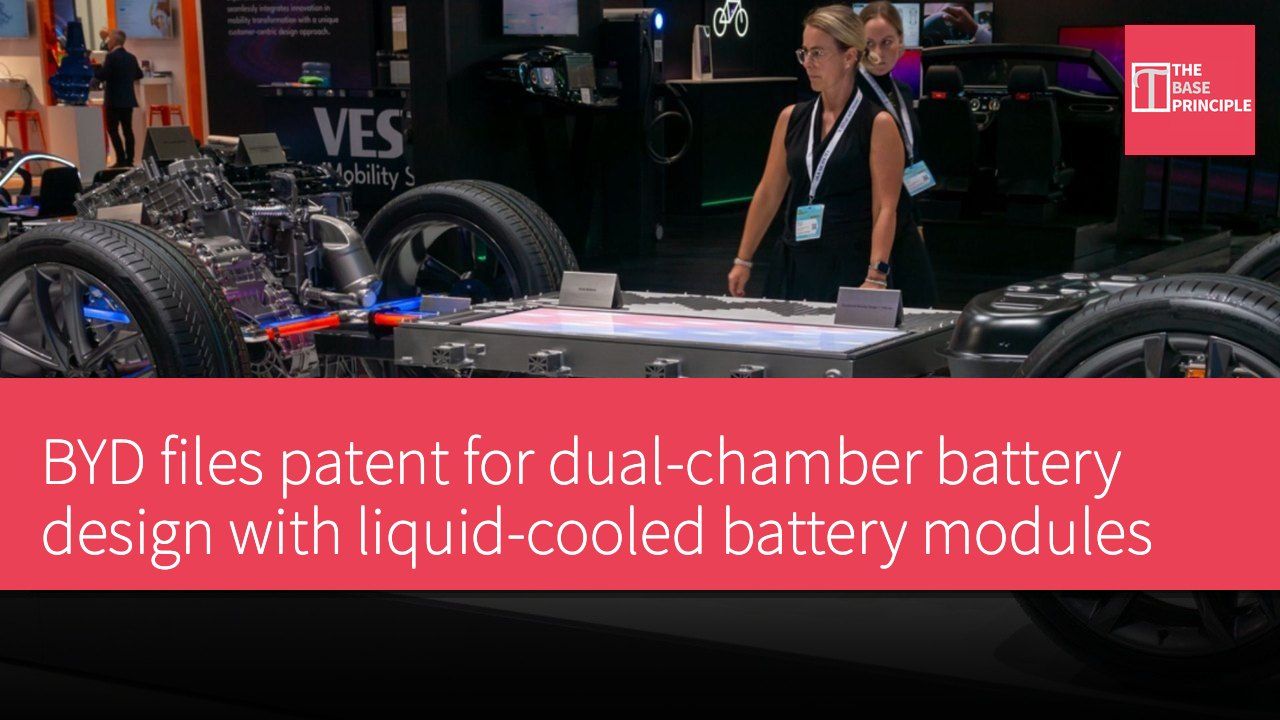
- BYD has applied for a dual-chamber battery design patent targeting liquid cooling technology.
- The patent design separates battery modules and electronic equipment into upper and lower chambers.
- Dielectric cooling liquid provides electrical insulation while cooling.
- The design has not been confirmed for electric vehicle use and remains under examination.
Cooling battery cells directly in liquid presents an engineering challenge: how to isolate the liquid from electrical equipment. BYD has filed a patent application for a dual-chamber cabinet that separates immersed battery modules from electronics and routes their connections through the upper portion of the liquid-filled compartment. China's National Intellectual Property Administration published the application on October 5, 2026, under number CN 122868832 A. Filed in March 2025, the application describes a battery cabinet and energy storage equipment that use dielectric fluid to absorb heat directly from the modules. The design places electrical equipment in a dry upper chamber, while battery modules sit in a wet lower chamber.
The focus lies in the boundary between these spaces, where connections must pass without allowing cooling liquid to contact components that must remain dry.
Technical challenges of the dual-chamber design
Many battery systems remove heat through indirect cooling devices. Liquid flows within aluminum cold plates that contact the battery modules, absorbing heat through the battery casing and the material between the battery and the cold plate. Immersion cooling changes this heat transfer path. Battery modules are immersed directly in non-conductive liquid, allowing heat to transfer from their wetted surfaces to the surrounding fluid. This shortens the thermal conduction path, but controlling the liquid's presence becomes part of the cabinet's design. Electrical equipment and connection points not intended for immersion must still be protected from the liquid.
BYD's patent application specifies dielectric cooling liquids, including hydrocarbon- or ester-based formulations. These liquids provide electrical insulation while cooling the immersed modules. The proposed cabinet divides the battery and its electrical equipment into two isolated chambers. The lower chamber houses the immersed modules, while the upper chamber holds electrical components located outside the liquid volume. Electrical and signal connections enter the dry chamber through the upper portion of the wet chamber. This arrangement avoids routing those connections through the bottom or deeper parts of the liquid-filled chamber. This positioning is critical because hydrostatic pressure increases with depth.
Sealed interfaces near the top experience less liquid pressure, reducing the force acting on the boundary between chambers compared with interfaces at greater depth.
Market applications of BYD's patent
Thus, the design combines insulating liquid with physical separation between cooling equipment and electrical equipment. The cabinet layout addresses how connections cross that isolation zone while keeping sensitive components outside the main liquid volume. The application covers battery cabinets and energy storage equipment, but does not confirm use in passenger vehicles, so the filing does not indicate BYD intends to use this layout in electric vehicles. Existing systems use different cooling layouts. BYD's MC Cube-T specifies liquid cooling, while CATL's EnerOne and EnerC energy storage systems use cold plates outside their battery modules.
CATL's Qilin vehicle battery places a liquid cooling plate between adjacent cells, whereas BYD's patent places the modules in the cooling liquid itself. The application remains under substantive examination, and the company has not announced commercial production plans for the cabinet.
Potential impact of BYD's liquid cooling technology
BYD's dual-chamber battery design patent demonstrates innovation in battery cooling technology, particularly the application of liquid cooling. This design not only improves thermal conduction efficiency but also ensures the safety of electrical equipment, which is especially important given the growing prevalence of electric vehicles. Although the patent remains under examination and does not explicitly point to electric vehicle applications, its technical potential could have a far-reaching impact on future battery system designs. As market demand for high-performance batteries increases, such innovations will become key to competitive advantage.