
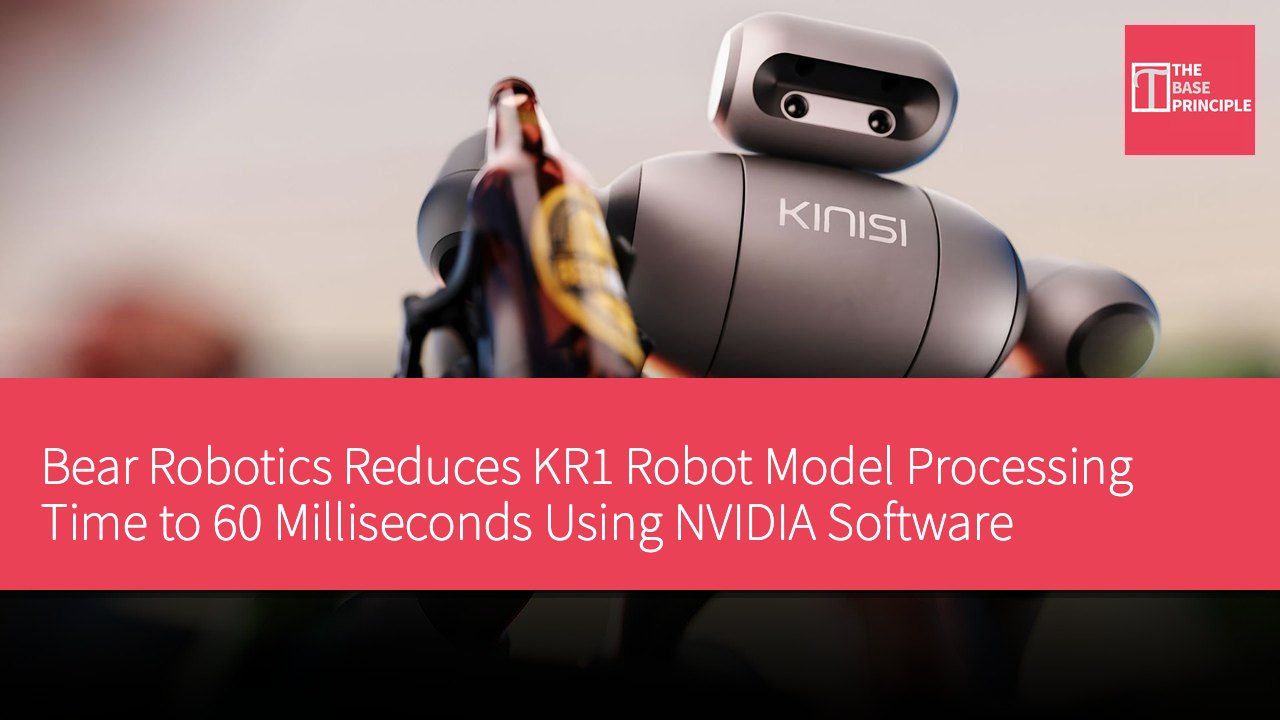
- Bear Robotics has reduced the KR1 robot model processing time to 60 milliseconds using NVIDIA software.
- The KINO-2 platform helps KR1 learn object handling tasks from demonstrations.
- Bear has deployed over 16,000 robots at more than 5,000 customer locations.
- Faster inference times help the robot identify and handle objects more quickly.
Bear Robotics announced that it has reduced the time required to run the robot base model on its KR1 humanoid robot by about eight times, from 500 milliseconds to 60 milliseconds, using NVIDIA software. This improvement comes from a new robotic learning platform called KINO-2, designed to translate human demonstrations into tasks that the KR1 can perform. The company reported that the processing time for its proprietary model improved by 4.2 times, from 72.3 milliseconds to 17.2 milliseconds. These figures are based on internal measurements from Bear, referring to model inference, which is the process of generating outputs from a trained model.
This does not mean that the robot's movement speed has increased eightfold or that the time to complete physical tasks has been reduced by eight times.
Bear Robotics focuses on developing robots for commercial operations and unveiled KINO-2 at NVIDIA GTC Berlin. The company stated that it has deployed over 16,000 robots at more than 5,000 customer locations, although most of these robots are service robots rather than humanoid robots.
Features of the KINO-2 Platform
KINO-2 is designed to help KR1 learn object handling tasks from demonstrations without requiring engineers to program each action individually. Bear collects demonstrations of tasks and uses these to train and improve the model, which is then evaluated on the KR1 before being tested in customer operations. The platform supports models developed internally by Bear as well as external base models, which can learn patterns from training data and apply them to tasks involving different objects and environments.
To run the software on the KR1, Bear integrated NVIDIA Isaac OS into its perception system, which processes information about the robot's surrounding environment. The setup uses NVIDIA Jetson AGX Thor hardware and includes NVIDIA Holoscan SDK 5.0. Bear also employs NVIDIA TensorRT and model quantization to reduce inference latency. Quantization reduces the computational demands of the model by representing values at lower precision.
According to Bear, these changes help reduce the inference time of NVIDIA Isaac GR00T from an initially unoptimized 500 milliseconds to about 60 milliseconds, while the inference time for its proprietary model decreased from 72.3 milliseconds to 17.2 milliseconds.
Faster inference times may help the robot respond more quickly when identifying objects and deciding how to handle them. However, the announcement did not provide comparative data on overall task time, operational accuracy, or long-term reliability.
KR1 Warehouse Workflow Demonstration
At NVIDIA GTC Berlin, Bear showcased the KR1 executing a warehouse workflow that combines object handling and transportation. The robot receives orders from a warehouse management system, picks bottles, places them in boxes, delivers the boxes to a unloading point, and then returns to retrieve empty boxes. The demonstration combines the operational skills learned through KINO-2 with Bear's existing navigation, control, and workflow software. Bear Robotics' Chief Robotics Officer Bren Pierce stated, "The people doing the work already understand their products, equipment, and workflow."
The demonstration allows us to capture that knowledge and teach it to the robot."
Bear also plans to develop operational capabilities through customer pilots involving supermarket returns and warehouse box handling. The company intends to combine dedicated mobile robots for transporting goods with the KR1 humanoid robot for handling objects, both of which will operate through a shared fleet management and workflow system. The GTC demonstration showcased how these capabilities can work together in specific warehouse tasks. Bear has not disclosed the reliability performance results of the KR1 completing broader customer workflows without intervention.
Breakthrough Advances in KR1 Robot Technology
Bear Robotics' KR1 robot has achieved significant reductions in processing time through NVIDIA's technology, which is crucial for the automation of commercial operations. The launch of the KINO-2 platform not only enhances the robot's learning capabilities but also reduces reliance on manual programming by engineers. This technological advancement allows robots to be more flexible and responsive in complex environments, enabling them to perform warehouse tasks more effectively and improve overall efficiency. As the company plans to expand its application scenarios, the development of the KR1 could potentially transform the future of commercial automation.