
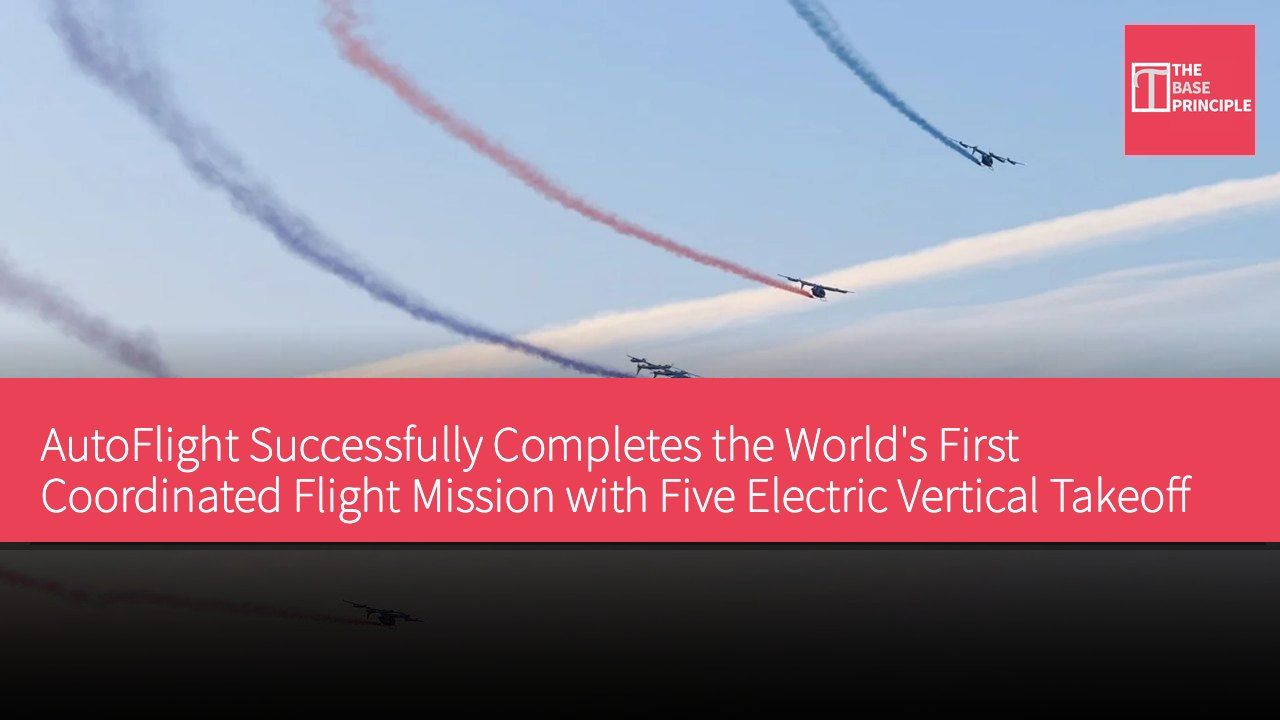
- AutoFlight has completed the world's first coordinated flight mission with five eVTOLs.
- The entire flight process was autonomously conducted by the flight control system, requiring no human intervention.
- The demonstration included aircraft of different designs and weight classes, necessitating high levels of coordination.
- The company is exploring the potential to connect air and water transportation.
Chinese electric aircraft developer AutoFlight has completed a coordinated formation flight involving five electric vertical takeoff and landing (eVTOL) aircraft, including one 5-ton model and four 2-ton models. This demonstration brought together three different aircraft variants, which the company claims is the world's first formation flight of five eVTOLs. The flights took place on October 31 and November 1 at AutoFlight's test flight base at Bailing Lake in Kunshan, China. The five aircraft maintained coordinated flight in formation for 47 minutes, with the lead V5000 Matrix flying a distance of over 133 kilometers (83 miles).
AutoFlight stated that the entire flight process was conducted autonomously, requiring no human intervention.
The formation included one 5-ton V5000 Matrix and four 2-ton aircraft from the V2000 series. The latter includes the V2000CG CarryAll, designed for cargo transport, and the V2000CGF CarryAll firefighting variant. Coordinating flights with different-sized aircraft not only requires maintaining a common flight path but also faces additional challenges. Each aircraft must remain stable relative to the others while accounting for variations in speed, altitude, wind speed, and flight behavior.
When the formation includes aircraft of different designs and weight classes, these demands become more complex. The flight control system must coordinate navigation, communication, and separation while ensuring that the movements of one aircraft do not compromise the safety of others.
Challenges of Different Aircraft Designs
AutoFlight reported that during the demonstration on November 1, despite strong winds, the formation maintained stable flight and ensured safe horizontal and vertical separation. The company described this exercise as a test involving route planning, flight control, communication, and safety management for different aircraft models. This achievement builds on an earlier demonstration in May 2026, when AutoFlight conducted a formation flight with three aircraft consisting of one V5000 Matrix and two V2000 series aircraft.
The exercise focused on verifying the interface between the two weight classes, including communication links, route planning, and flight coordination.
The aircraft involved in the latest demonstration have applications that extend beyond passenger transport. The V2000CG CarryAll is an all-electric cargo eVTOL designed for medium to long-range aerial logistics. AutoFlight lists the aircraft's maximum takeoff weight as 2,000 kilograms and maximum payload as 400 kilograms. Its design features a configuration for lift and cruise, combining specialized rotors for vertical takeoff and landing with wings and an independent propulsion system for forward flight. This allows it to operate without the need for traditional runways while utilizing winged flight to enhance cruise efficiency.
The larger V5000 Matrix is a 5-ton platform that AutoFlight is developing for passenger and heavy cargo applications. Its announced specifications include a maximum takeoff weight of 5,700 kilograms and a maximum cruise speed of 280 kilometers per hour. The company also showcased a hybrid electric cargo version, the V5000CGH, which has a claimed maximum range of 1,500 kilometers. AutoFlight views the coordination of multiple aircraft as foundational for future advanced air mobility networks. Such systems could ultimately connect longer-distance routes with regional transport and short-haul end services by utilizing different aircraft based on payload and trip requirements.
Potential for Future Air Mobility
The company is also exploring how to connect air and water transportation. During the demonstration, guests visited AutoFlight's water-based vertical takeoff and landing port, Sunship, located at Dian Mountain Lake, and observed the formation flight from the lakeside. Currently, the flights of these five aircraft remain a technical demonstration rather than a commercial transport service. However, as eVTOL developers move towards broader deployment, the ability to autonomously coordinate mixed fleets may become a crucial aspect of managing more complex low-altitude operations.
Item Specifications V2000CG CarryAll Maximum Takeoff Weight 2,000 kilograms V2000CG CarryAll Maximum Payload 400 kilograms V5000 Matrix Maximum Takeoff Weight 5,700 kilograms V5000 Matrix Maximum Cruise Speed 280 kilometers/hour V5000CGH Maximum Range 1,500 kilometers
Technical Significance of Autonomous Coordinated Flight
AutoFlight's successful demonstration showcases the potential of autonomous coordinated flight technology, which is crucial for future air mobility systems. As eVTOL technology advances, the ability to effectively manage the coordinated flight of multiple aircraft will be key to low-altitude operations. This not only enhances transport efficiency but also facilitates the integration of different modes of transportation, paving the way for the future of urban air mobility.