
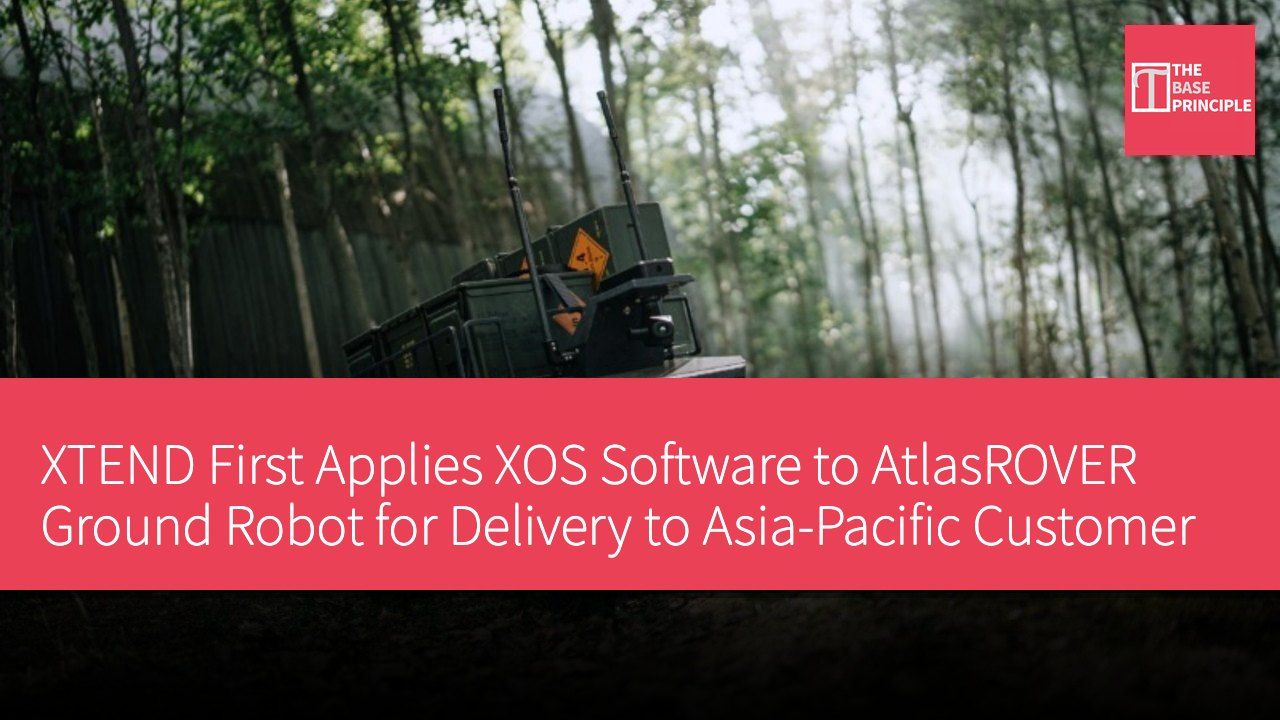
- XTEND has delivered its AtlasROVER robot to an Asia-Pacific customer for the first time.
- The XOS operating system is designed to provide shared tools for different types of robots.
- AtlasROVER is designed for operation in challenging environments, carrying mission-specific payloads.
- XTEND aims to create a unified robot software system supporting multiple platforms.
Israeli physical artificial intelligence company XTEND has now expanded its robotics business into ground systems, delivering its AtlasROVER robot to a customer in the Asia-Pacific region for the first time. The AtlasROVER is XTEND's first robot to use its XOS operating system. The XOS is designed to provide shared tools for different types of robots, including AI capabilities, mission-specific applications, and control systems for human operators. XTEND says this move is part of its broader plan to create a unified software system for robots operating in the air, on the ground, and eventually at sea.
XTEND Expands into Ground Systems
XTEND has extended its XOS robot operating system from aerial platforms to ground systems with the deployment of the AtlasROVER robot to a customer in the Asia-Pacific region. This is the first XOS-powered AtlasROVER system delivered by XTEND since it acquired the Latvian robotics company Atlas earlier this year. The deployment demonstrates XTEND's broader effort to use XOS as a common software layer for different types of robot platforms. According to XTEND, the AtlasROVER is designed to operate in challenging environments and can carry different mission-specific payloads.
The company has not disclosed the identity or location of the customer, the number of robots delivered, or the specific tasks covered by the contract.
As such, the deployment provides limited information on the platform's operational role but highlights XTEND's efforts to extend its software architecture to ground robots. At the core of the integration is XOS, which XTEND describes as a hardware-agnostic operating system for physical AI and human-guided autonomy. The system aims to provide a common framework supporting AI capabilities, mission applications, and operator workflows, rather than developing separate software environments for each robot platform. According to XTEND, it allows different robot systems to operate through a shared software architecture while retaining platform-specific hardware and capabilities.
Integration and Application of XOS
The integration of AtlasROVER provides XTEND with a ground platform that can operate within the same broader XOS ecosystem as its aerial robot systems. This approach allows operators to use familiar interfaces and mission tools across different robot types, without having to learn different control systems for each platform. XTEND says the architecture is designed to support collaboration between different robot platforms while keeping humans involved in critical operational decisions. The acquisition of Atlas has expanded the range of ground robots available to XTEND and provided the company with additional engineering and manufacturing capabilities in Europe.
Following the acquisition, XTEND began integrating Atlas's technology and deployment systems into its wider range of robotic products. The integration of AtlasROVER represents the first visible step in applying XOS to this newly expanded range of ground robots. For XTEND, the deployment of AtlasROVER is about more than just a single vehicle. The company is positioning XOS as a software foundation capable of connecting robots operating in different environments. Although the system was initially developed around aerial robots, extending it to ground platforms can help XTEND create a more unified ecosystem, enabling operators to manage different robotic assets through common tools and workflows.
XTEND's Chief Executive Officer and Co-Founder Aviv Shapira said in a statement, "Our goal is not to build isolated robotic products, but to create a common software layer that can extend to aerial, ground, and eventually marine systems." Such an extension would make the software platform increasingly independent of any specific robot form, providing a common interface for human-guided autonomy. XTEND says it has deployed more than 12,500 systems in over 30 countries, including five active combat zones.
The company has nearly 300 employees, more than half of whom are based in Israel, with manufacturing facilities in the UK, Singapore, and Latvia, as well as a production base in Tampa.
Strategic Implications of XTEND's Transition
XTEND's expansion of XOS to ground robots demonstrates its long-term strategy in integrating robotics technology. This is not just a technical advancement but also a response to market demands. As the range of robot applications expands, the ability to provide a unified software platform will help improve operational efficiency and reduce learning costs. Such a strategy also helps XTEND maintain its technological leadership in an increasingly competitive market and promotes collaboration between different platforms.