
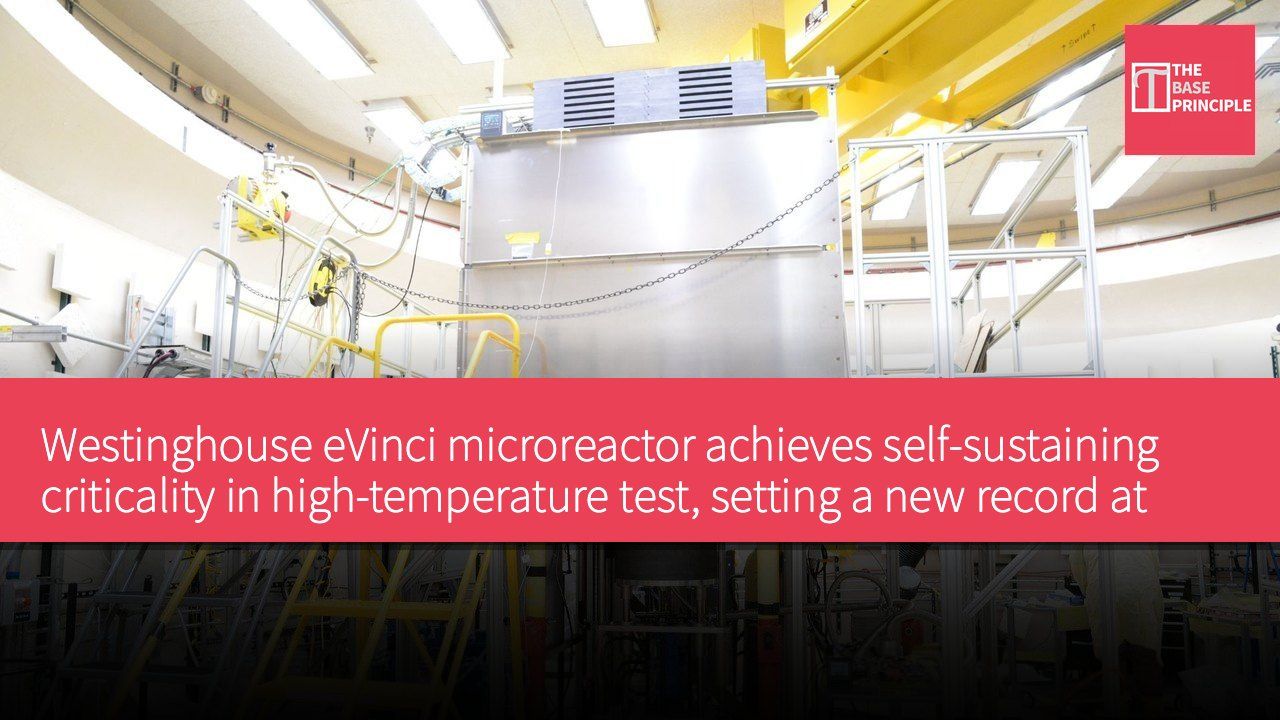
- Westinghouse's eVinci microreactor reached 1,852°F during a high-temperature test.
- The test provided new data on the heating behavior of the reactor core.
- The high-temperature measurements help improve reactor analytical models and predictive capabilities.
- The project reflects U.S. advances and momentum in nuclear engineering.
Westinghouse has again run a high-temperature test of its eVinci microreactor, giving engineers new data on how the reactor core behaves as it heats up. The experiment reached criticality at 1,225°F (about 663°C) and produced subcritical reactivity measurements at a peak core temperature of 1,852°F (about 1,011°C). Researchers conducted the test on September 3 at the National Criticality Experiments Research Center in Nevada, with support from Los Alamos National Laboratory and the Nevada National Security Site, a facility under the National Nuclear Security Administration.
The results extend a testing program that compares physical measurements against reactor model predictions, a comparison that helps engineers pinpoint where simulations need improvement before the findings are applied to prototype hardware.
What the high-temperature test means
Criticality is the state in which a nuclear chain reaction sustains itself. Engineers use controlled criticality experiments to examine how changing reactor conditions affect its behavior. The eVinci test reached that state at 1,225°F, after which researchers took subcritical reactivity measurements as the core reached 1,852°F. Westinghouse said the measurement set a new temperature record for that type of reactivity experiment at NCERC. The result also gave researchers temperature-dependent data close to the reactor's expected operating environment.
These measurements are important because temperature can affect the physical properties of materials inside a reactor. Engineers need accurate data to understand those effects and feed them into predictive models.
eVinci's potential applications
The experiment is part of Westinghouse's build-test-learn development process. Each test provides an opportunity to examine how computational results line up with measured reactor behavior. The eVinci reactor uses a compact architecture built around heat pipes, TRISO fuel and a graphite core. The heat pipes move heat away from the reactor core without using the conventional pumps found in many larger reactor systems, an arrangement central to the reactor's compact design. Westinghouse is developing eVinci for applications where conventional nuclear plants may not meet physical or logistical requirements, with potential uses including remote locations, defense systems and space missions.
Westinghouse has also said the reactor can deliver power for eight years without refueling, although the company has not yet demonstrated that operating period with a commercial reactor; the claim nonetheless remains part of the eVinci design and deployment concept.
The high-temperature measurements now give Westinghouse engineers more evidence to refine their analytical models. Those models help predict how the reactor will respond to changes in temperature and other operating conditions. Westinghouse President and CEO Dan Sumner described the work as part of a rapid cycle of building, testing and improving advanced nuclear technology. "Our team is rapidly building, testing, learning and improving advanced nuclear technology," he said, while also praising the Department of Energy, the NNSA, Los Alamos and the NNSS for their support of the test program.
Acting Assistant Secretary for Nuclear Energy Chimi Zacot pointed to the project as an example of U.S. nuclear engineering progress. Westinghouse's work, he said, reflects the broader push to expand advanced nuclear technology in the United States. The latest experiment is not a commercial deployment of eVinci, but it does give engineers another set of measurements from a demanding thermal environment.
Technical breakthroughs and application prospects for the eVinci reactor
The high-temperature test of the eVinci microreactor shows its innovative potential in nuclear energy technology. These measurements not only provide engineers with important data but also help them improve predictive models and further understand how the reactor behaves in extreme environments. As the reactor design continues to be optimized, eVinci's compact architecture and refueling-free operating characteristics make it more attractive for remote locations and specialized applications. These advances reflect U.S. efforts in nuclear engineering and could also have a far-reaching impact on the future deployment of nuclear energy.