
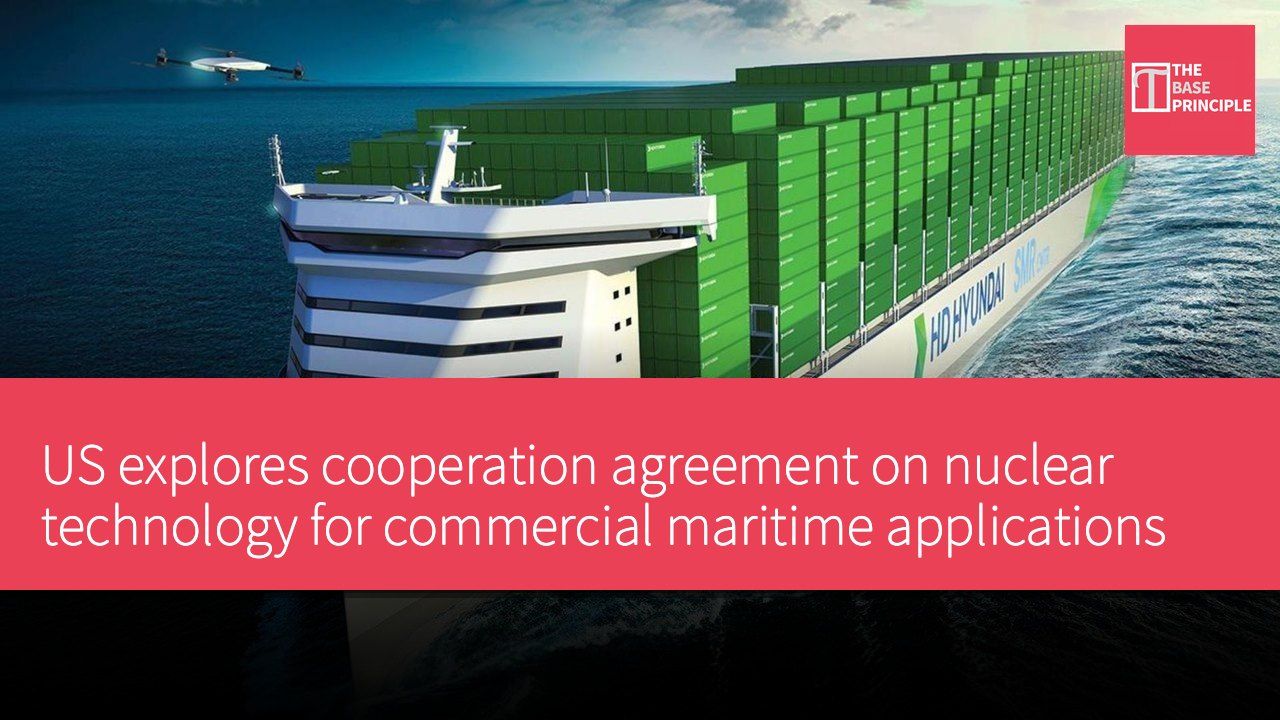
- The US Department of Energy and the American Bureau of Shipping sign agreement to explore nuclear technology in maritime applications.
- Agreement focuses on assessing feasibility of nuclear-powered vessels and floating power plants.
- ABS will manage Maritime Nuclear Applications Group, providing technical and policy support.
- Agreement does not specify concrete projects; focus is on establishing framework to support maritime nuclear energy.
The US Department of Energy (DOE) and the American Bureau of Shipping (ABS) have signed an agreement to explore the use of advanced nuclear technology in commercial maritime applications, including nuclear-powered vessels and floating power plants. The memorandum of understanding (MOU), announced on October 13, establishes a framework for feasibility studies, technical research, and coordination between government agencies and industry. The initiative will also examine the ports, shipyards, and industrial infrastructure needed to build and support nuclear-powered maritime systems. The agreement brings together the DOE Office of Nuclear Energy and ABS, a maritime classification society that develops technical standards for vessels and offshore facilities.
The partners aim to assess how advanced nuclear technology can be safely applied to commercial maritime operations.
Scope of nuclear technology applications
The agreement identifies floating nuclear solutions and nuclear transport corridors as key areas for concept and feasibility studies. It also includes support for developing a US shipbuilding industry capable of constructing and operating nuclear-powered assets. Floating nuclear power plants could provide electricity via marine platforms, while nuclear-powered vessels would use onboard reactors for propulsion. However, the MOU does not specify particular reactor designs, vessel projects, locations, or construction timelines, focusing instead on assessing the feasibility of these applications rather than committing to specific projects. The work will consider the technical, regulatory, economic, and policy issues required to establish a maritime nuclear sector, with these assessments intended to help determine what is needed to advance potential applications beyond the concept stage.
ABS's role and responsibilities
Under the agreement, ABS will co-manage the Maritime Nuclear Applications Group (MNAG), a research center and resource hub focused on maritime nuclear technology. The organization will also provide technical, regulatory, economic, and policy support for concept and feasibility studies. ABS will coordinate related work through the US Maritime Administration's US Maritime Innovation Center and serve as its secretariat. The partnership also aims to foster coordination among relevant federal agencies as the government works to develop a viable domestic maritime nuclear sector. ABS Chairman and CEO John McDonald said: "Advanced nuclear technology is moving from concept to application, and the maritime industry needs to be ready for it."
He noted that the agreement provides a framework to expand ongoing work with the DOE and industry partners, aimed at making nuclear energy a practical option for commercial maritime applications.
DOE Assistant Secretary for Nuclear Energy Ted Garrish said the collaboration will help explore how decades of experience with nuclear technology can be applied to maritime operations and support US innovation in the field. ABS has already been working to establish the technical and regulatory foundations for maritime nuclear applications. The organization said it has published comprehensive classification rules for floating nuclear power plants and granted approval in principle for several nuclear projects. Approval in principle is an early assessment of a proposed design and does not mean a project has received final authorization or is ready for construction. The new MOU expands this work through a formal partnership with the DOE, bringing research, feasibility studies, and government coordination into a shared framework.
The agreement does not announce specific nuclear-powered vessels, floating power plants, or construction plans, but rather establishes a process to examine the technical and industrial capabilities that could support commercial nuclear applications at sea.
Future potential of US maritime nuclear applications
The cooperation agreement between the US Department of Energy and the American Bureau of Shipping underscores the emphasis on nuclear energy for commercial maritime applications. As global demand for renewable energy grows, nuclear energy's scope of application is expanding as a potential clean energy option. This agreement aims not only to explore technical feasibility but also highlights the importance of establishing relevant infrastructure. ABS's involvement will promote technical, regulatory, and economic support, paving the way for future nuclear projects and potentially transforming the maritime industry's energy landscape.